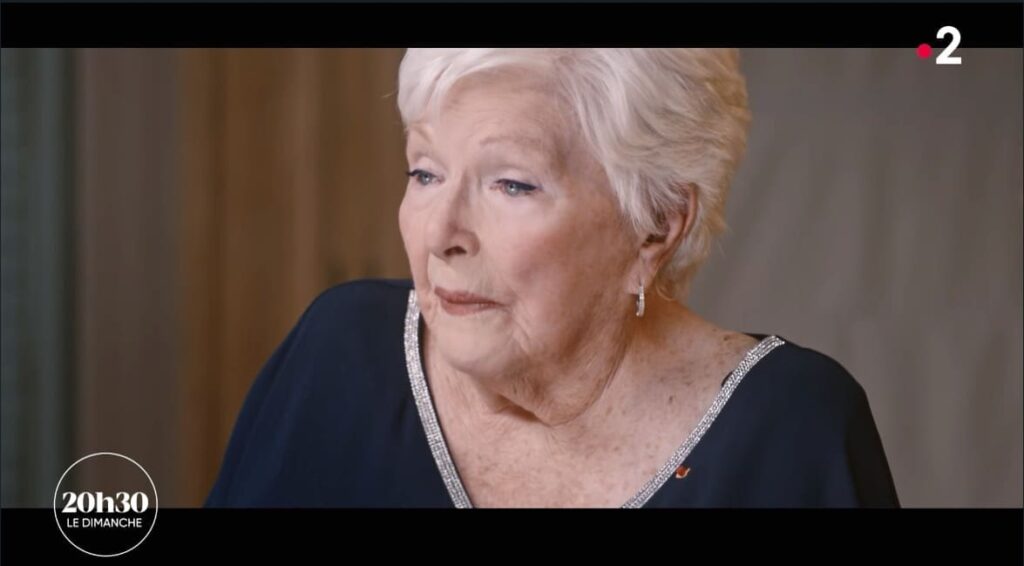
On Sunday evening on France 2, Line Renaud , a guest on the program " 20h30 le dimanche ," shared her personal experience of a clandestine abortion. In her testimony, Renaud recounted this episode from her youth, which occurred in the 1950s, a time when abortion was illegal in France . She described the fears and risks associated with the procedure, performed in precarious and dangerous conditions, emphasizing the impact it had on her.
During the interview, Line Renaud revealed that she became pregnant at 18, but that her partner, who would later become her husband, Loulou Gasté , didn't want children, and that she wanted to respect his decision: " I wasn't settled enough in Loulou's life to impose myself, to want and to say ' I want '. All I remember is that everything was black. We went up a staircase, I arrived in front of a woman who came with two knitting needles. She pierced my cervix, I bled. And that was it …"
During her testimony, Line Renaud recalled the importance of freedom of choice and the right to abortion, a right acquired in France in 1975 with the Veil Law, concluding: "Mrs. Simone Veil, thank you. Thank you, Mrs. Veil."
Simone Veil's fight so dear to Line Renaud
As a reminder, in 1974, when Valéry Giscard d'Estaing was elected President of the Republic, Simone Veil was appointed Minister of Health in Jacques Chirac's government. She was the only female minister at the time. From the very first cabinet meeting, the issue of legalizing abortion was raised . At that time, the subject was extremely taboo, and many women were forced to have clandestine abortions. A tragedy of the era: a large number of them did not survive their abortions, performed in unsanitary conditions. At the time, there were 5,000 deaths each year due to these clandestine abortions. A horrifying figure…
In this dramatic context, and in a society hostile to the right to abortion, Simone Veil was tasked with passing the bill, which initially earned her considerable criticism. Edgar Faure, then President of the National Assembly, gave Simone Veil the floor for a speech that would secure her place in history. It was November 26, 1974, and Simone Veil began her speech: “First of all, I would like to share with you a woman’s conviction. I apologize for doing so before this Assembly, composed almost exclusively of men: no woman resorts to abortion lightly. One only needs to listen to women. It is always a tragedy, and it will always remain a tragedy.” For 40 minutes, Simone Veil became the spokesperson for all those women who suffer or die…
Following Simone Veil's speech, three days of heated debate ensued. The law was finally passed on the night of November 29, 1974, and then promulgated on January 17, 1975, after the text had been passed by the Senate. It stipulated that "a pregnant woman whose condition places her in a situation of distress may request a doctor to terminate her pregnancy. This termination may only be performed before the end of the tenth week." However, the victory was only temporary, as the law was initially passed for only five years, until 1979. Ultimately, the government, refusing to back down in the face of this major step forward in French society, adopted it permanently, and the legal time limit for abortion was even extended to 12 weeks.
Although this law was a major step forward for women, Simone Veil always insisted on opposing the trivialization of abortion , which, according to her, "will always remain a tragedy." While the law was not an encouragement to have abortions, it at least allowed women to have a choice and, above all, prevented them from dying during clandestine operations.