Yves Boisset has spanned nearly three decades of filmmaking, electrifying the screen with his political commitment, his passion for truth, and his taste for thrillers with a message. A director of shocking films, fueled by burning current events or disturbing news stories, he has made cinema a tool for denunciation, while never forgetting to captivate his audience. A look back at the career of a director often censored, sometimes attacked, but always standing tall—through five of his most significant works.
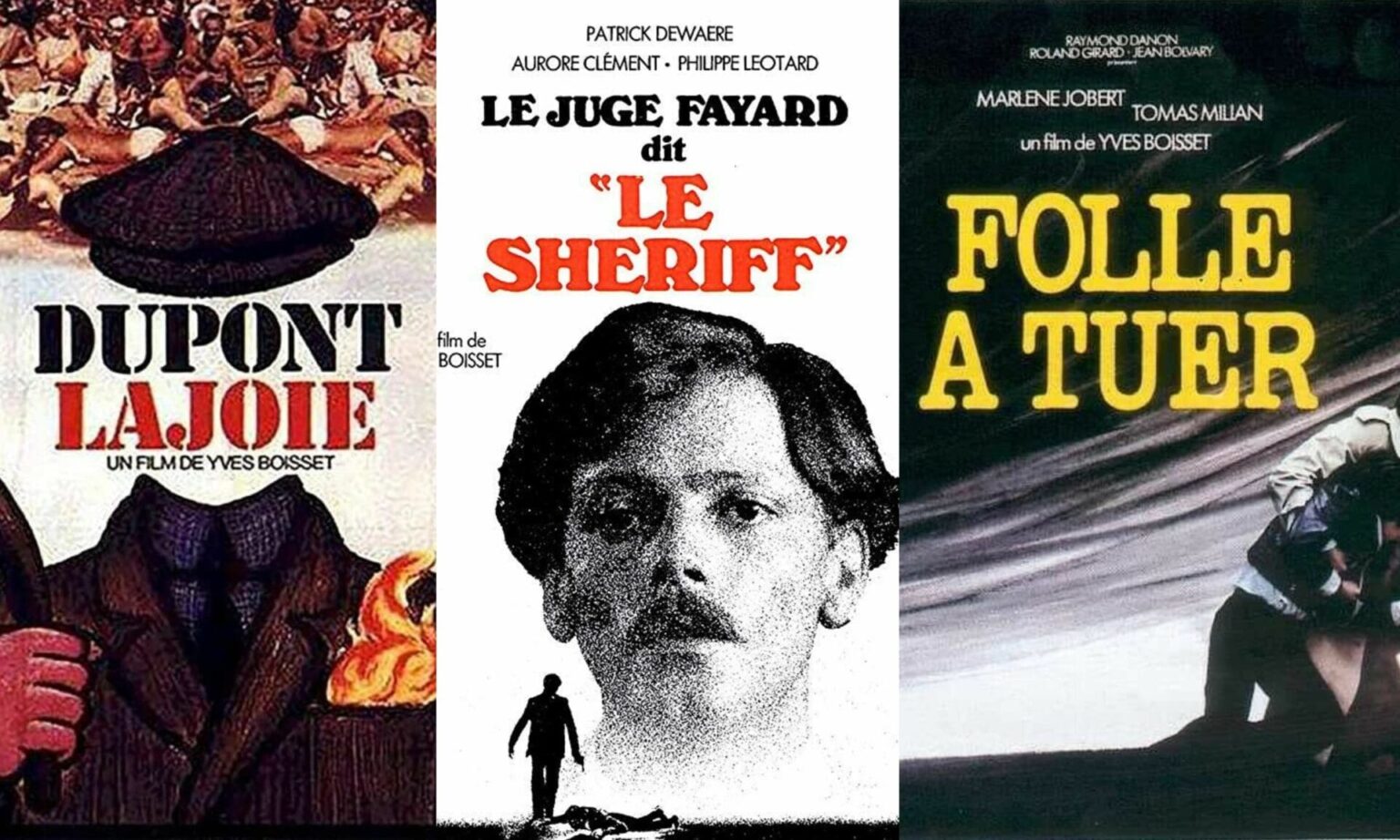
1. Dupont Lajoie (1975) – Ordinary racism with a scalpel
Arguably his most iconic film. Starring Jean Carmet as a campy, unwillingly racist Frenchman, Dupont Lajoie dissects commonplace hatred with unprecedented violence for the time. Inspired by true events, the film sparked controversy, far-right attacks, and protests. Yet it triumphed in Berlin (Silver Bear) and remains a model of French social cinema today.
2. Judge Fayard, known as “the Sheriff” (1977) – When the truth is inconvenient
Patrick Dewaere plays an honest young judge confronted by a corrupt judicial system. Inspired by the assassination of Judge Renaud in Lyon, the film takes on the SAC, the armed wing of the Gaullist regime. Despite partial censorship—the dialogue is censored by beeps—Boisset transforms this constraint into dramatic effect, winning the Louis-Delluc Prize.
3. RAS (1973) – The Algerian War in front of the camera
While the subject was still taboo, Boisset dared to film the Algerian War and its shadowy areas. Refusal to obey, torture, and the disillusionment of young soldiers: RAS is a hard-hitting film that shocks some audiences and arouses the wrath of the far right. Scenes are censored, reels stolen, but the film attracts nearly a million viewers.
4. The Attack (1972) – The Ben Barka Affair, Thinly Disguised
Jean-Louis Trintignant, Michel Piccoli, Gian Maria Volonté… the cast lives up to the film's ambition: to depict the kidnapping and disappearance of Moroccan opposition leader Mehdi Ben Barka, against a backdrop of collusion between governments and secret services. Banned from filming in several locations, The Attack received the Grand Prix for Best Director at the Moscow Film Festival. The film confirms Boisset as a first-rate provocateur.
5. Spy, Get Up (1982) – The tense thriller
Starring Lino Ventura, this elegant and paranoid spy film is an adaptation of a novel by George Markstein. It is also one of the rare Boisset films in which the dramatic tension transcends the purely political. Disorienting and ambiguous, the film reveals another side of its director: that of an excellent director of actors and a lover of suspense.
A cinema of combat, conviction and contradictions
True to his ideals, Yves Boisset has never stopped filming against the established power, institutional injustices, and the shadowy areas of the Republic. In the 1990s and 2000s, he turned to television, creating notable works such as The Dreyfus Affair (1995), The Trousers (1997), and Jean Moulin (2002), continuing his quest for historical and social truth.
Award-winning, often criticized, and sometimes marginalized, Boisset remains one of the few French filmmakers to have used fiction as a weapon and crime fiction as a platform. His films seek not to please, but to awaken consciences. Mission accomplished.