A small lump in the palm of the hand, a thickening of the skin, or a finger that gradually becomes impossible to straighten: these symptoms can indicate Dupuytren's disease. This chronic condition affects the tissues under the skin of the hand and can lead to permanent finger contracture. While generally painless, it can still impair certain everyday activities when it reaches an advanced stage.
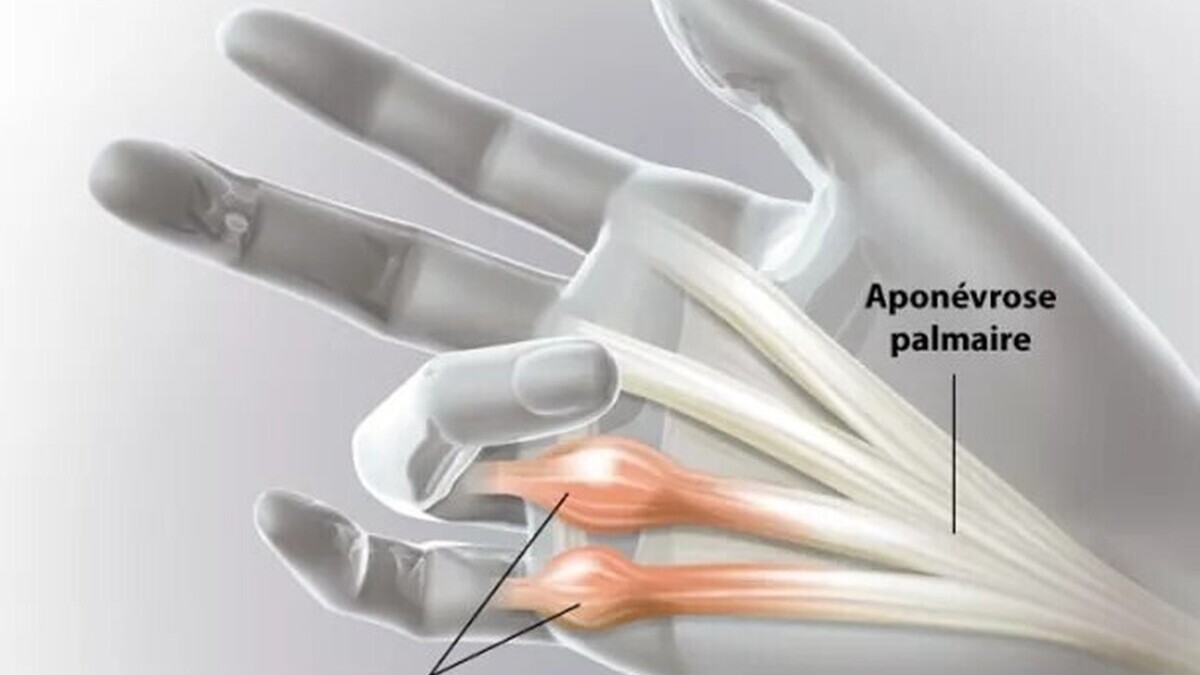
Dupuytren's disease is characterized by an abnormal thickening of the palmar aponeurosis, a fibrous membrane located beneath the skin of the hand. This tissue normally helps protect the underlying structures and stabilize the palm. In affected individuals, certain cells produce an excessive amount of collagen, leading to the formation of nodules and then fibrous bands. These bands can gradually contract and keep the fingers in a flexed position. The disease affects men more often, particularly after the age of 50, and has a significant hereditary component. Diabetes, smoking, and excessive alcohol consumption are also associated with an increased risk.
Fingers that gradually curl towards the palm
The first signs often go unnoticed. A small, firm lump appears in the palm, usually near the ring or little finger. It may be slightly tender at first, but often becomes painless. Over time, fibrous cords develop under the skin and can gradually prevent the fingers from fully extending. The condition can affect one or both hands, with the progression sometimes varying considerably between the two. Some patients retain simple nodules for several years, while others develop significant contracture in a relatively short time.
As the disease progresses, everyday tasks become more difficult, such as putting on gloves, washing the face, grasping certain objects, or putting a hand in a pocket. The inability to fully lay the palm and fingers flat on a table is a characteristic sign of contracture. Diagnosis is usually based on a simple clinical examination, without the need for imaging tests. Contrary to some misconceptions, the disease does not result directly from damage to the tendons responsible for finger movement, but from a change in the fibrous tissues that surround them superficially.
Interventions to regain better mobility
In the absence of significant contracture or functional impairment, simple monitoring may suffice. There is no medication that can permanently cure the disease or systematically prevent its progression. When the fingers become difficult to straighten, several interventions can be considered. Percutaneous needle aponeurotomy involves cutting the fibrous bands to free the affected fingers. This technique, generally performed under local anesthesia, can allow for a relatively rapid recovery, but it is not suitable for all forms of the disease.
A more traditional surgical procedure, called aponeurectomy, removes some of the fibrous tissue responsible for the contracture. It may be recommended when the condition is extensive or complex. Recovery depends primarily on the duration of the disease and the state of the joints. Rehabilitation may be necessary after the procedure to improve mobility and minimize complications. Despite treatment, recurrences are still possible, sometimes several years later, because the procedures correct the symptoms of the disease without permanently eliminating its cause.
Dupuytren's disease is neither contagious nor dangerous to other organs. However, it can become particularly debilitating when hand mobility is severely reduced. A lump in the palm does not always require intervention, but progressive finger contracture warrants a consultation with a hand specialist. Appropriate treatment often leads to a return of better mobility, especially when the joints have not yet undergone irreversible changes.