

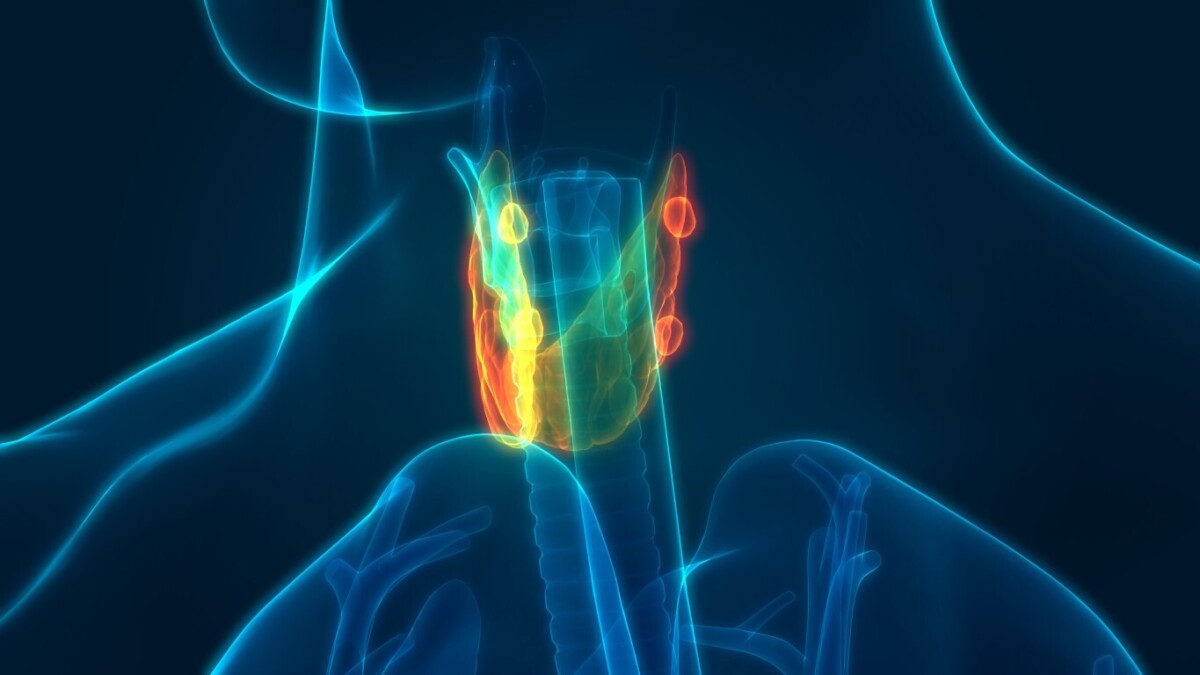
A small lump at the base of the neck, an unusual change in voice, or persistent difficulty swallowing: these symptoms can sometimes indicate thyroid cancer. This disease develops in a gland essential to the body's hormonal function. While most thyroid nodules are benign, some abnormalities require further investigation to rule out a malignant tumor.
The thyroid is a gland located at the front of the neck, just below the larynx. It produces hormones that play a role in regulating metabolism, body temperature, and heart rate. Cancer can develop from different types of thyroid cells. The most common forms are papillary and follicular thyroid cancers, generally grouped together as differentiated thyroid cancers. Other forms, such as medullary or anaplastic thyroid cancers, are much rarer and have different characteristics. The disease affects women more often and can appear at different ages.
A nodule often discovered by chance
Thyroid cancer usually causes no symptoms in its early stages. It is frequently discovered when a doctor feels a small lump in the neck or when an ultrasound performed for another reason reveals a nodule. In the vast majority of cases, these nodules are not cancerous. However, certain characteristics may warrant further investigation, including unusual growth, suspicious ultrasound abnormalities, or the presence of enlarged lymph nodes. More rarely, a tumor may cause persistent hoarseness, difficulty swallowing, or a feeling of pressure in the neck.
Diagnosis relies primarily on thyroid ultrasound, which allows assessment of the size and appearance of the nodules. Depending on their characteristics, a fine-needle aspiration biopsy may be performed to collect cells for analysis. The results help estimate the risk of malignancy and guide treatment. Blood tests are also carried out to evaluate thyroid function, but normal hormone levels do not rule out cancer. In certain specific forms, particularly medullary thyroid cancer, specific biological or genetic testing may be necessary.
Treatments are often effective when the disease is localized.
Surgery is one of the main treatments for thyroid cancer. Depending on the size, type, and extent of the tumor, the procedure may involve removing a single lobe of the thyroid or the entire gland. In some cases, lymph nodes in the neck must also be removed. For certain differentiated cancers, radioactive iodine treatment may be offered after surgery to destroy any remaining thyroid cells. When the entire thyroid has been removed, lifelong hormone replacement therapy with levothyroxine becomes necessary.
The prognosis for a cure is generally very good for papillary and follicular cancers diagnosed at a localized stage. Some small, very low-risk tumors may even, under specific conditions, be managed with active surveillance rather than immediate intervention. In contrast, aggressive or advanced forms require more complex strategies, which may include targeted therapies or other specialized treatments. Follow-up care relies primarily on clinical examination, ultrasound, and certain biological markers, with monitoring tailored to the risk of recurrence.
The discovery of a lump in the neck does not automatically mean that cancer is present. Thyroid nodules are common, particularly with age, and most are benign. However, a growing mass, a persistent change in voice, or unusual difficulty swallowing warrants a consultation. Early diagnosis allows doctors to distinguish between abnormalities requiring treatment and those that can simply be monitored, while also avoiding unnecessary interventions for harmless nodules.









Respond to the article
Be the first to comment on this article.