

Banderol, Dan-T, Filin, Geran-5: Moscow is multiplying its low-cost quasi-missiles, designed for mass production and to bypass Ukrainian interception systems. These hybrid weapons, neither quite drones nor truly missiles, are reshaping air warfare over Ukraine.
A residential building was hit in Kharkiv on a Sunday morning, injuring sixteen people, and the munition was something investigators are struggling to classify: neither a missile nor a conventional drone. It was a Banderol that struck the city on August 9, 2026, according to the findings of the local prosecutor's office and the NGO Airwars. This device, brought to light by Ukrainian intelligence eighteen months ago, illustrates a trend that deeply worries Kyiv: Russia has embarked on a race to produce cheap munitions capable of overwhelming Ukrainian air defenses through sheer numbers and speed.
Serhii Beskrestnov, military technology advisor to President Volodymyr Zelensky , is closely monitoring the emergence of these new weapons. On October 22, he publicly warned: “Unfortunately, this day was not limited to the new Filin rocket. Russia attacked us with another modification of the Geran-5 drone.” Behind these code names lies a coherent doctrine: to flood Ukrainian airspace with inexpensive weapons, fast enough to evade current interceptors, and numerous enough to deplete enemy defense stocks.
The Banderol is the archetype. Produced by the Russian company Kronshtadt, it flies at altitudes between 400 and 2,000 meters before descending to 200 meters as it approaches its target, and can be launched from an aircraft or from the ground. Its range does not exceed 500 kilometers, far from the 2,500 kilometers of the Russian Kh-101 cruise missile, but its unit cost, estimated between $50,000 and $100,000, makes it incomparably more accessible than the latter, whose price can reach two million dollars. To further reduce costs, Kronshtadt uses readily available civilian components: the engine that propels the Banderol is manufactured by the Chinese firm Swiwin and sold on mainstream online marketplaces.
To circumvent the jamming of satellite navigation signals, the Banderol is equipped with a so-called "Kometa" antenna, whose multiple sensors, called patches, allow it to distinguish a genuine satellite signal from a jammed one. Kateryna Bondar, a researcher at the Center for Strategic and International Studies (CSIS), explains that the first Russian models had only four of these patches, making guidance unreliable. Some recent versions now incorporate up to thirty, significantly improving their resistance to Ukrainian electronic countermeasures.
The economic logic behind these weapons is relentless. To shoot down a single Russian drone, Ukrainian defenses can deploy up to three interceptor drones, as Kateryna Bondar points out: “The Ukrainians cannot intercept these new weapons. The Banderol and the Dan-T are too fast for the interceptor drones they currently use. Air defenses are used to neutralizing Shahed drones that fly at 150 km/h, but it will be more difficult to intercept small missiles that fly at over 400 km/h.”
The Dan-T, presented by the Ukrainian Air Force as the successor to the Banderol, was unveiled in September 2026. Produced by Rostec, it is reportedly 35% cheaper than its predecessor and can target armored vehicles, fortified positions, and light infrastructure. Like the Banderol, it can be launched from an aircraft, allowing the Russian command to reuse existing platforms, including helicopters and jet aircraft, without developing new launch systems. The Orion drone, which had become too vulnerable on the front lines, was thus repurposed as a launch platform for these munitions.
The Filin, the latest in the series, takes off from the ground using a propulsion system, guided by a Chinese inertial navigation system coupled with a Kometa antenna. Of its 81 components, as identified by Ukrainian intelligence, 35 are of American origin and 22 are of Chinese origin—a higher proportion of Chinese components than in previous models.
The Geran-5 occupies a unique place in this arsenal. Descended from a line of drones inspired by the Iranian Shahed, it has gradually evolved into something more akin to a cruise missile. Kateryna Bondar is categorical: "The Geran-5 is based on very different technology than the Shahed. Its structure is very different from that of its Iranian and Russian predecessors." Capable of traveling between 900 and 1,000 kilometers with a 90-kilogram explosive payload, it is significantly more difficult to intercept than its predecessors. According to Ukrainian Air Force spokesman Yuriy Ihnat, Ukrainian forces manage to neutralize only about 60% of these new jet-powered aircraft, compared to 90 to 95% for older models. In late October 2026, a new variant, designated K5-K, was identified in the Kyiv region.
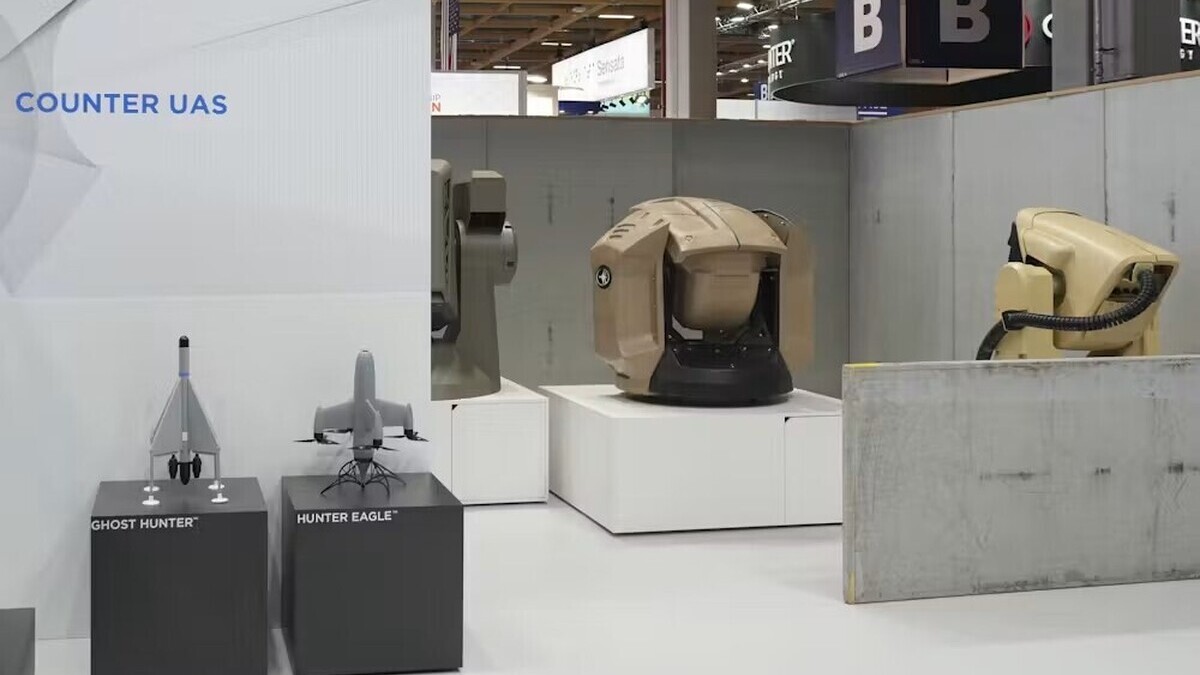
Faced with this proliferation, Ukraine is seeking countermeasures. The Brave1 innovation cluster claims to have developed a machine gun mounted on an automated turret, capable of shooting down Banderol missiles, and asserts that it has destroyed around sixty such vehicles. Fast interceptor drones, such as the Bars, are also being deployed by some units in an attempt to catch up with the Geran-5 jet-powered missiles. However, the actual effectiveness of these countermeasures remains impossible to independently verify, and the technological race between the two sides is far from over.










Respond to the article
Be the first to comment on this article.