

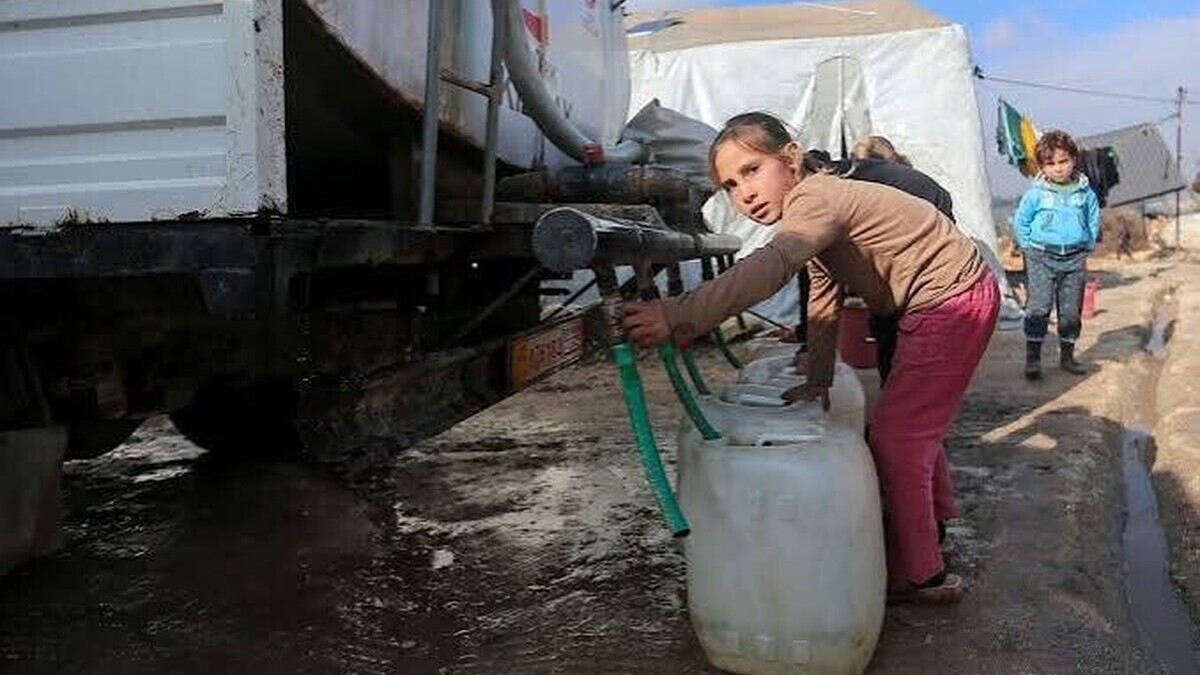
Water supply infrastructures are increasingly affected by armed conflicts. According to a report published on Thursday, November 5, 2026, by UNICEF, the number of reported attacks damaging or destroying water and sanitation facilities has tripled between 2021 and 2025. This situation exposes millions of civilians, especially children, to diseases, malnutrition, and violence.
Access to drinking water is becoming a major challenge for populations living in war zones. In the fourth volume of its report « Water Under Fire, » published Thursday, November 5, the United Nations Children’s Fund (UNICEF) warns about the increase in attacks affecting water supply, sanitation, and hygiene systems. The study, covering 23 countries and territories between January 2021 and June 2026, reveals that reported attacks damaging or destroying these infrastructures were three times more numerous in 2025 than in 2021. They involve increasingly diverse facilities and extend to a growing number of geographic areas.
The report identifies seven categories of attacks that can compromise access to water. Some directly target treatment plants, pipelines, wells, or reservoirs. Others cause contamination of available resources or prevent the delivery of spare parts and chemicals essential for water purification. The consequences can be significant: when a station stops functioning, entire neighborhoods can be deprived of drinking water. Populations are then forced to turn to unsafe sources, increasing health risks in territories where medical services are often already fragile.
From Sudan to Gaza, severely damaged infrastructures
Several situations illustrate the extent of the destruction. In Sudan, in March 2024, only one of the thirteen water treatment plants in Khartoum State was still operational. In Burkina Faso, more than 145 water points were destroyed during attacks between 2020 and 2025, depriving about 830,000 people of access to drinking water. More than half of the affected inhabitants were children. These destructions complicate the living conditions of displaced populations and increase their dependence on humanitarian aid.
In the Gaza Strip, UNICEF reports more than 130 kilometers of damaged sewage pipelines since October 2023. Untreated water is now discharged into the Mediterranean Sea or temporarily stored, which increases contamination risks. The organization also highlights that water networks can be paralyzed without direct damage. In Ukraine, attacks on energy infrastructures deprived nearly seven million children of regular access to electricity, heating, and water in December 2022. The operation of pumping and treatment stations depends closely on electrical supply.
Particularly severe health consequences for children
The absence of safe water is not limited to a daily supply difficulty. It directly compromises the functioning of health facilities, which need water to sterilize equipment, ensure deliveries under satisfactory conditions, and prepare nutritional treatments for children suffering from severe malnutrition. Consuming contaminated water also promotes intestinal infections and repeated diarrhea. These illnesses prevent children from properly absorbing nutrients and can worsen their health, especially when they already suffer from nutritional deficiencies.
In eastern Chad, the World Health Organization established a link between a hepatitis E outbreak and poor access to drinking water in camps hosting Sudanese refugees. Between January and April 2024, 2,092 suspected cases were recorded, half of which involved children aged 6 to 17. The report also highlights the dangers faced when traveling to fetch water. In Gaza, children have been killed or injured while waiting their turn at distribution points. In households forced to obtain water outside, this responsibility falls on women and girls in seven out of ten cases, exposing them more to violence and interruptions in their schooling.
UNICEF calls to protect facilities and humanitarian workers
UNICEF Executive Director Catherine Russell reminds that water and sanitation infrastructures must benefit from protection under international humanitarian law. The organization emphasizes that emergency interventions, even when they temporarily restore supply, cannot replace effective protection of facilities. Maintenance personnel are also exposed. In Lebanon, fourteen employees of public water establishments were killed during the 2024 conflict. To reduce interruption risks, humanitarian teams develop local solutions, notably solar installations. In Afghanistan, about 65% of water supply systems supported by UNICEF now operate using this energy.
These efforts remain threatened by lack of funding. According to the UN agency, 137.9 million people need assistance in countries with coordinated humanitarian responses for water, sanitation, and hygiene. Yet, only 26% of the necessary funding for 2026 has been received. UNICEF calls on states, parties to conflicts, and international donors to guarantee infrastructure security, facilitate humanitarian team access, and strengthen attack monitoring mechanisms. The organization insists on the need to consider water as an essential service for civilian survival, whose protection must remain a priority, including during wartime.





Respond to the article
Be the first to comment on this article.