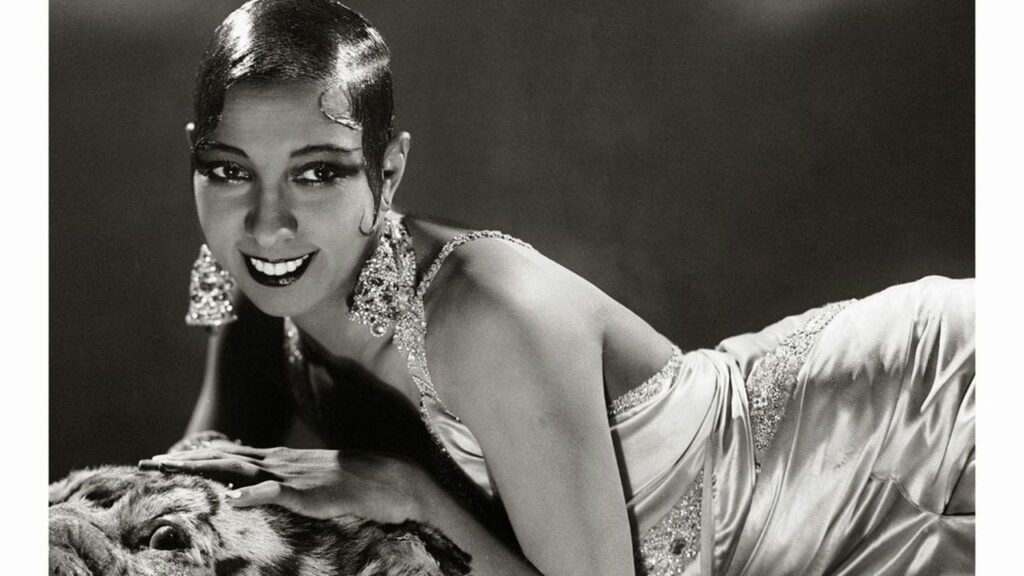
On June 3, 1906, Josephine Baker was born in a poor neighborhood of St. Louis, Missouri (United States). Her real name was Freda Josephine McDonald, and she grew up in an African-American family, living in poverty and segregation. But thanks to her energy and talent, she became an icon of the Roaring Twenties in Paris, before establishing herself as a resistance fighter, civil rights activist, and mother of a large family. An exceptional life, at the crossroads of art and history.
From the Saint-Louis stage to the Folies Bergère
From a very young age, Joséphine Baker dreamed of the stage. She began dancing in the streets, then in traveling theater troupes. At 19, she crossed the Atlantic to Paris, where she made her debut in La Revue nègre at the Théâtre des Champs-Élysées in October 1925. Her daring performance—especially her famous dance with the banana belt—set the capital ablaze.
In the 1930s, she was the star of the Folies Bergère. Her song "I Have Two Loves, My Country and Paris" became a symbol of her attachment to France, which she officially adopted in 1937 when she married a French industrialist, Jean Lion. Her rise was meteoric. Far from the racist prejudice she suffered in the United States, Joséphine found in France a country where she could be herself.
An artist at the heart of history
In 1939, on the eve of World War II, Joséphine Baker used her celebrity to support the Resistance. A spy for Free France, she hid messages in her music and clothing, traveled to North Africa to support French troops, and raised funds to donate to the Red Cross. For these courageous acts, she received the Resistance Medal, the Croix de Guerre, and the Legion of Honor.
In the 1950s and 1960s, she fought alongside Martin Luther King for civil rights in the United States. On August 28, 1963, she spoke in Washington, D.C., just before the famous "I Have a Dream" speech. Dressed in her resistance uniform, she recalled her commitment to fighting racism: "In France, I was never afraid."
Josephine Baker also adopted 12 children of different backgrounds, whom she raised in her Château des Milandes in the Dordogne, which she transformed into a utopian place of brotherhood. This generous project ultimately ruined her, but she never renounced her beliefs.
She died in Paris on April 12, 1975, a few days after a final triumph on stage. In 2021, she entered the Pantheon, becoming the first Black woman to be honored with this national recognition.