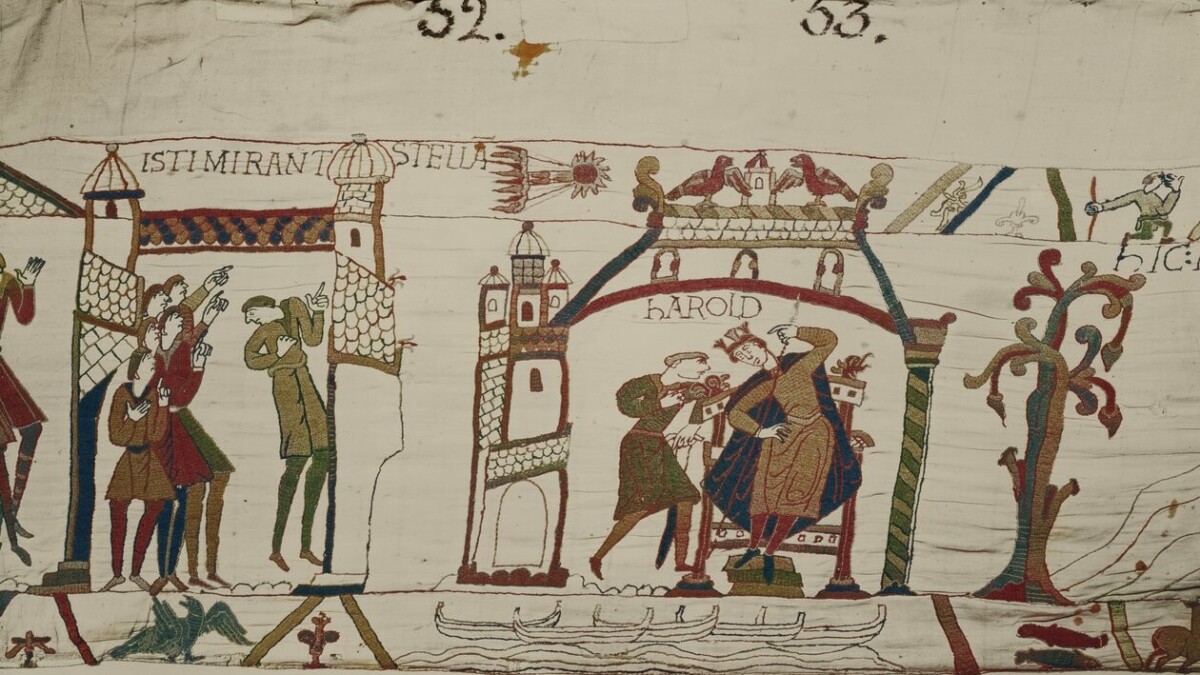
The Bayeux Tapestry, an exceptional medieval embroidery depicting William the Conqueror's conquest of England, continues to reveal its secrets nearly a thousand years after its creation. Among its most famous scenes is the appearance of Halley's Comet, interpreted as a sign of a major political upheaval. Yet, one detail intrigues historians: its position in the narrative does not correspond to astronomical reality.
A deliberate error serving the narrative
The embroidery depicts the comet shortly after Harold's coronation as King of England in January 1066. However, astronomical calculations show that Halley's Comet did not appear in the sky until the end of April of that same year. This discrepancy of several months is not a mistake on the part of the artists, but a deliberate choice intended to reinforce its political message.
In medieval times, comets were widely seen as omens foretelling wars, deaths, or changes of reign. By placing the celestial body immediately after Harold's accession to the throne, the patrons of the embroidery suggested that the heavens disapproved of his rule and were already heralding William's imminent victory. As several art historians point out, this depiction is more a matter of propaganda than chronological accuracy.
From celestial omen to scientific object
Long before it was understood as an astronomical phenomenon, Halley's Comet held a significant place in the collective imagination. It appears in numerous works of art, from the Bayeux Tapestry to Giotto's frescoes, where it inspired the depiction of the star guiding the Magi. According to specialists in the history of comets, these appearances primarily reflect the fascination and fear inspired by a celestial body capable of suddenly appearing in a sky considered immutable.
It wasn't until the 18th century that the British astronomer Edmond Halley demonstrated that it was the same comet returning periodically every 75 to 76 years. By studying several early observations and taking into account the gravitational influence of Jupiter and Saturn, he successfully predicted its return in 1758. This discovery definitively transformed a phenomenon long associated with omens into a perfectly identified scientific object, without, however, erasing the strong symbolic significance it had acquired over the centuries.