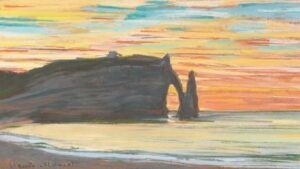
The Museum of Fine Arts in Lyon is dedicating a major exhibition to the cliffs of Étretat, a landscape that has become a central motif in the history of landscape painting in France. Entitled "Étretat, Beyond the Cliffs," it brings together paintings, drawings, photographs, and documents to show how this stretch of the Normandy coast has been captured, reinvented, and then mythologized by several generations of artists. The exhibition is on view until March 1, 2026, and opens with an immersive sequence that places the visitor face to face with the site, in a context where this coastline is now being closely examined for its fragility.
A landscape that attracted artists from the 19th century to the interwar period.
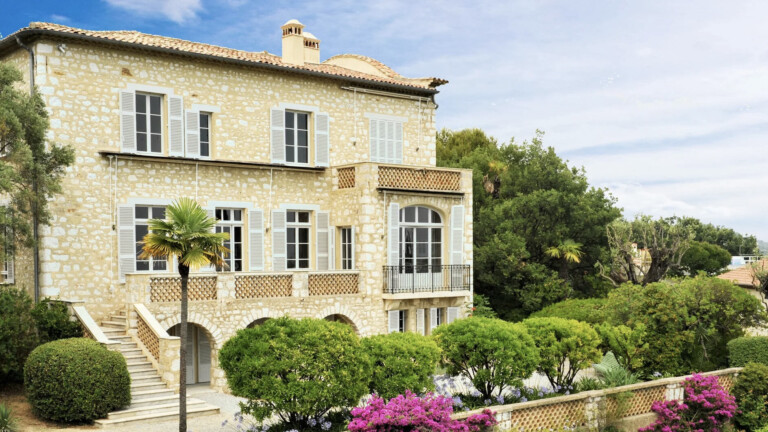
The exhibition begins by tracing the origins of this fascination, when artists started coming to Étretat as early as the 1820s, drawn by the arches, the Needle, and the contrasts of the white chalk. It shows how perspectives diversified, ranging from close-ups of the geology to more distant compositions where the subject is placed within a rural or maritime setting. The exhibition also highlights how, during the same period, the site became an artistic and tourist destination, fueled by the rise in travel and the gradual development of villas, studios, and hotels.
The narrative then shifts to how the coastline is populated in the images. Scenes of work on the beach, followed by early seaside leisure activities, bear witness to a coastline undergoing a transformation: from a harsh, utilitarian space to a sought-after setting, recommended for sea bathing and frequented by visitors. By varying the media and artists' styles, the collection avoids any sense of repetition while maintaining a clear objective: to understand how the same landscape can produce radically different visions depending on the era, technique, and intention.
Courbet, Monet, Matisse: Étretat as a breeding ground for pictorial invention
The heart of the exhibition highlights Étretat as a laboratory. With Courbet, the shoreline becomes a physical and direct subject to paint, where the energy of the sea and cliffs imposes a powerful realism. With Monet, the motif is transformed into a field of experimentation: variations in light, series, changes in angles and distances, ultimately making Étretat a pivotal place for developing Impressionist modernity. The cliffs are no longer simply “a beautiful landscape,” but a pictorial challenge, to be addressed differently depending on the time of day, the weather, or the season.
The final section expands to include post-Impressionism and the avant-garde movements, demonstrating how the site continued to be revisited as painting simplified forms and embraced flat planes. Matisse's stays in Étretat in 1920 bring this narrative to a close: for him, the cliff, the sky, and the sea became almost blocks of color, a conscious dialogue with those who came before him. The exhibition thus concludes with a clear idea: Étretat is not merely a famous backdrop; it is a motif that has accompanied major shifts in landscape painting.
Étretat, beyond the cliffs is on display at the Museum of Fine Arts of Lyon , 20 Place des Terreaux, until March 1, 2026. The museum is open Wednesday to Monday from 10 a.m. to 18 p.m., and Friday from 10:30 a.m. to 18 p.m., closed on Tuesdays and public holidays.