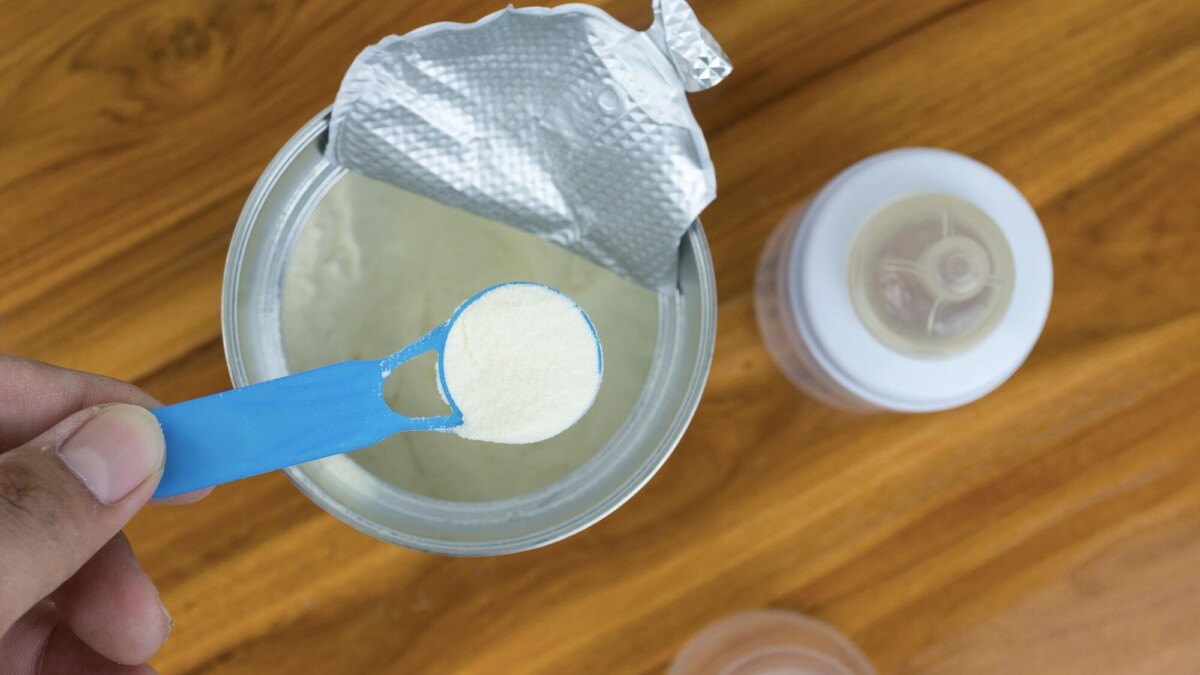
A report by the association Générations Futures warns of the presence of persistent pollutants in infant formula. While these findings raise legitimate questions about infants' exposure to chemicals, their interpretation requires distinguishing between contamination, exposure, and health risks.
Published on Thursday, November 26, 2026, the report by Générations Futures is based on the results of food safety tests carried out in 2024 and submitted by the European Food Safety Authority (EFSA). Of the 25 infant formula samples analyzed in France, seven showed a quantifiable concentration of at least one PFAS. Six contained PFOS, a substance considered potentially carcinogenic, and one contained PFOA, classified as a known human carcinogen since 2023.
These results, however, do not allow us to conclude that 28% of infant formula sold in France is contaminated. The number of samples remains too limited to establish a representative estimate of the national market. Across the eleven European countries studied, 27% of the 81 samples analyzed showed measurable contamination. The available data also do not allow us to identify the brands concerned.
European regulations are still insufficient.
The European Commission recommends a guideline value of 50 nanograms per kilogram of product for each of the four main PFAS in infant formula. However, this guideline is neither a legally binding limit nor a threshold guaranteeing the absence of health risks. In 2020, the EFSA (European Food Safety Authority) set a tolerable weekly intake of 4,4 nanograms per kilogram of body weight for these four substances combined. Risk assessment therefore depends, in particular, on the measured concentrations, the quantities consumed, and the child's weight.
Future Generations is now calling for stricter food controls, an expansion of the number of substances tested for, and the establishment of appropriate regulatory limits. While the results constitute a health signal that deserves careful attention, they do not allow for establishing the danger of a currently marketed product or recommending one brand over another. Concerned parents are advised to consult their pediatrician before making any changes to their child's diet.
Sources cited in the article Rapport de Générations Futures · EFSA · European Commission