

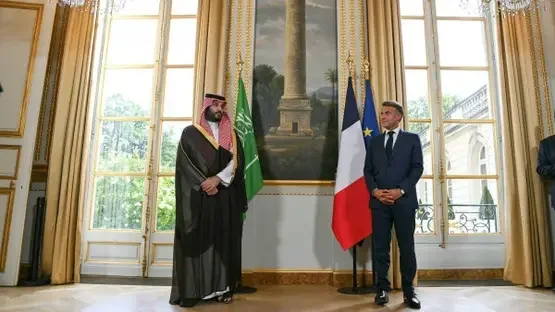
Received by Emmanuel Macron on August 23 and 24, Saudi Crown Prince Mohammed bin Salman concluded a particularly busy official visit to France. Investments, defense, artificial intelligence, transportation, regional diplomacy: Paris and Riyadh now demonstrate a relationship that extends far beyond traditional arms and energy contracts. Twenty-one agreements and memoranda of understanding were announced, most notably a spectacular €6 billion Saudi investment in the Île-de-France region.
There are the images, and then there are the figures. On Sunday, August 23, Emmanuel Macron and Mohammed bin Salman appeared together in Paris at the closing ceremony of the eSports World Cup. The following day, the scene changed: the Saudi Crown Prince was received at the Élysée Palace for the political and economic heart of his visit.
After two days of talks, the message sent by Paris and Riyadh is hard to miss. France intends to become one of the key European partners in the economic transformation envisioned by Mohammed bin Salman, while Saudi Arabia wants to strengthen its investments in France.
The two leaders primarily presided over the first meeting of the Franco-Saudi Strategic Partnership Council, the creation of which was decided during Emmanuel Macron's state visit to Saudi Arabia in December 2024. A way to institutionalize a relationship that has strengthened considerably in recent years.
A €6 billion Saudi investment near Paris
This is undoubtedly the most spectacular announcement of the visit. The Saudi group Qiddiya Investment Company, linked to the powerful Saudi sovereign wealth fund PIF, plans an investment of up to 6 billion euros in Cergy-Pontoise, in the Île-de-France region.
The project aims to create a vast destination combining entertainment, tourism, hospitality, culture, and sports. Initial plans suggest up to three large theme parks, along with hotels and other infrastructure.
Emmanuel Macron announced the anticipated creation of 22,000 jobs, describing the project as unparalleled in France since Disneyland Paris. One of the three parks is expected to be dedicated to the world of Dragon Ball Z, although this theme has not yet been officially confirmed in the agreement.
Beyond its spectacular nature, the investment constitutes a political signal: while France has been seeking for years to attract more capital from the Gulf, Riyadh is preparing to commit several billion to a highly visible French tourism project.
Alstom, CMA CGM: French groups are accelerating their expansion in Saudi Arabia
The relationship also works in the other direction. French companies are looking to take their share of the hundreds of billions of dollars mobilized by Riyadh to transform the kingdom as part of Vision 2030.
Transportation is one of the key sectors. Alstom, in particular, has secured a contract worth approximately €500 million related to the Riyadh metro. The French group is to supply new trainsets and expand its industrial presence in the kingdom. CMA CGM, for its part, is strengthening its port operations in Jeddah with an investment of several hundred million euros.
These operations are part of a much broader Saudi strategy. In the coming years, the kingdom must simultaneously prepare for the Riyadh World Expo in 2030 and the 2034 FIFA World Cup , while developing new cities, railway infrastructure, airports and tourist destinations.
For French companies, the market is considerable. Bilateral trade between France and Saudi Arabia already reached approximately $11,8 billion in 2025.
Energy: Aramco is forging closer ties with French companies
Another historical pillar of the relationship is energy. Saudi Aramco took advantage of the Franco-Saudi period to conclude several agreements with French companies. These agreements cover both equipment for the energy industry and new technologies.
But the transformation of the Franco-Saudi relationship is evident precisely here: Paris and Riyadh no longer want to limit their cooperation to oil. Water management, transportation, industry, finance, digital technology, and tourism are now at the heart of their economic partnership. France is already presented in the joint communiqué as a major investor in Saudi Arabia in several of these sectors.
Artificial intelligence: the new field of cooperation
This is probably one of the most revealing aspects of the visit. Artificial intelligence, quantum computing, and emerging technologies are officially becoming priority areas for Franco-Saudi cooperation.
The two countries have decided to strengthen their collaboration in these sectors, and several private agreements support this ambition. For Riyadh, the objective is clear: to gradually reduce its economy's dependence on hydrocarbons and make Saudi Arabia a global technological powerhouse.
For Paris, the challenge lies in positioning its technological ecosystem and its companies to capitalize on the massive investments undertaken by the kingdom.
Defense: Paris and Riyadh want to go further
Defense remains a crucial element of the relationship. A new Franco-Saudi declaration provides for strengthened cooperation in armaments and military training, as well as increased strategic coordination between the two countries.
No mega-arms contracts comparable to France's historic large-scale sales in the Gulf were publicly announced at this event. The sequence of events is therefore primarily political: it confirms the desire of both capitals to maintain a privileged military relationship in a region profoundly disrupted by successive crises.
AlUla: Partnership with France extended until 2035
It has become one of the symbols of the French presence in the new Saudi Arabia. The partnership surrounding AlUla will be extended until 2035.
Archaeology, heritage, tourism, culture, economic development and environmental protection: for several years France has been supporting the transformation of this historic region of northwestern Saudi Arabia into an international tourist destination.
Paris and Riyadh have decided to continue this cooperation for nearly another decade. The agreement illustrates another dimension of Mohammed bin Salman's strategy: building a tourism and cultural industry capable of attracting tens of millions of visitors to a country that, just a few years ago, was largely closed to international tourism.
Twenty-one agreements to expand the relationship
In total, the two parties announced 21 agreements and memoranda of understanding.
These sectors include defense, energy, transportation, healthcare, artificial intelligence, emerging technologies, finance, tourism, culture, and entertainment. An investment roundtable bringing together Emmanuel Macron, Mohammed bin Salman, and several leading French and Saudi business executives also provided an opportunity to examine new projects.
Paris and Riyadh aim to establish a financial framework to facilitate projects undertaken by French companies in Saudi Arabia. In other words, the stakes go beyond the contracts announced during the visit: it's about preparing for investments in the coming years.
Iran, Gaza, Lebanon: Macron and MBS demonstrate their convergence
The visit, however, was not solely focused on economics. Emmanuel Macron and Mohammed bin Salman devoted a significant portion of their discussions to the crises gripping the Middle East. Regarding Iran, Paris and Riyadh advocate a diplomatic solution to the Iranian nuclear program and urge Tehran to fully cooperate with the International Atomic Energy Agency.
The two countries also condemned the attacks on ships in the Strait of Hormuz and advocated for the restoration of normal and free navigation in this vital artery for global trade. On the Israeli-Palestinian issue, Macron and MBS welcomed the announcement of an agreement concerning the disarmament of Hamas and reaffirmed their support for a two-state solution, with the creation of a Palestinian state based on the 1967 borders. They also denounced the continued Israeli settlement activity.
In Lebanon, Paris and Riyadh aim to strengthen the state and its institutions, while in Syria, the two capitals intend to support the country's stabilization and economic reconstruction. The creation of a Saudi-Syrian-French Business Council was particularly welcomed.
MBS confirms its return to the center of the international game
Beyond the billions and the contracts, the visit also reveals the evolution of Mohammed bin Salman's international status. The crown prince is no longer seen in Paris simply as the de facto ruler of one of the world's leading oil powers. He has become a key player on major Middle Eastern issues, as well as a sought-after investor and the architect of an economic transformation that is opening up vast markets for Western companies.
For Emmanuel Macron, the strategy is clear: to maintain privileged access to Riyadh, attract Saudi capital to France and position French companies at the heart of Vision 2030. For Mohammed bin Salman, Paris simultaneously offers a political relationship with a nuclear power that is a permanent member of the Security Council, industrial and technological expertise and a major gateway to Europe.
August 23 and 24, 2026 will thus have marked a new stage.
With 21 agreements announced, a spectacular €6 billion investment in the Île-de-France region, and cooperation now extending from defense to artificial intelligence, the Franco-Saudi relationship is entering a new phase. More than a mere protocol visit, Mohammed bin Salman's trip to Paris primarily underscored a reality: Paris and Riyadh now intend to solidify their rapprochement for the long term.


Community
Comments
Write a comment
Be the first to comment on this article.