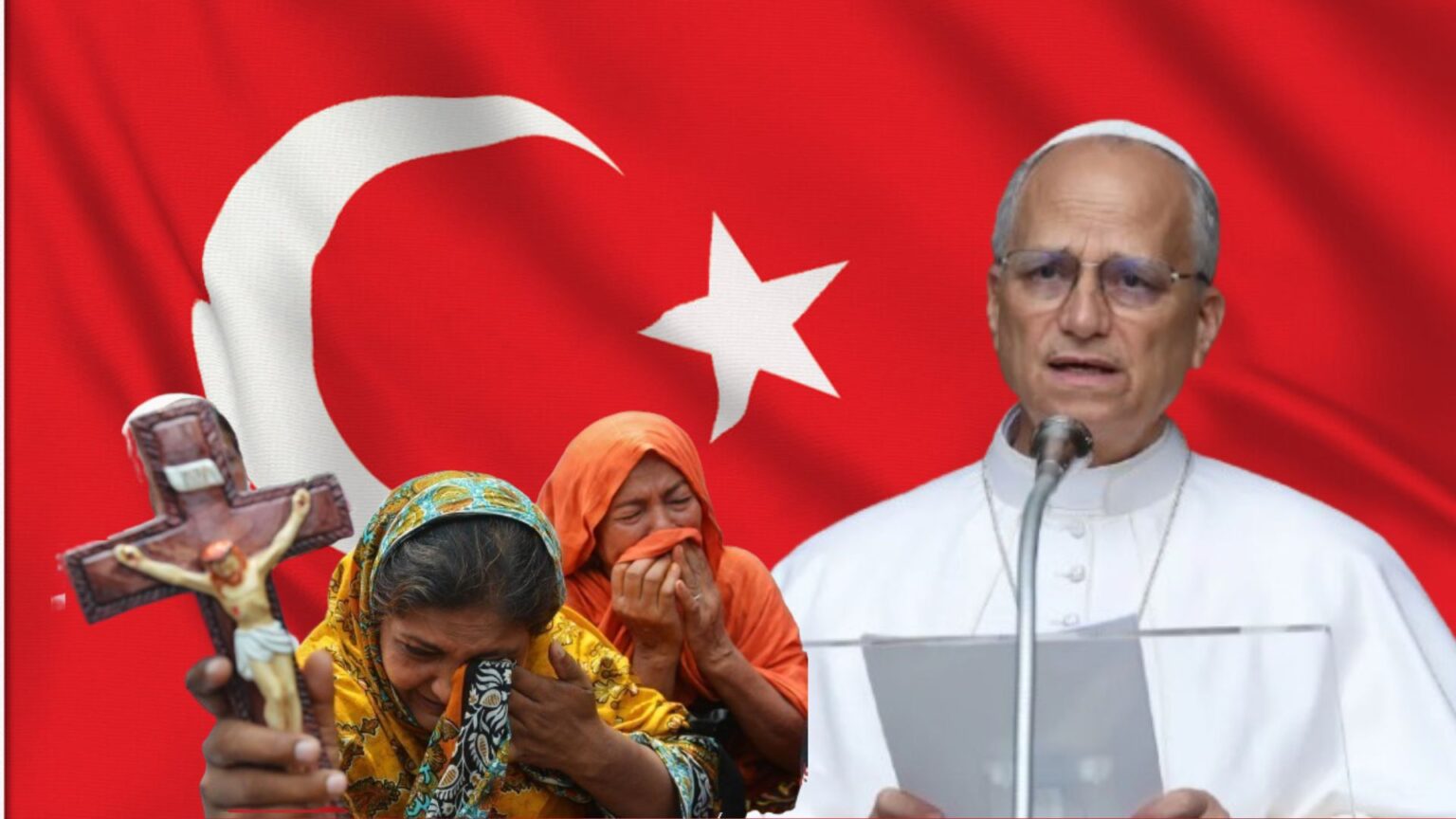
On the occasion of Pope Leo XIV's first visit abroad, to Turkey from November 27 to 30 to commemorate the 1700th anniversary of the Council of Nicaea, the European Centre for Law and Justice (ECLJ) published an alarming report on the persecution of Christians in Türkiye.
In a century, the land of the first councils has seen the proportion of Christians plummet from approximately 20 to 25% of the population at the beginning of the 20th century to just 0,3 or 0,4% today, representing 200,000 to 320,000 faithful nationwide. This near-total disappearance owes less to the vagaries of history than to a succession of genocides, deportations, pogroms, and policies aimed at forging an ethnically and religiously homogeneous nation.
A diffuse but persistent persecution
The ECLJ report describes a persecution that has become structural. Attacks against churches, armed assaults, recurring threats, a climate of insecurity maintained by a public discourse that equates Turkishness with Sunni Islam: for many Christians, and especially for converts of Muslim origin, fear is part of daily life.
This social hostility is compounded by a battery of administrative and legal constraints. The churches lack true legal personality recognized by the state, which complicates the management of places of worship, schools, and charitable works. Community foundations have lost thousands of assets, expropriated or placed under state control. Furthermore, the state allows itself to interfere in Greek Orthodox and Armenian patriarchal elections, and the Halki Major Seminary, the historical heart of Orthodox clergy training, has remained closed since 1971.
For several years, Turkish authorities have also targeted foreign Christians: pastors, missionaries, NGO leaders, and ordinary worshippers are expelled or banned from the country based on "national security" codes (G-87, N-82), without any real recourse. The ECLJ has already documented these practices before the European Court of Human Rights, notably through the case of American pastor Andrew Brunson, who was arbitrarily detained for two years before being released in 2018.
A moral test for Europe
This new report, circulated among parliamentarians, diplomats, and European institutions, aims to place the plight of Turkish Christians at the heart of the dialogue with Ankara. The ECLJ is specifically calling on the Parliamentary Assembly of the Council of Europe to officially take up the issue, based on a petition that could lead to a report and recommendations addressed to Turkey.
At a time when the European Union is discussing its strategic relations with Ankara (energy, migration, defense), can we continue to talk about partnership, customs modernization, or political rapprochement while turning a blind eye to the near disappearance of the communities that formed the Christian soul of Anatolia? Without clear positions from European states, without political and legal conditions for the relationship with Ankara on the effective respect for Christian minorities, the 257,000 Christians who still remain in Turkey will inexorably head towards extinction.
For them, the papal trip should not only be symbolic but the starting point of a Western resurgence, which finally dares to say that the religious freedom of Christians is non-negotiable.