

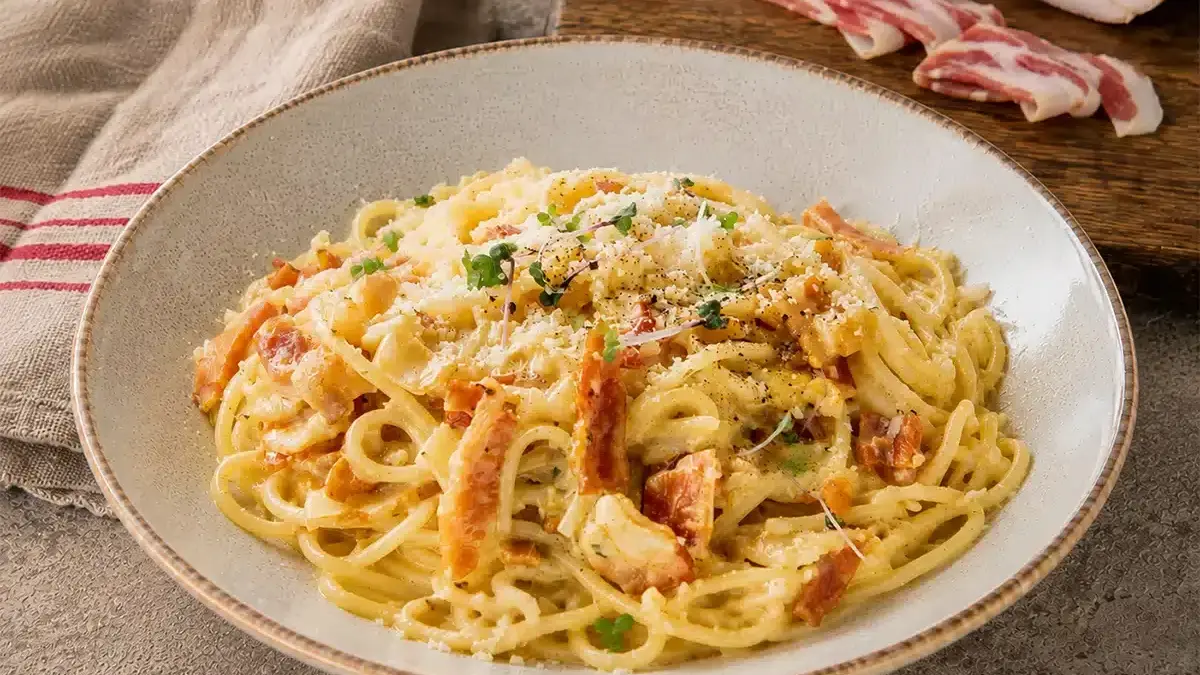
Among the most popular Italian dishes in the world, pasta carbonara holds a special place. Yet, behind this seemingly simple recipe lies a culinary debate that regularly pits Italian purists against those who prefer modern interpretations. Contrary to a common practice in France , traditional carbonara contains neither cream nor smoked bacon. Its secret lies in a few key ingredients and a precise preparation technique.
Pasta carbonara is one of the best-known and most beloved Italian specialties worldwide. Easy to prepare, economical, and particularly hearty, this dish has become a staple in restaurants and home kitchens alike. In France, it is often associated with a sauce made with crème fraîche, bacon, and sometimes onions. However, this preparation differs significantly from the traditional Roman recipe. In Italy , and especially in Rome, carbonara relies on a combination of pasta, eggs, guanciale, pecorino romano, and black pepper. None of these ingredients are intended to be replaced with cream in the classic version. The creamy texture of the dish comes solely from the emulsion formed between the eggs, grated cheese, and the pasta cooking water.
The exact origin of carbonara remains a subject of debate among food historians. Several theories coexist, none of which has achieved complete consensus. One links the dish's name to the carbonari , the Italian charcoal burners who supposedly prepared simple, nourishing meals during their work. Another hypothesis places the development of the recipe during or after World War II, when American soldiers stationed in Italy are said to have helped popularize the combination of pasta, eggs, and pork. The first written records of recipes resembling modern carbonara appear in the mid-20th century. Unlike other Italian specialties whose origins date back centuries, carbonara as we know it today seems relatively recent. Its history also illustrates the constant evolution of culinary traditions, sometimes presented as immutable when in fact they have been built up gradually.
The secret to a successful carbonara lies in cooking the eggs properly.
The traditional preparation requires few ingredients but a certain amount of skill. For four people, you will generally need about 400 grams of spaghetti or rigatoni, 150 to 200 grams of guanciale, four egg yolks (optionally with one whole egg), 100 grams of pecorino romano cheese, and freshly ground black pepper. The guanciale, an Italian cured meat made from pork cheek, is cut into pieces and then gently heated in a pan to render some of its fat. This fat plays an important role in the flavor and final texture of the sauce. Meanwhile, the pasta is cooked in plenty of lightly salted water. In a separate bowl, the eggs are mixed with the grated cheese and pepper until well combined.
The most delicate step comes when assembling the ingredients. Once the pasta is cooked, it's tossed with the guanciale and some of its rendered fat. The egg and cheese mixture is then stirred in off the heat, gradually adding a little pasta water to create a smooth, enveloping sauce. The temperature should be high enough to thicken the sauce slightly, but not so high that the eggs scramble. It's precisely this balance that gives carbonara its characteristic texture. The starch in the pasta water helps stabilize the emulsion, while the pecorino cheese provides a pronounced, salty flavor. Therefore, heavy cream isn't necessary to achieve a smooth sauce. It can even alter the taste of the dish by masking the flavors of the cheese and guanciale.
While the traditional Roman recipe remains a benchmark, adaptations abound today. Some cooks replace guanciale with pancetta, which is easier to find in certain countries, while others use Parmesan instead of Pecorino. Vegetarian versions have also emerged, featuring mushrooms or grilled vegetables. In France, carbonara with cream remains very popular, particularly because it allows for an easy creation of a rich sauce without mastering the emulsion technique. These variations can be appreciated for their flavor, but they do not correspond to the traditional Roman preparation. The international success of carbonara ultimately demonstrates how a recipe composed of just a few ingredients has become a true gastronomic phenomenon. Behind its apparent simplicity, it serves as a reminder that in cooking, the quality of the ingredients and the precision of the techniques sometimes matter more than the sheer number of ingredients.









Respond to the article
Be the first to comment on this article.