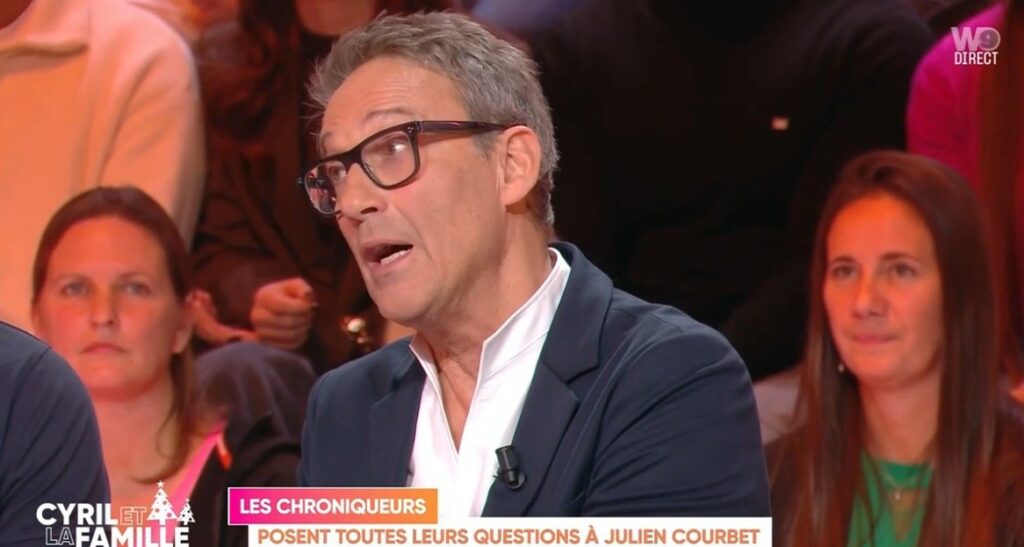
Guest in TBT9on W9, Julien Courbet a livré un témoignage accablant sur ses années passées à France Télévisions. Aujourd’hui figure de M6, il a décrit une manière de travailler qu’il considère comme éloignée des standards d’indépendance attendus d’un groupe audiovisuel public. Ses propos arrivent alors que France Télévisions est déjà sous le regard attentif d’une commission d’enquête parlementaire, chargée d’examiner son fonctionnement interne et son degré de neutralité.
"I don't have fond memories of it." : the bitter assessment of his time at France 2
Julien Courbet explains that his experience at France 2 is nothing like his experience in the private sector. He states that he doesn't have "fond memories" of the public broadcaster and recalls the smoother communication when he worked at TF1. He specifically mentions a past interview with former CEO Étienne Mougeotte, to whom he presented a concept that was approved "in 35 seconds ," a sign, according to him, of a more direct and responsive decision-making environment.
Unofficial practices that raise questions
The presenter revealed that some of his interactions with France 2 followed a pattern that surprised him. When presenting a project, he was reportedly asked if he happened to know a government minister , a question his interviewers justified by explaining that it "helped with the proposal ." For Julien Courbet, this initial question illustrated a system where political connections seemed, in his opinion, to carry more weight than the merit of the project itself.
These remarks echo certain concerns already raised in institutional reports, notably by the Court of Auditors or ARCOM, which have regularly examined the decision-making processes and strategic choices of the public group.
An inquiry commission mobilized on several fronts
Julien Courbet's statements come as a parliamentary inquiry, established on October 28, 2025, at the initiative of the Union of the Right for the Republic group, is specifically examining the neutrality, governance, and financing of public broadcasting. This commission, composed of thirty members of parliament and one independent member, has set itself the objective of examining the decision-making mechanisms governing the creation of programming schedules, assessing the transparency of internal practices, identifying any potential external influences, and scrutinizing the use of budgets allocated to France Télévisions.
His work is based in particular on reports from the Court of Auditors, contributions from ARCOM and public hearings already conducted by parliamentary committees in charge of cultural affairs.
These statements could provide material for future hearings.
Even though it is an account of a personal experience, Julien Courbet's remarks could fuel discussions among parliamentarians in the coming weeks. They resonate with an already heated debate surrounding the editorial independence of the public broadcasting group, a topic frequently raised by media experts and several former executives who have testified before the institutions. As the commission continues its work, this testimony adds another piece to a case that will undoubtedly continue to generate questions and analysis.