

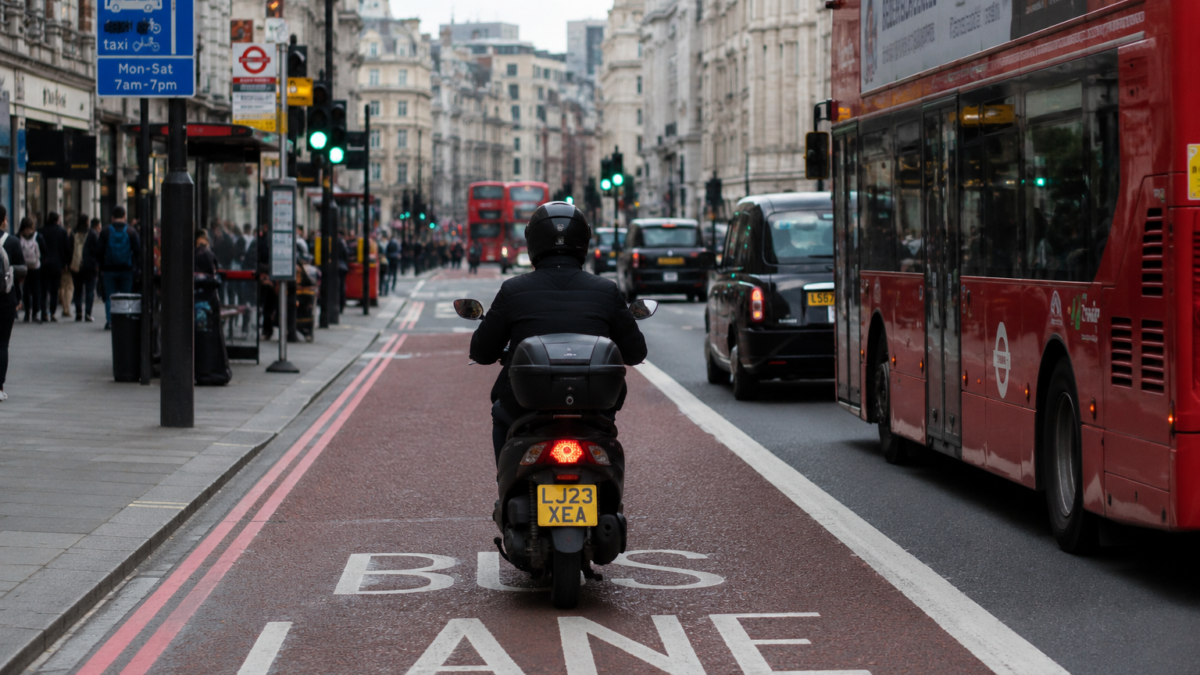
In London, motorcycles and scooters can use most bus lanes on major routes managed by Transport for London. This isn't universal, as local signage is still the determining factor and some lanes are under the jurisdiction of individual London boroughs. However, the principle has been in place since 2012: when a bus lane can accommodate motorized two-wheelers without disrupting public transport, it is open to them.
In Paris, the policy remains almost the opposite. Motorcycles and scooters are normally prohibited from using bus lanes, unless otherwise indicated, under penalty of a €135 fine. They are therefore relegated to general traffic lanes, where they share the space with cars, vans, and trucks. This prohibition deserves to be re-examined, not to grant a privilege to motorcyclists, but to better manage existing traffic patterns.
Separating two-wheelers from cars to reduce conflicts
The first argument concerns visibility. In traffic jams, a scooter rider alternates between their lane, lane splitting, and the position changes required by vehicles turning, merging, or opening doors. Allowing them to use certain bus lanes would offer a more predictable route and reduce the number of intersections with car traffic. A clear trajectory is easier for motorcyclists, drivers, and bus drivers to anticipate.
A motorcycle also takes up far less space than a car, which often carries only one person. Refusing access to bus lanes doesn't make two-wheelers disappear; it simply concentrates them in the general traffic and increases lane splitting. When lane capacity allows, a few extra motorcycles or scooters don't automatically create congestion for buses. The issue must be assessed line by line, based on actual measurements, and not resolved by a blanket ban.
A measure compatible with the priority given to public transport
Opening certain bus lanes does not mean calling into question the priority of public transport. London maintains timetables, signage, and restrictions specific to each route. Paris could apply the same principle by reserving access to sufficiently wide and less congested lanes, while maintaining the ban on narrow, heavily trafficked lanes or those shared with many cyclists. Buses would retain priority, and authorization could be suspended during peak hours.
The trial would allow for an objective measurement of the effects on bus operating speeds, accidents, dangerous overtaking, and journey times. Cameras could penalize excessive speeds, illegal overtaking, and any behavior that endangers cyclists or passengers getting off a bus. If a lane slows down public transport or becomes more dangerous, it would be immediately removed from the system.
Better regulation rather than blind prohibition
The objection concerning cyclists is legitimate, but it doesn't justify inaction. Not all bus lanes have the same configuration, and not all are open to bicycles. On shared roads, a minimum width, a speed limit, a ban on overtaking a bicycle when space is insufficient, and enhanced signage could be implemented. The most critical lanes would remain exclusively reserved for buses and bicycles.
Paris should therefore launch a trial on several representative routes for twelve to eighteen months. The capital would not be taking a blind gamble: it would be adapting a policy already implemented for over a decade on a significant portion of the London network. Between a blanket ban and uncontrolled access, there is a pragmatic solution: allow motorized two-wheelers where the infrastructure permits, measure the results, and ultimately prioritize effectiveness over ideology. Transport for London presents the rules applicable to bus lanes , while the City of Paris outlines the specific traffic regulations for motorized two-wheelers.







Community
Comments
Write a comment
Be the first to comment on this article.