

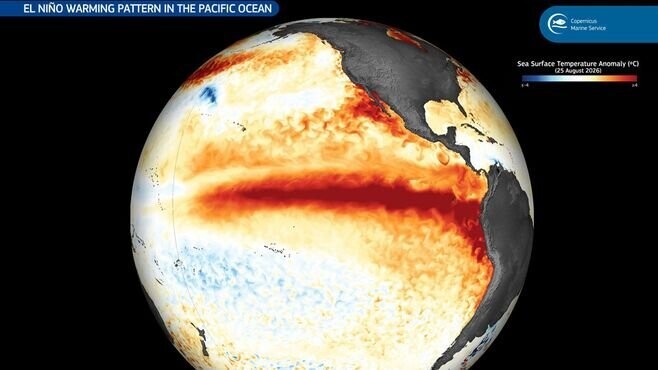
While climate debates often focus on the responsibility of human activities, the powerful El Niño episode currently developing in the Pacific is a reminder of a fundamental reality of climatology: the climate system depends both on underlying trends linked to human activities and on powerful natural mechanisms capable of altering, sometimes strongly, temperatures and rainfall from year to year.
According to La Chaîne Météo (The Weather Channel), which relies in particular on the latest available climate projections, El Niño strengthened considerably during the summer of 2026. In an article published on August 21, meteorologist Régis Crépet now suggests a greater than 90% probability that the event will reach a "very strong" intensity during the fall and winter of 2026-2027. In the eastern equatorial Pacific, ocean temperature anomalies locally reached up to +2,9°C in July. La Chaîne Météo even highlights the possibility of an event of historical intensity.
These observations are not isolated. On July 31, the World Meteorological Organization (WMO) also confirmed that a strong El Niño was developing and was expected to continue intensifying. The international organization believes that the phenomenon will impact global climate patterns, notably by increasing the likelihood of above-normal temperatures in many regions and by significantly altering rainfall patterns.
El Niño, a gigantic natural mechanism
El Niño is not caused by human activity. It belongs to the natural phenomenon called ENSO (El Niño-Southern Oscillation), which corresponds to periodic variations in the surface temperatures of the tropical Pacific Ocean and the associated atmospheric circulation. The WMO notes that these episodes generally occur every two to seven years and usually last from nine to twelve months.
However, this mechanism can have considerable consequences on a global scale. The unusual warming of a vast area of the Pacific Ocean alters the trade winds, tropical convection, and, consequently, a portion of the global atmospheric circulation. Some regions may experience increased rainfall and flooding, while others may experience droughts or abnormally high temperatures.
This is precisely what demonstrates how simplistic it would be to explain every weather anomaly or annual temperature variation solely by human activity. Oceans, volcanoes, atmospheric circulation variations, El Niño, and La Niña are also natural climate factors. The IPCC explicitly acknowledges this natural variability: its work distinguishes between anthropogenic influences, natural forcings (such as volcanic or solar activity), and the internal variability of the climate system, of which El Niño is one of the most significant examples.
Recent history provides a particularly striking example. According to the WMO, the record global heat of 2024 resulted from a combination of exceptionally high concentrations of greenhouse gases and several natural factors, including El Niño. The organization emphasizes that the natural phenomenon contributed to temporarily amplifying temperatures, but could not alone explain their exceptional level.
El Niño 2026, a reminder of the power of natural phenomena
For France, the weather channel La Chaîne Météo itself is urging caution. Even an exceptional El Niño event alone cannot predict the winter of 2026-2027. And this is precisely what reminds us how much the climate remains subject to a multitude of powerful natural mechanisms: the state of the North Atlantic, the position of the jet stream, atmospheric blocking patterns, stratospheric circulation, ocean temperatures, and the interactions between the ocean and the atmosphere. All these natural parameters are capable of profoundly altering temperatures and precipitation from one season to the next.
The impending El Niño event thus constitutes a spectacular demonstration of the still considerable influence of natural variability on Earth's climate. A massive warming of the Pacific Ocean, without any direct human origin, can single-handedly reorganize a portion of global atmospheric circulation, shift precipitation patterns, promote droughts in some regions, floods in others, and contribute to fluctuations in the global average temperature.
This reality serves as a reminder that it would be overly simplistic to attribute every heat wave, every mild winter, every drought, or every weather anomaly solely to human activity. Climate is not a mechanism controlled by a single factor. Natural phenomena continue to play a major role and can, over periods of several months or even several years, amplify, mask, or significantly alter observed trends.
This does not mean that human influence on long-term warming is nonexistent or secondary: on the contrary, the scientific consensus establishes its major role in the trend observed since the industrial era. But this underlying trend coexists with extremely powerful natural variability, which public debates sometimes tend to underestimate when they seek an immediate cause for every weather event.
El Niño 2026 could provide a real-world illustration of this. Humans influence the climate today, but they neither control nor explain all its variations. The oceans, major atmospheric currents, natural cycles, and the complex interactions of the Earth system remain capable of temporarily disrupting the global climate on a considerable scale. It is this combination of human influence and natural forces that must be kept in mind to truly understand climate change.







Community
Comments
Write a comment
Be the first to comment on this article.