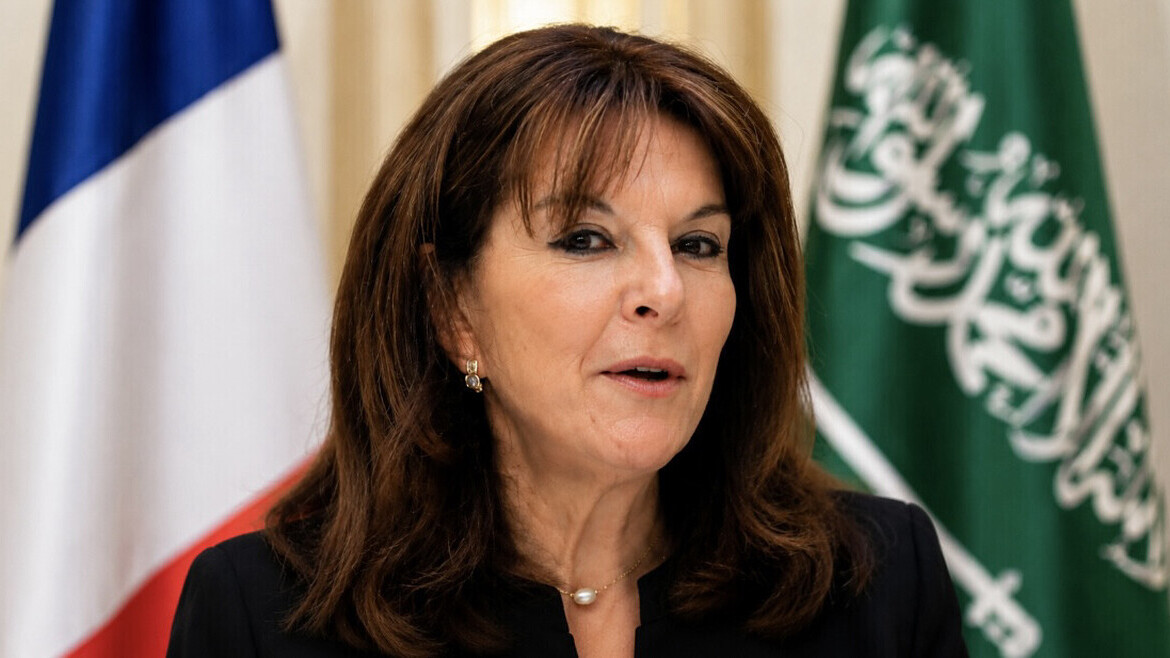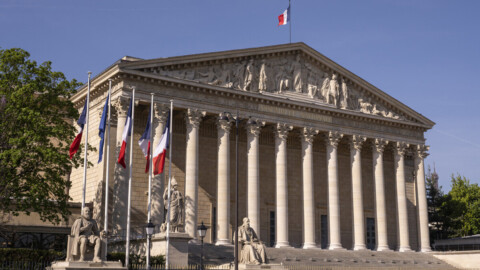

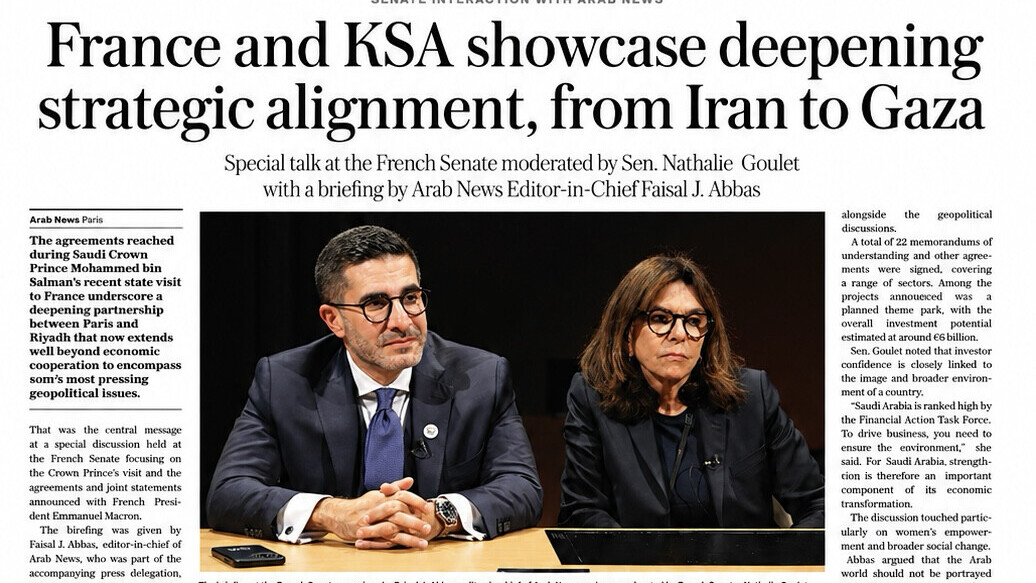
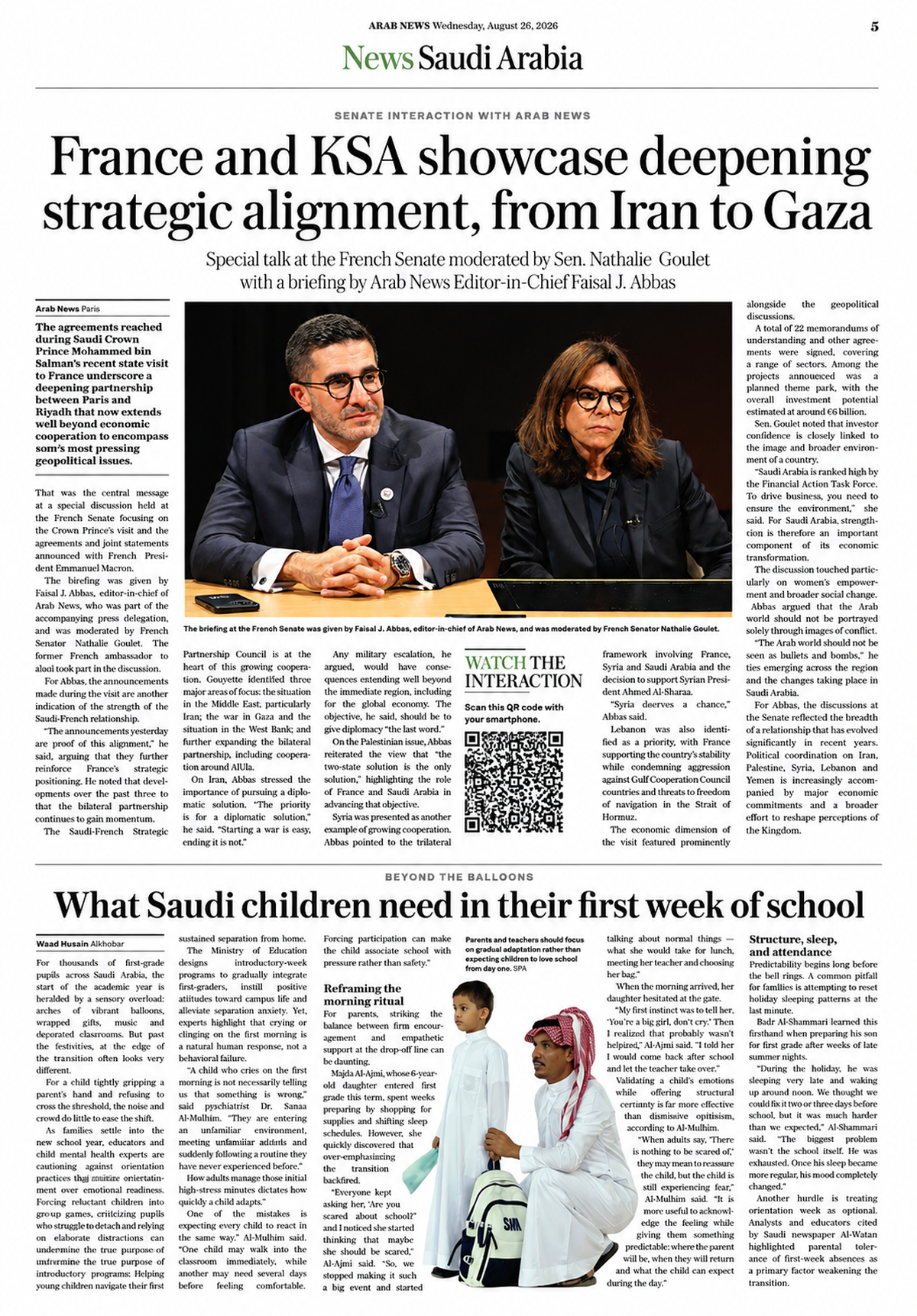
The rapprochement between France and Saudi Arabia is no longer limited to investments and major contracts. At a meeting held at the French Senate and moderated by Senator Nathalie Goulet, relations between Paris and Riyadh were discussed in their political, diplomatic, economic, and strategic dimensions, with several regional issues at the heart of the discussions: Iran, Gaza, the West Bank, Syria, Lebanon, and Yemen. This meeting followed directly from the state visit to France by Saudi Crown Prince Mohammed bin Salman and the agreements and joint declarations announced with Emmanuel Macron. Faisal J. Abbas, editor-in-chief of Arab News , who had accompanied the Saudi delegation to France, presented the main issues at stake in this new phase of Franco-Saudi relations. Former French ambassador to Saudi Arabia, François Gouyette, also participated in the discussion.
Nathalie Goulet at the heart of the discussions in the Senate
Senator Nathalie Goulet of Orne led the discussions on the Franco-Saudi relationship, which has expanded considerably in recent years. For Faisal J. Abbas, the announcements made during Mohammed bin Salman's visit clearly demonstrate this rapprochement. He believes the decisions taken confirm the growing alignment between Paris and Riyadh and simultaneously strengthen France's strategic position. At the heart of this cooperation is now the Franco-Saudi Strategic Partnership Council, designed to structure relations between the two countries. François Goulet identified three main areas: the crises in the Middle East, with particular attention to Iran, the war in Gaza, and the situation in the West Bank; as well as the deepening of bilateral relations, notably concerning Al-Ula.
Iran: Paris and Riyadh favor the diplomatic route
The situation in Iran featured prominently in the discussions. Faisal J. Abbas advocated for a diplomatic solution, arguing that a new military confrontation would have consequences far exceeding the borders of the Middle East, particularly for the global economy. "The priority is to find a diplomatic solution ," he stated, before summarizing the risk of escalation: "Starting a war is easy, ending it is not." The stated objective is therefore to allow diplomacy to have the final say and to avoid an expansion of the conflict that could further destabilize the region.
Gaza and Palestine: the two-state solution reaffirmed
The Palestinian issue represents another point of convergence between France and Saudi Arabia. Faisal J. Abbas reaffirmed that "the two-state solution is the only solution ," emphasizing the role played by Paris and Riyadh in trying to advance this diplomatic perspective. This coordination on the Palestinian question has become one of the main political aspects of the rapprochement between the two countries, alongside discussions concerning the war in Gaza and the situation in the West Bank.
Syria: "Syria deserves a chance"
Syria was also cited as an example of growing cooperation between Paris and Riyadh. Discussions focused in particular on the trilateral framework involving France, Saudi Arabia, and Syria, as well as on support for Syrian President Ahmed Al-Sharaa. Faisal J. Abbas summarized this position in a few words: "Syria deserves a chance." Lebanon is also among the shared priorities. France continues to support the country's stability, while regional security issues, attacks against Gulf Cooperation Council states, and threats to freedom of navigation in the Strait of Hormuz were among the concerns raised.
22 agreements and up to €6 billion in potential investments
The Franco-Saudi rapprochement also has a significant economic dimension. A total of 22 memoranda of understanding and other agreements covering various sectors were signed during Mohammed bin Salman's visit. Among the announced projects is a theme park project in France. The overall investment potential associated with the various projects presented is estimated at around €6 billion. These investments could create up to 22,000 jobs. Discussions in the Senate highlighted a relationship that now operates in both directions: French companies are continuing their development in Saudi Arabia, while Saudi capital is playing an increasingly important role in investments made in France.
Yemen: Riyadh now wants to "stop the war"
The situation in Yemen was also discussed at length. Faisal J. Abbas recalled that Saudi Arabia had warned the Obama administration of the threat posed by the Houthis about ten years ago. " Ten years later, it is still a threat, not only to the region, but to the world," he stated. Saudi Arabia has notably provided support to Yemen through military training and intelligence sharing. But the priority now is ending the conflict. "The priority today is to stop the war ," Faisal J. Abbas emphasized. The discussions also highlighted the strategic importance of the Bab al-Mandab Strait compared to that of the Strait of Hormuz, the disruption of which would have particularly significant consequences for the global economy.
Nathalie Goulet emphasizes Saudi Arabia's image among investors
Beyond regional crises, Nathalie Goulet also emphasized a directly economic issue: the Kingdom's international image. For the senator, investor confidence also depends on a country's reputation and its economic and regulatory environment. She specifically highlighted Saudi Arabia's positive standing with the Financial Action Task Force (FATF), the international body responsible for combating money laundering and terrorist financing. "To develop business, you have to guarantee the environment ," she stressed. The Kingdom's social transformation, particularly the growing role of women in society and the economy, was also discussed.
Another image of the Arab world
Faisal J. Abbas argued for the need to move beyond reducing the Arab world to the wars and crises that regularly dominate its international media coverage. "The Arab world should not be seen solely through the lens of bullets and bombs ," he stated. The economic and social transformations undertaken in Saudi Arabia as part of Vision 2030 are thus playing an increasingly important role in the Kingdom's international strategy. This issue aligns with the positions recently put forward by Nathalie Goulet regarding Saudi Arabia's transformations and the economic opportunities the country offers.
Nathalie Goulet proposes the creation of a Franco-Saudi Press Club
The meeting at the Senate finally turned its attention to the role of the media in shaping perceptions of Saudi Arabia and, more broadly, the Arab world. Faisal J. Abbas specifically mentioned the development of multilingual content and the use of artificial intelligence to broaden the international reach of regional media. However, making this content accessible does not guarantee that it will be read or watched. Faisal J. Abbas summarized this with the expression: "You can lead a horse to water, but you can't make it drink." Nathalie Goulet, for her part, proposed the creation of a Franco-Saudi Press Club , intended to strengthen exchanges between French and Saudi journalists and media professionals.
From economic cooperation to a comprehensive strategic partnership
The meeting held at the Senate primarily confirms the dramatic expansion of relations between Paris and Riyadh. Investments and trade remain essential, but they now coexist with diplomatic coordination on the major crises in the Middle East. Iran, Palestine, Gaza, Syria, Lebanon, and Yemen have become key issues on which the two capitals are seeking to align their positions. Added to this are cultural exchanges, AlUla, investments, Saudi Arabia's economic transformation, and now media exchanges. The relationship between France and Saudi Arabia is thus increasingly transcending the framework of traditional bilateral cooperation to take the form of a much broader strategic partnership.