An Ifop study for the magazine Ecran de Veille, conducted by telephone from August 8 to September 2, 2025 with a sample of 1005 people of Muslim faith, taken from a nationally representative sample of 14,244 people aged 15 and over residing in metropolitan France, describes a slow but profound evolution of Islam in France over the past forty years.
A re-Islamization driven by the younger generations
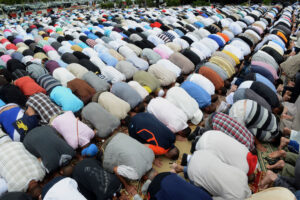
According to this survey, people who identify as Muslim now represent approximately 7% of the adult population, compared to 0,5% in the mid-1980s. This increase is part of a religious landscape transformed by the decline of Catholicism and the rise of the "non-religious," who now represent nearly 40%. But beyond this numerical weight, it is the level of religious commitment that clearly distinguishes Muslims from other believers. Eight out of ten Muslims describe themselves as religious, significantly more than adherents of other faiths. Nearly a quarter define themselves as very or extremely religious, with a peak among 15- to 24-year-olds where this intense religiosity is becoming the norm. At the same time, religious practice has significantly increased since the late 1980s: daily prayer now involves a majority of respondents, while weekly attendance at the mosque on Fridays has more than doubled. Here too, young people are the most observant, whereas one would expect a gradual distancing across generations in a classic secularization pattern. Dietary obligations follow the same trajectory. The complete fast of Ramadan is more widely observed than forty years ago, particularly among 18- to 24-year-olds, where it has become almost systematic. The proportion of Muslims who do not consume alcohol has also reportedly increased, with near-universal abstinence among younger people, reflecting a tightening of norms surrounding religious prohibitions.
Between reinforced religious norms and Islamist temptation
This re-Islamization is not limited to religious practice; it extends to daily life, to dress and behavior. While the veil remains a minority practice among Muslim women overall, its use is increasing significantly among 18- to 24-year-olds, where nearly one in two now wears it. The survey highlights both the weight of religious obligation, the identity-based dimension of affirming belonging, and its use as a form of protection against stares and pressures in public spaces. At the same time, a significant proportion of respondents report refusing at least some form of contact with the opposite sex, whether it be kissing, mixed-gender swimming pools, handshakes, or the doctor-patient relationship, with this rejection of mixed-gender interactions even more pronounced among young women. The authors also describe a shift toward what they characterize as religious absolutism. A majority of respondents believe that when science and religion seem to disagree on the origin of the world, religion is right, and support for a modernization of Islam has declined sharply compared to the late 1990s. On legal issues such as inheritance and ritual slaughter, the proportion of those who favor religious rules over French law has increased significantly, while a substantial number consider the application of Islamic law, at least in part, desirable in the countries where they live. Finally, the survey indicates a much wider reach of Islamist movements than before. More than one in three Muslims approves of at least some positions described as Islamist, a level twice as high as that measured in the late 1990s. One in three expresses sympathy for at least one movement within political Islam, with the Muslim Brotherhood being the most popular. This movement would gain the support of a particularly large proportion of those under 25, which, according to the authors, suggests a lasting establishment of these ideological references within the new generations.