On November 27, 1895, exactly 131 years ago, Alfred Nobel signed his will at the Swedish-Norwegian Club in Paris . The wealthy Swedish industrialist, inventor of dynamite, decided to dedicate the bulk of his immense fortune to creating awards for individuals who had contributed most to the well-being of humanity. He thus gave birth to what would become one of the most prestigious distinctions in the world: the Nobel Prize.
The inventor of dynamite wants to reward the benefactors of humanity
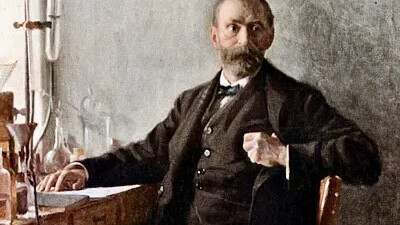
Born on October 21, 1833 in Stockholm , Alfred Nobel was a Swedish chemist, engineer, inventor and industrialist. He made his fortune through his research on explosives, notably the invention of dynamite, which he patented in 1867. At the head of an international industrial empire, he filed 355 patents during his lifetime.
But behind the businessman there is also a passionate lover of literature, philosophy and science, who is interested in issues of peace and disarmament.
In his will, Alfred Nobel stipulated that the income from his fortune would be distributed annually to those who had brought "the greatest benefit to humanity".
It defines five fields: physics, chemistry, physiology or medicine, literature, and peace. It also specifies that the nationality of candidates should not be taken into consideration in the awarding of the prizes.
A colossal inheritance that provokes the anger of his family
Alfred Nobel died on December 10, 1896 in San Remo, Italy , at the age of 63. A bachelor with no children, he left behind a considerable fortune.
More than 31 million Swedish kronor are earmarked for funding future awards. The decision has sparked controversy within his family, with some heirs attempting to have his will invalidated.
It took several years of negotiations to ensure his last wishes were respected. On June 29, 1900, the statutes of the Nobel Foundation were officially approved.
Two Frenchmen among the first laureates in 1901
The first Nobel Prizes were awarded on December 10, 1901, five years to the day after the death of their founder.
The German physicist Wilhelm Conrad Röntgen was awarded the prize for his discovery of X-rays, while the German physician Emil von Behring was recognized for his work on serotherapy, particularly against diphtheria. The Dutchman Jacobus Henricus van 't Hoff received the Nobel Prize in Chemistry.
France also features prominently: the writer Sully Prudhomme receives the first Nobel Prize in Literature, while Frédéric Passy shares the first Nobel Peace Prize with the Swiss Henry Dunant, founder of the Red Cross.
The Nobel Prize in Economics was not included in the will.
Unlike the five historical prizes, the Nobel Prize in Economics was not conceived by Alfred Nobel. It was created in 1968 by the Central Bank of Sweden, on the occasion of its tercentenary, and awarded for the first time in 1969.
Its official name is the " Sveriges Riksbank Prize in Economic Sciences in Memory of Alfred Nobel".
A tradition that has lasted for 125 years
Each year, the awards are traditionally presented on December 10, the anniversary of Alfred Nobel's death. The ceremonies take place in Stockholm, with the exception of the Nobel Peace Prize ceremony , which is held in Oslo, Norway , in accordance with the industrialist's last wishes.
In 2026, the amount of each prize was increased to 12 million Swedish kronor.
One hundred and thirty-one years after the signing of his will in Paris, Alfred Nobel remains more associated with great scientific advances, literature and peace than with the invention of dynamite, which had nevertheless made his fortune.