

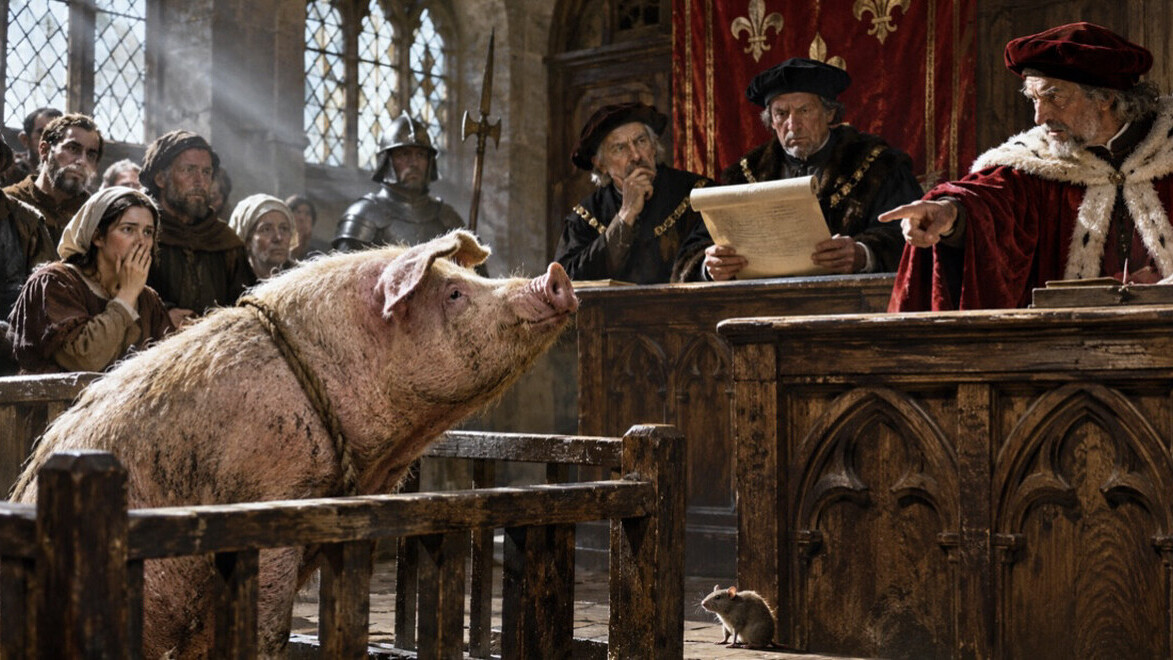
A pig condemned to hang for killing a child, rats prosecuted for devouring crops, insects defended by lawyers, and animals brought before a court like actual criminals. For centuries, in France and other European countries, animals were subjected to legal proceedings that seem utterly unbelievable today. Some were detained, tried, and publicly executed. Others received legal defenses or were subjected to religious proceedings. Let's revisit these cases where courts applied to animals rules and punishments normally reserved for human beings.
The sow of Falaise: condemned to death and publicly executed in 1386
In 1386, in Falaise, Normandy , a sow was accused of fatally injuring a young child. The animal allegedly attacked the infant's face and arm, causing injuries that led to its death. The case was brought before the local court, which treated the attack as a crime punishable by death.
The sow was condemned to death and publicly executed. According to historical accounts, she was dressed in human clothing before her execution. However, the best-known details of this spectacle come from later accounts and should be distinguished from the elements attested by the archives.
What makes the case particularly incredible is the existence of accounting records relating to the execution. The justice system organizes a public punishment, with the expenses and formalities associated with carrying out a sentence.
At that time, pigs frequently roamed the streets and villages. They fed on refuse and lived in close proximity to the inhabitants. Attacks on young children posed a real danger. When a tragedy occurred, the animal could be treated as the perpetrator of a homicide.
The sow of Savigny: condemned to hang, her six piglets spared for lack of evidence
In January 1457, in the seigneury of Savigny, in Burgundy , a sow and her six piglets were accused of having participated in the death of a 5-year-old child. The case gave rise to a particularly detailed legal proceeding, the records of which have been preserved.
Witnesses are heard, and the court seeks to determine each person's exact role in the child's death. The sow is found guilty and sentenced to be hung by her hind legs.
The fate of the six piglets, however, presents a difficulty. They were with their mother, but no testimony establishes that they actually participated in the attack. Their presence at the scene is not sufficient to prove their guilt.
The court therefore decided not to sentence them to death. The piglets were spared due to a lack of evidence to punish them. The case presents a remarkable peculiarity: the court distinguished between the mother's responsibility and that of her offspring, refusing to automatically apply the same punishment to all the animals.
The legal documents also reveal the importance of formalities. Witnesses, the sentence, and the fate of animals are recorded according to practices similar to those used in proceedings against individuals.
The rats of Autun: a lawyer explains to the court that his clients risk being eaten by cats
In the early 16th century, in the Autun region of Burgundy, a now-famous case pitted locals against rats accused of devouring their crops. The rodents were allegedly summoned before an ecclesiastical court and forced to answer the accusations against them.
A lawyer named Barthélemy de Chasseneuz, also known as Chassanée, is traditionally presented as their defender. Instead of contesting the damage caused by the animals, he is said to have chosen to raise procedural objections.
His first argument concerns the summons. Since the rats are scattered across numerous villages, it would be impossible to guarantee that all of them were properly informed of the hearing date. A court summons issued to a few individuals would not be sufficient to prosecute the entire rodent population.
The lawyer then reportedly raised an even more unexpected objection: rats cannot reach the courthouse without risking their lives. The paths are frequented by cats, their natural enemies. Therefore, their absence cannot be blamed as long as their safety is not guaranteed.
These arguments have become one of the best-known examples in the history of animal trials, even though the exact course of the rat trial, often dated to 1522, is not confirmed by a complete contemporary court record.
The rooster of Basel: accused of laying an egg, he reportedly ended up on the pyre.
In 1474, in Basel, in present-day Switzerland , a rooster was reportedly prosecuted for an act deemed unnatural: laying an egg. The story, recounted in ancient narratives, has become one of the most astonishing episodes associated with animal justice.
In the beliefs of the time, an egg attributed to a rooster could be considered particularly dangerous. It was imagined that it could give birth to a basilisk, a monstrous creature to which medieval traditions ascribed deadly powers. The animal was thus suspected of being linked to evil forces.
According to the traditional version, the rooster was brought before a tribunal and sentenced to be publicly burned along with its egg. The execution reportedly attracted a crowd of onlookers who came to witness the destruction of the animal, which was considered dangerous.
This story reflects the fears and superstitions surrounding certain unexplained natural phenomena. An unusual egg, a biological anomaly, or a misidentification could fuel accusations of witchcraft.
The insects of Saint-Julien: vineyard pests pursued for decades
In Saint-Julien, Savoy , in the 16th century, residents facing insect infestations in their vineyards initiated ecclesiastical proceedings against those responsible for the destruction. The animals in question were weevils or related beetles, accused of attacking crops and compromising harvests.
The case is particularly astonishing because the insects are not simply cursed or chased away. They are the subject of an organized legal process, with representatives and legal arguments. The inhabitants seek to have them removed, while the defense argues that these creatures, like humans, were created by God.
The question then becomes almost theological: can inhabitants forbid animals from feeding on the plants that nature provides? Do insects also have a form of right to subsistence?
The first legal proceedings are recorded in the mid-16th century. A new phase of the dispute emerged in the 1580s. The inhabitants then considered granting the insects land where they could live and feed without damaging the vineyards.
The discussions focus on the characteristics of this territory, its vegetation, and its capacity to support pests. The defense, in particular, contests the proposed conditions. The surviving documents do not allow for a definitive determination of the outcome.
Tyrolean mice: pregnant females granted a reprieve before their expulsion
In 1519, in Tyrol, according to a frequently repeated historical account, peasants initiated legal proceedings against field mice accused of destroying their crops. The animals were considered responsible for the damage suffered by the farmers, who wanted them removed from the agricultural land.
The case has reportedly given rise to a particularly unusual legal debate. Animal rights representatives are not only contesting the accusations; they are demanding guarantees to allow their clients to leave the premises without being attacked by predators.
The defense reportedly requested a special permit protecting the mice from cats, dogs, and other dangers they might encounter during their journey. They also reportedly raised the issue of pregnant females and young animals, who are unable to travel long distances immediately.
According to the traditional account of the procedure, the authorities grant pregnant females and their young an additional fourteen days. The other animals are ordered to leave the premises within the specified timeframe.
This differential treatment is particularly striking: the justice system would have taken into consideration the vulnerability of the animals while seeking to protect the crops.
The Beaupré bull: sentenced to hang after killing a teenager
On May 16, 1499, in the seigneury of Cauroy, dependent on the abbey of Beaupré near Beauvais, a bull was condemned to death after killing a young boy named Lucas Dupont, aged about fourteen or fifteen.
The teenager was tasked with herding cattle belonging to a farmer named Jean Boullet. During this activity, he was fatally attacked by a red-coated bull. The animal was seized by the authorities, and proceedings were initiated to determine the circumstances of its death.
The court did not simply order the bull's slaughter. A judicial sentence was issued, condemning the bull to be hanged. The document specified the victim's identity, the animal's owner, the location of the incident, and the circumstances of the attack.
The pig from Sèves: the animal condemned to death, its owners also punished
On April 18, 1499, in Sèves, near Chartres , a pig was prosecuted for causing the death of a young child. The case was examined by the jurisdiction under the authority of Josaphat Abbey.
The animal was sentenced to be hanged. But the court decision wasn't limited to the pig's fate: the owners were also penalized for their negligence. They were responsible for the child entrusted to their care, and the authorities determined they failed to take the necessary precautions to protect him.
They were fined 18 francs. The judgment thus distinguishes between two responsibilities: that attributed to the animal for the fatal attack and that of the adults responsible for supervising the child.
This case sheds light on the logic behind these procedures. Convicting the animal did not necessarily preclude sanctions against those responsible for its care. The justice system could therefore simultaneously punish both the animal and the humans whose negligence contributed to the tragedy.
Animals imprisoned, executioners paid, and sometimes very costly trials
These cases did not all fall under the same jurisdiction. Domestic animals accused of injuring or killing a person were generally prosecuted before secular or manorial courts. Insects and rodents responsible for agricultural damage, on the other hand, could be subject to ecclesiastical proceedings, particularly to obtain their removal or to pronounce religious measures against them.
Trials involving domestic animals could incur expenses comparable to those of proceedings against human beings. Records mention costs for detention, food, transport, and execution. Professional executioners were paid to carry out the sentences, sometimes in the presence of a crowd gathered to witness the torture.
The practice was not universally accepted, even in the Middle Ages. As early as the 13th century, the jurist Philippe de Beaumanoir challenged the principle of these condemnations. For him, an animal could not be held criminally responsible for its actions like a human being, since it lacked the necessary discernment to distinguish between good and evil.
These procedures gradually disappeared with the evolution of law and concepts of criminal responsibility. Nevertheless, they left numerous traces in judicial archives, particularly in France, where several convictions handed down between the 13th and 16th centuries are still known today.










Respond to the article
Be the first to comment on this article.