

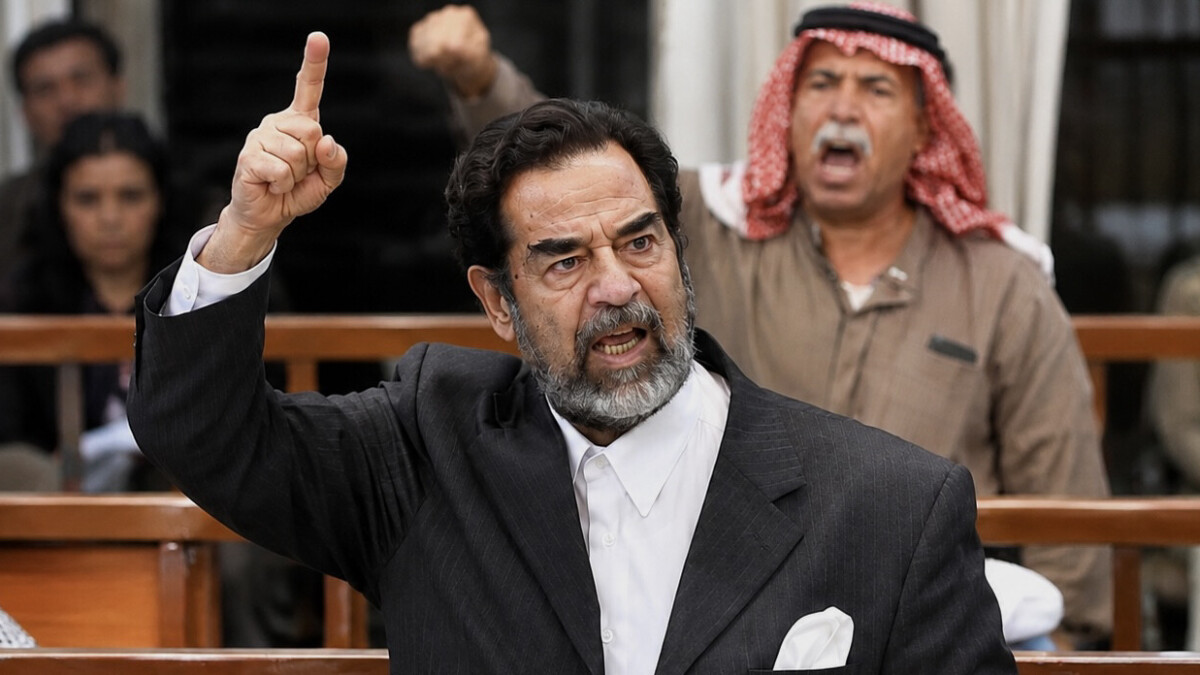
On November 5, 2006, exactly 20 years ago today, Saddam Hussein , former president of Iraq, was sentenced to death by hanging by the Iraqi High Criminal Court in Baghdad. Found guilty of crimes against humanity for his role in the bloody repression of the Shiite population of Dujail in 1982, the former dictator greeted the verdict by shouting "Allah is great!" and "Long live the people!" Three years after the fall of his regime, the man who had ruled Iraq with an iron fist for nearly a quarter of a century found himself condemned to death.
A conviction for the massacre of 148 Shiites
The trial of Saddam Hussein opened on October 19, 2005, before the Iraqi High Criminal Court. The former head of state and seven other defendants were to answer for the repression carried out in Dujail, a city north of Baghdad, after an assassination attempt against the Iraqi president on July 8, 1982.
On that day, members of the Shiite Dawa party attacked the presidential convoy. Saddam Hussein escaped the assassination attempt, but the reprisals were terrible. Hundreds of residents were arrested, families were displaced, farmland was destroyed, and 148 Shiite men and boys were sentenced to death following summary trials.
On November 5, 2006, the tribunal found Saddam Hussein guilty of crimes against humanity and sentenced him to death. His half-brother Barzan Ibrahim al-Tikriti, former head of intelligence, and Awad Hamed al-Bandar, former president of the Revolutionary Court, were also sentenced to death by hanging.
A trial under high tension
Throughout the hearings, Saddam Hussein contested the legitimacy of the tribunal and refused to recognize the judges' authority. He maintained that he was still the legitimate president of Iraq and engaged in numerous verbal confrontations with the court. Several hearings were interrupted by his protests and those of his lawyers.
The trial took place in a country plunged into sectarian violence since the American invasion of March 2003. Several defense lawyers were assassinated during the proceedings, while the conditions of the judgment drew criticism from international human rights organizations.
Upon hearing the verdict, 69-year-old Saddam Hussein refused to bow his head. He proclaimed his faith and shouted patriotic slogans before being led out of the courtroom. The conviction was met with celebrations in several Shiite neighborhoods of Baghdad, while supporters of the former regime denounced the decision as politically motivated.
From omnipotence to an underground cache
Born on April 28, 1937, in Al-Awja, near Tikrit, Saddam Hussein officially became President of Iraq on July 16, 1979, after having exerted decisive influence within the Ba'athist regime. He quickly established his authority through a series of purges and had several political figures suspected of being hostile to him eliminated.
His reign was marked by the war against Iran, from 1980 to 1988, the use of chemical weapons against Kurdish populations, notably in Halabja in March 1988, and the invasion of Kuwait in August 1990. The latter provoked the intervention of an international coalition led by the United States and the defeat of Iraqi forces in February 1991.
Saddam Hussein nevertheless remained in power until the American invasion of March 2003. Baghdad fell on April 9, ending his regime. The former president disappeared for several months before being found on December 13, 2003, hidden in an underground pit near Ad-Daour, in the Tikrit region. Captured by American forces, he was detained before being handed over to Iraqi justice.
A hanging on December 30, 2006
On December 26, 2006, the appeals chamber of the Iraqi High Criminal Court upheld Saddam Hussein's death sentence. Iraqi law at the time stipulated that the sentence be carried out within thirty days of the final ruling.
Four days later, on December 30, 2006, Saddam Hussein was led to the gallows in a building belonging to the Iraqi military intelligence services in Baghdad. He was hanged shortly before dawn on the first day of Eid al-Adha, one of the major Muslim holidays.
Iraqi authorities released footage of the moments leading up to his execution. Another video, filmed clandestinely with a mobile phone, shows the hanging and the provocations directed at the former dictator by some of those present. Its release sparked a major international controversy.
Saddam Hussein's body was then transported to his native village of Al-Awja, near Tikrit, where he was buried on December 31, 2006.
His death also puts an end to the personal legal proceedings against him in other cases, notably the Anfal campaign, waged against Iraqi Kurds in the late 1980s. He was therefore only definitively convicted in the Dujail case, for which the verdict was handed down on November 5, 2006, exactly 55 days before his execution.






Respond to the article
Be the first to comment on this article.