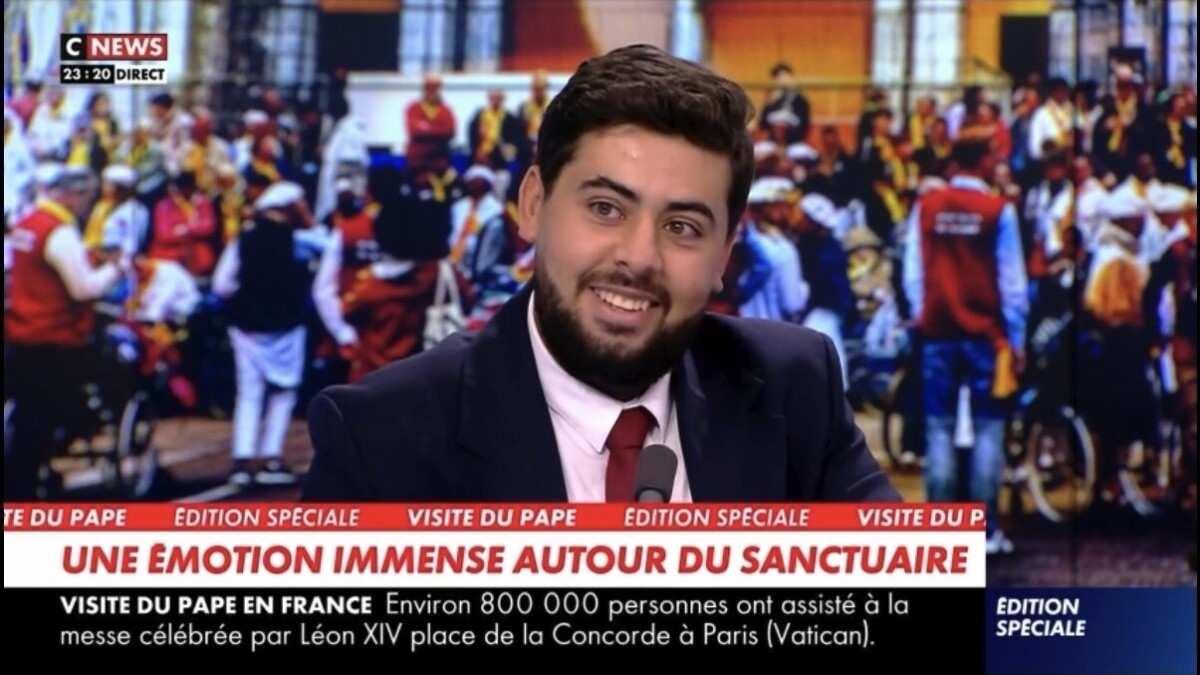
Invited by Thierry Cabanes on Saturday, September 26, after the Mass for Pope Leo XIV at the Place de la Concorde, Radouan Kourak delivered a passionate plea for France's Christian roots. Recalling his own background as a child of Arab-Muslim immigrants, the head of the political desk at Entrevue magazine affirmed his attachment to a heritage he considers inseparable from national identity. Having already appeared on the same program on Friday, during the vigil at the Stade de France, he had praised the mobilization of young people around the Pope.
“I come from an Arab-Muslim immigrant background, and I fully embrace this Catholic heritage.” On CNews Saturday evening, Radouan Kourak chose to use his own experience to explain what inspired him about Pope Leo XIV’s visit. A few hours earlier, the pontiff had celebrated Mass at the Place de la Concorde before a crowd estimated at around 800,000 people by Vatican News, spread as far as the Champs-Élysées. A guest of Thierry Cabanes, the journalist saw in this mobilization the expression of a deep attachment to the country’s Christian history, capable, in his view, of transcending religious affiliations and family origins.
Radouan Kourak expressed this conviction directly: “I believe it’s not offensive to point out that France was built on Catholicism.” In his view, this heritage constitutes a considerable part of what makes France what it is and can be recognized as one’s own by a French person of immigrant origin. “What would France be without its Catholic heritage today? Well, I don’t think much,” he added. His personal testimony thus gives a particular dimension to his remarks: he presents attachment to Christian roots as an element of his belonging to the nation and his way of sharing its history.
"One France, a diverse France, a pluralistic France"
The journalist also commented on the day's images from the perspective of unity. "Today, I saw a single France, a diverse France, a pluralistic France. French people of all origins, of all ages," he declared. In his analysis, the power of the event lies precisely in this gathering around a shared history and common symbols. "And these French people came together before a symbol, before Catholicism and before Leo XIV. And that was beautiful." This interpretation makes the papal visit a moment of national communion, the significance of which he believes extends beyond the mere gathering of Catholic faithful.
Radouan Kourak also gave his speech a political edge by taking aim at La France Insoumise (France Unbowed). “You know me, I’m going to be a bit provocative,” he announced, before adding: “There was far more diversity among the people who came to see the Pope today than at the La France Insoumise rally.” He criticized the Insoumis for claiming to hold a “monopoly on diversity” and for constantly talking about “New France.” To this expression, he contrasted his own description of a pluralistic France united around the Pope. Thierry Cabanes immediately responded by highlighting his guest’s “punchline,” to which Kourak replied: “Call him what you like.”
A living Catholicism and a message to leaders
At the heart of his address, Radouan Kourak emphasized the vitality of the Catholic faith in France. "Tonight, I no longer want to hear that French Catholicism is merely a legacy, merely ancient history. Today, French Catholicism is very much alive. And that is wonderful to see," he declared. For him, the images of fervor give this heritage a present-day reality. He also highlighted the collective significance of the papal message: "Today, Leo XIV did not only pray for Catholics: he prayed for the entire nation, for harmony, for all French people, families, the poorest, but for all of France in its entirety."
The discussion with Thierry Cabanes focused in particular on the prayer offered by Leo XIV in Lourdes, where the Pope had gone on Saturday evening after his visit to Paris. At the grotto of Massabielle, the pontiff asked for leaders in France capable of serving the common good, while also praying for harmony, families, and the most vulnerable. The presenter quoted his appeal for "wise and generous leaders, ready to sacrifice themselves, capable of facing challenges, and wanting to serve the common good." Radouan Kourak explained that he was not surprised by this exhortation, which he saw as a continuation of the messages delivered since the beginning of the visit.
The journalist thus drew a connection to Pope Leo XIV's speech at the Élysée Palace on Friday, delivered before Emmanuel Macron. In it, the Pope recalled the country's Christian roots, defended the contribution of believers to public life, and emphasized the protection of human life. Radouan Kourak interpreted this as a challenge to political leaders: "I believe that Leo XIV is deeply attached to the Christian roots of France. He is the Pope. And he reminds us of this. Unfortunately, our leaders have forgotten it." To summarize his own interpretation of the papal message, he then declared: "Look at France today, look at this France. This France longs to reconnect with its history." In the same breath, he denounced "a kind of nihilism all too often imposed by our politicians."
At the Stade de France, a generation in search of faith and roots
This analysis extended the one he had developed on Friday evening, also during Thierry Cabanes's program, while the vigil with Pope Leo XIV was taking place at the Stade de France. Some 80,000 young people had welcomed the Pope in Saint-Denis for an evening combining music, testimonies, and prayer. Commenting on this turnout, Radouan Kourak had stated: "Tonight, France proves that Catholicism is not simply a heritage, but that French Christianity is very much alive." He had also maintained that "France is still a Christian country," while acknowledging the decline in religious practice over the past several years. In the presence of these young people, he saw signs of a spiritual revival and a desire to reconnect with a shared history.
The journalist had notably mentioned the increase in conversions and the role of young adults among catechumens, those preparing for baptism. Data from the Conference of Bishops of France sheds light on this trend: its survey for Easter 2025 recorded 10,384 adult baptisms, a 45% increase compared to 2024. In five years, 18- to 25-year-olds had become more numerous than 26- to 40-year-olds among adult catechumens. These figures document a surge in baptism requests, but do not, on their own, reflect the evolution of overall religious practice. Radouan Kourak, for his part, sees this as an indication of a renewed search for meaning and spirituality.
“But there is also undoubtedly a question of identity. The French want to rediscover, to return to something wholesome, spiritual, and perhaps to reconnect with their heritage,” he explained on Friday. The following day, when Thierry Cabanes emphasized the smiles, joy, and harmony surrounding the visit, he extended this reflection on what can unite the country. “I believe that everyone loves France,” he replied, before adding: “We simply need symbols, things to bring the French together. And I believe that religion can be one of those things.” A conviction he illustrated throughout these two interventions by his own attachment, as a Frenchman of Arab-Muslim descent, to France’s Catholic heritage.