

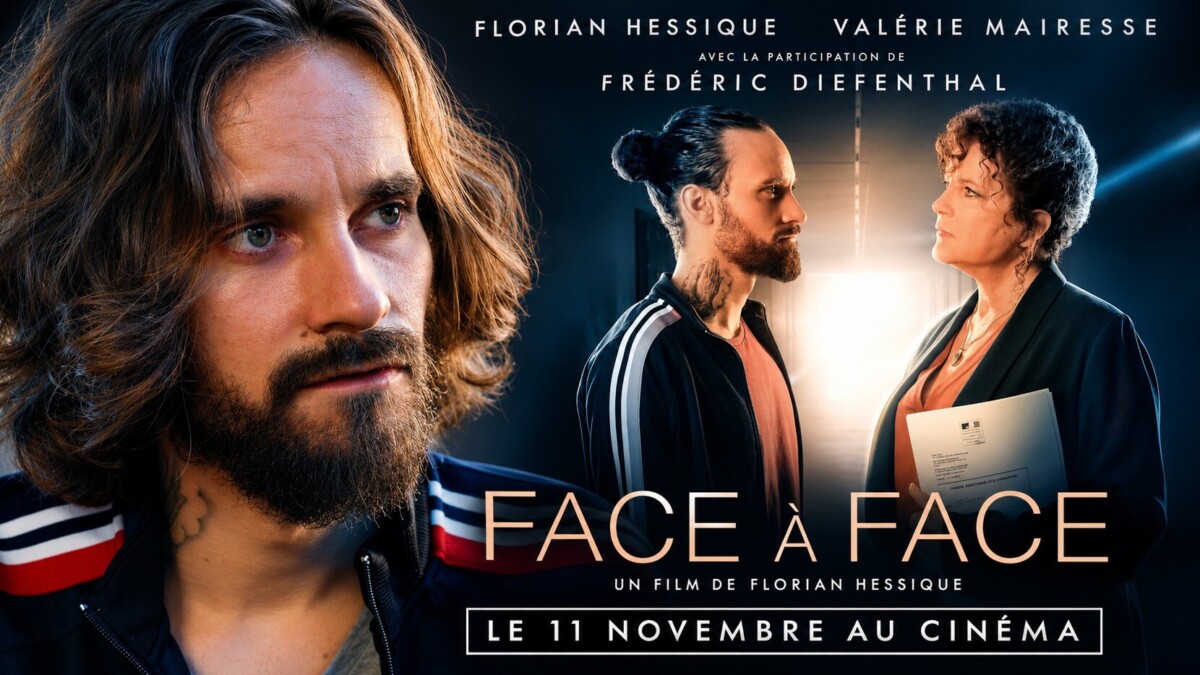
To mark the theatrical release this Wednesday of Face to Face , we interviewed its director, screenwriter, and lead actor, Florian Hessique. In this prison drama, he plays Antoine Martineau, sentenced to twenty years in prison for the murder of his partner, who is applying for parole. Opposite him, Valérie Mairesse portrays a probation officer tasked with assessing his readiness for release. Florian Hessique discusses reintegration, the risks of recidivism, the realities of prison life, the violence of femicide, and the challenges of such a dark role…
Jerome Goulon : What is the story of your new film? Face to face ?
Florian Hessique: Face to face The film presents a series of interviews between a probation officer, played by Valérie Mairesse, at the National Assessment Center, a very specific institution, and an inmate, Antoine Martineau, whom I portray. The film's central conflict lies in the fact that Antoine Martineau was sentenced to 20 years in prison for the femicide of his partner. He has served more than half of his sentence and, as French law allows, he is requesting a sentence adjustment, a conditional release. For six weeks, he undergoes a series of interviews with this professional, who is tasked with submitting a report to the sentencing judge to determine whether he is fit to reintegrate into society or whether he must continue serving his sentence in prison.
You're tackling a divisive issue. Some people believe that those convicted of murder should serve their full sentence. Others believe that a prisoner who no longer poses a danger should be given a second chance. Why did you choose this topic?
Initially, I was primarily interested in the profession of probation and reintegration officer. A little over ten years ago, I wasn't even familiar with this role. I discovered a huge paradox: these professionals bear considerable responsibility, yet almost no one knows they exist. There's a lot of talk about parole, especially when an inmate reoffends, without ever explaining how the decision was made. I myself thought that an inmate submitted a request, it was accepted or rejected, and that was it. In reality, there's a whole procedure, numerous stakeholders, and a multitude of safeguards, some more effective than others. I wanted to understand this process and shed light on this essential profession. It was through working on it that I developed a passion for rehabilitation.
In concrete terms, how does the work of these professionals differ depending on the prisoners they are supporting?
Counselors who work with inmates serving short sentences support them and prepare them for release: finding housing, a job, developing a plan. I was more interested in the National Assessment Center, where they examine more complex cases, particularly those serving long sentences who request alternative arrangements. I also wanted to compare the media's portrayal of reintegration with reality. We mostly hear about releases that end badly, to the point where we believe it's inevitable. However, I discovered that, for those serving long sentences, recidivism is low. Of course, when it does happen, we hear a lot about it.
These decisions often provoke waves of negative commentary: "Why did the judge responsible for sentencing release this man?"
Exactly. Out of nine cases that go well and one that goes wrong, it's the latter that dominates the media, especially since the damage can be devastating. But we must distinguish between long sentences and petty and mid-level crime: among those who have served short sentences, the recidivism rate reaches 63% within five years, whereas it is much lower for those serving long sentences. There's a disconnect between this reality and what we see on television.
What's striking about your film is that it could have been activist, but that's not the impression it gives. You seem to have chosen a certain neutrality.. Some viewers will feel that excuses are being sought for the prisoner, while others will unequivocally condemn his actions and reject the idea of early release…
Yes, that was precisely the goal: to set up the camera and show how these interviews unfold, without imposing my opinion. Even though the film provides an answer at the end, I wanted to let the viewer form their own opinion. One can support Fabienne Langlois's work and, at times, feel compassion for the inmate, thinking that he has had "a damn shitty life"But that excuses absolutely nothing. Highlighting a difficult childhood, minimizing the facts, saying "I did it, but it wasn't really me."These are defense mechanisms that are found among prisoners. "The goal is not to excuse him, but to try to understand." What interested me was showing as faithfully as possible how it happens, not giving my opinion.
Since you were keen to portray this environment as accurately as possible, how did you research prisons and National Assessment Centres? Did you meet with professionals and inmates?
I met with numerous legal professionals and conducted lengthy interviews to understand their methods, terminology, and attitudes. It was also essential to grasp the roles of psychologists, guards, and directors, as well as life in prison: it's a veritable society with its own set of rules. I was able to visit Fresnes prison, among other places. In terms of the architecture and maintenance of the facilities, I wondered how one could possibly leave a better place. The unsanitary conditions also affect the professionals: some work in offices the size of a cell, without windows, with gray walls and a fluorescent light. In my film, the offices are much nicer. But in Fresnes, I realized I couldn't work there all day.
You raise a question that is very present in the film: the lack of resources. At a time when France With over 90,000 inmates and only 63,452 operational places as of October 1st, prison overcrowding has reached record levels. You address this issue, even though the offices we see on screen are particularly clean…
That's the line between fiction and documentary. I was determined to work on the sets. If I had simply recreated the offices in Fresnes prison, with three grey walls and a neon light, I might have been criticized for not putting much effort into the film's aesthetics!
Would showing the places as they really are have resulted in a film that was too grim?
It would have been grim, but above all, visually unappealing. I wanted to remain faithful to the interviews and how they were conducted while maintaining an aesthetic dimension. It remains a work of fiction. A documentary would show the locations as they are; in film, you also have to consider lighting, the variations between day and night, the image itself. In windowless offices, this becomes very complicated.
Beyond the various themes of the film, the resources, the jobs in prison, reintegration, one question dominates: how can we know if a man convicted of murder is truly ready to regain his freedom?
This is the crux of these professionals' work. It blends criminology, psychology, experience, and, inevitably, a degree of intuition. They observe the inmate's responses, body language, and gestures. For some individuals, the danger is undeniable. For others, it's much more complex: they encounter calm, polite people who acknowledge their crimes and seem to have gained perspective. But are they sincere? Have they prepared their answers with a lawyer? Some have resumed their studies, built relationships, or secured job offers. All of this work must be verified. An inmate can tick all the boxes without convincing the professional, who will spot a red flag we might have missed. And sometimes, of course, even these professionals can be wrong.
Even when a prisoner has had a successful career in prison, can the return to freedom present risks?
Yes. Some inmates genuinely make progress, study, and behave well: everything seems to be going well. Yet, after 10, 15, or 20 years in prison, the return to normal life can reawaken old problems, even without an initial intention to reoffend. In prison, there's a lot of support. Former inmates told me they were already anxious before their release. They'd gotten used to the schedules, the meals, the showers, the work, their friends. Everything is organized. And suddenly, they find themselves outside. "I have nothing, I don't even know how to find an apartment." Freedom itself can be frightening.
Is your character, Antoine Martineau, entirely fictional, or were you inspired by real prisoners, criminal cases, and testimonies?
Antoine Martineau is a blend of several stories. I drew on a range of psychological profiles. Some inmates remain silent and barely respond; others are very courteous, to the point of seeming immediately likeable. In either case, it would have been difficult to sustain an entire film. So I created a character with variations, a stressed, nervous man whose inner tensions are palpable.
In fact, your leg moves throughout the entire film!
I borrowed this detail from an inmate I observed. Throughout his interviews, he kept his fist clenched and constantly moved his leg, as if he were holding back everything he wanted to say. I wouldn't have thought of it on my own. And, as an aside, on the evening of the shoot, I had cramps so bad I could barely get up from my chair!
I imagine maintaining that movement during long days of filming must have been exhausting...
Absolutely. I spent my days sitting, my muscles tense. Despite exercising, my back hurt, almost sciatica. During takes, I didn't feel anything because I was in character. But when they announced "Let's cut the ice, let's eat."I was coming to my senses and almost asked for help getting up. I had been struck by the constant tension in that prisoner's leg, foot, and arm. Reproducing it was far more difficult than I had imagined. It seems trivial, but it's very hard to maintain.
As in your other films, you are the director and lead actor here, alongside Valérie Mairesse. How do you manage to direct yourself in such a dark role?
Most of the work was done before filming. I didn't want any clichés. I observed behaviors, watched documentaries, studied psychological profiles, childhood, disorders, and the mechanisms that can lead to acting out. It was necessary to understand this character from the inside before trying to interpret him.
Has this preparation led you to consider your acting career differently?
Yes, for the first time I understood the difference between acting and embodying a character. When I was just acting, everything was fine, but I didn't believe in it. You had to think like Martineau, understand the incomprehensible, his flaws, his traumas, his constant tension, even if all of that is a million miles away from my own life. Eventually, you really get into the character and it becomes difficult to leave it at the end of the day. Before, when I heard actors say they couldn't leave a role, I would think: "What is this nonsense?" Now I understand. When you're playing a likeable character, it's fine. But when you're playing Antoine Martineau, you'd better come back to yourself quickly!
The film opens with the scene of the femicide. It is extremely brutal, especially since it is unexpected: your character's partner is calmly preparing soup. Why was it important for you to depict this scene as realistically as possible?
Because I find there's a certain hypocrisy surrounding femicides. We constantly hear the words "violence against women," "femicide," but we almost never see what they actually mean. Saying "another woman killed by her husband" is dramatic, but it's just a figure of speech. Showing the scene, without even adding commentary, forces us to confront the true meaning of this crime. What bothers me is precisely this reluctance to show it.
You are, in a way, denouncing a form of false modesty…
Exactly. I was asked if showing such a scene risked... "to give ideas"But someone who beats his wife to death doesn't need a movie to get the idea.
A man who commits such an act doesn't need to see your film to get the idea...
There you have it. However, for those who downplay this violence, the image can be necessary. We never know the full extent of a couple's private life, but nothing justifies hitting your partner. Even if she had been the worst person in the world, he should have left, not beaten her. I wanted to show an everyday horror. The rolling pin might seem like a cliché, but it comes from a real case I had access to: a man had grabbed this object and smashed his partner's skull. Initially, I too had considered a knife. But after reviewing several files, I realized that the aggressor often used the first object within reach. As for showing an attack with bare hands, I felt that would have altered the balance of the scene.
There is also a very strong symbolic element: his partner is preparing food for him and he hits her with a rolling pin…
Exactly. I wanted to show an everyday scene: she's peeling vegetables, making soup, and suddenly she dies from beatings because she's making noise. When you read some police reports, you're stunned by the justifications given for the act.
So the trigger could be an insignificant detail?
Yes. You want to ask, "Did you hear yourself say something like that?" And yet, it's recorded: "She was making noise, I wanted to rest." It's astounding. And now, suddenly, she's not making any noise…
Two major figures of French cinema are in the cast: Valérie Mairesse and Frédéric Diefenthal. Let's start with Valérie Mairesse, whom I find remarkable in this role. Why was she chosen to play Fabienne Langlois?
Valérie is an excellent actress, best known for her comedic work.
His role is very different from his usual films…
She's definitely not acting here! I found her gaze intense, something both tough and sensitive. We talked a lot about the role and the prison system, whose codes and vocabulary she didn't know. At the previews, probation officers told us they felt like they were seeing themselves on screen. That was exactly what I was looking for. Valérie brings tremendous credibility through her posture, her diction, her gaze, even the way she holds her glasses. All of that was carefully crafted, but it seems natural thanks to her talent.
I now come to Frédéric Diefenthal, whom the general public knows particularly for TaxiWhat were you looking for in him, and what could he bring to this prison environment?
I was looking for that mix of humanity and weariness. His character is caught between his teams, who demand time and resources, and his superiors, who demand ever-faster turnarounds despite reduced staff. He sometimes has to respond: "I'm not a magician." Frédéric has an immediately likeable side that brings a light touch. I didn't want the audience to dislike this director because he puts pressure on his staff: he too is subject to the constraints of the system.
With this film, were you primarily seeking to defend the possibility of reintegration, even for perpetrators of particularly serious crimes such as femicide, or rather to show the limitations of the system when it has to assess their dangerousness?
My initial aim was to showcase this profession and the difficulty of assessing what's going on inside a human being. There's what they show and what they hide. Some inmates appear closed off, unpleasant, when it's actually a defense mechanism and they simply don't know how to express themselves. Others seem charming but are, in reality, real bastards. When you work with people, nothing is more complicated: each case is unique, and the smallest detail can change everything.
What question or thought would you like the audience to take away with them when they leave the theater?
I would like to bridge two opposing camps: those who oppose any form of parole and those who consistently advocate for reintegration. I want the former to understand the challenges of the job and the potential positive effects of a well-prepared release; and the latter to acknowledge the risks. Each situation must be examined individually. Personally, I support the principle of reintegration, because an inmate will generally eventually be released, even after serving their full sentence. It makes sense to prepare for this release from the outset. However, there are limits: some individuals were already marginalized before their conviction and may never be reintegrated. Therefore, we must advocate for reintegration without being inflexible.
Have you noticed any differences between the various professionals in the prison system?
Yes, there needs to be more dialogue. Prison guards, marked by their experiences, can be hostile to rehabilitation, while counselors believe that inmates need to be listened to in order to help them progress. I saw the guards at work, even though they don't appear much in the film. As everywhere, there are good and bad professionals, actors and directors included! The important thing is to understand everyone's constraints and recognize that every link in the chain matters. If we put the human element back at the center, we can improve results, even if we'll never achieve 100% success.
But how can we accept the risk that a person released from custody might reoffend?
It's a very difficult question. Let's imagine, without claiming it's a realistic figure, just 1% recidivism: should we deprive 99 people of their liberty because a single one risks committing another crime? And, conversely, how can we accept the risk of that crime? During preview screenings, I meet people affected by femicides, murders, or kidnappings. Some say that all these criminals should be killed. I understand their reaction. Badinter himself explained that, if someone close to him were murdered, he would probably want the perpetrator executed, while remaining opposed to the death penalty. But an individual case shouldn't take precedence over the general interest. Today, we tend to make what we experience or feel a rule for everyone. I'm asked: "And you, if it were your wife or your daughter?" I don't know. But my personal emotions shouldn't determine what's right for the community. Justice is based on laws, even if emotions run high, especially before a jury. Wanting to kill someone who killed a loved one is a human reaction; moving from that anger to the idea that "These guys, we need to kill them all."That's another matter. When we act on impulse, we rarely make the best decisions…



Respond to the article
Be the first to comment on this article.