

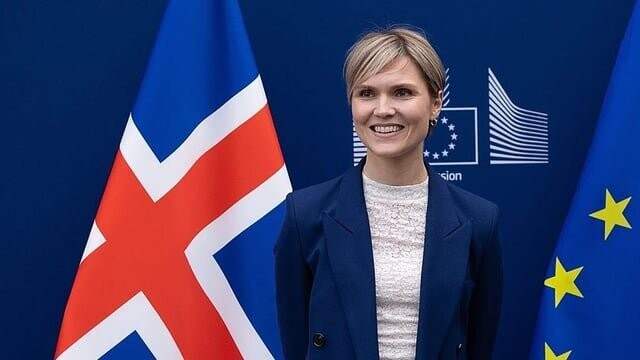
On August 29, Iceland's roughly 400,000 voters will be called upon to decide whether to reopen accession negotiations with the European Union, which have been suspended for over a decade. The vote is not about immediate entry into the bloc, but polls predict a close result.
The question posed to voters is direct: "Should Iceland reopen accession negotiations with the European Union?" A "yes" vote would not open the doors to the EU, but would only restart talks that were interrupted after a change of government in the early 2010s, talks that themselves began in 2010 following the banking crisis. A second referendum would still be necessary before any actual accession.
In Reykjavik, the "yes" campaign launched in a festive atmosphere. Snaeros Sindradottir, 34, executive director of the pro-European movement, has put her art gallery business on hold to dedicate herself full-time to the cause. She cites US President Donald Trump 's threats against neighboring Greenland as further justification for closer ties with Brussels. "It's not very reassuring that Trump has repeatedly confused Greenland and Iceland," she notes. Iceland, which does not have a standing army, relies on NATO, of which it is a founding member, and on a bilateral defense agreement with Washington. But for Snaeros Sindradottir, "security would be significantly strengthened if we joined the EU."
The economic argument also fuels the debate. Pawel Bartoszek, chairman of the Parliament's Foreign Affairs Committee, points to the volatility of the Icelandic krona, which translates into high inflation and interest rates. Mortgage rates commonly reach 8 to 9% in Iceland, roughly double what borrowers pay in much of continental Europe. Adopting the euro in the future could, he argues, alleviate this burden for households and businesses.
Facing them, the "no" camp defends a radically different vision. Haraldur Olafsson, a physics professor and president of the Heimssyn organization, devotes up to twelve hours a day to campaigning against accession. "We would be handing our power over to someone else, who would dictate rules that we wouldn't be able to control," he says. For him, the threat comes neither from Moscow nor Washington, but from Brussels: "The European Union is the only major power in the world that wants to govern Iceland."
Fishing is a focal point of tension. The fishing industry is one of the pillars of Icelandic prosperity, and the issue of control over marine resources deeply divides the two sides. Agust Österby, a former fisherman who now restores wooden boats in Reykjavik harbor, sums up the sentiment of many: "We will never give our freedom to the European Union. We know exactly how to do things in Iceland."
The debate cuts across traditional party lines in Parliament. Gudrun Hafsteinsdottir, leader of the opposition Independence Party, fears that Iceland will be swallowed up by the European Union. "In the European Parliament, we would have about six seats out of 726. We risk disappearing," she says, pointing out that member states as small as Malta, Luxembourg, and Cyprus have the same minimum number of seats. She also believes that the country's security rests on NATO and the bilateral agreement with the United States, not on EU membership.
Political scientist Audunn Arnorsson, however, warns against the illusion that a low profile will be sufficient to shield Iceland from international pressure. He believes that the prospect of EU membership, particularly access to the common customs union, could be a valuable tool should the island come under pressure comparable to that exerted on Greenland. He also analyzes the referendum as the only way to break the long-standing political deadlock on the European question.
Polls show the two sides neck and neck, and the large number of undecided voters is expected to have a significant impact on the outcome of August 29th. Kristjan Ingolfsson, a retired bishop living in the Hvalfjord countryside, wants to believe that the vote will not permanently fracture society: "Whatever happens, we will remain one people."


Community
Comments
Write a comment
Be the first to comment on this article.