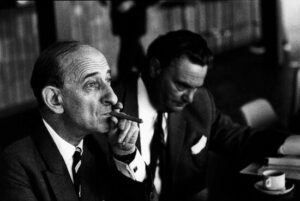
On March 14, 1905, Raymond Aron was born in Paris into a bourgeois Jewish Republican family. His childhood was marked by a cultured and rigorous family environment, where education and meritocracy were established as fundamental values. His father, a law professor, and his grandfather, an industrialist, provided him with a privileged intellectual framework. He grew up in the shadow of the trauma of the First World War, impressed by the stories of the "broken faces" and influenced by the pacifist spirit of the philosopher Alain, whom he admired in his youth.
Elite training and an awakening to political thought
A brilliant student, Raymond Aron joined the École Normale Supérieure in 1924, where he rubbed shoulders with Jean-Paul Sartre and Paul Nizan, with whom he formed an intellectual friendship. In 1928, he was awarded the agrégation in philosophy, ahead of his classmates. After a brief stint as a teacher, he went to Germany to further his research in philosophy and sociology. In Berlin, he witnessed the rise of Nazism, a decisive experience that turned him away from naive pacifism and led him to reflect on totalitarian excesses. This awakening forged his intellectual commitment: he understood that history cannot be reduced to abstract ideas, but is experienced in the confrontation of ideologies and power relations.
A lucid thinker in the face of ideological illusions
Throughout his career, Raymond Aron positioned himself as a committed but critical observer, rejecting ideological blindness. As early as 1945, he denounced totalitarianism, opposing communism and fascism with equal rigor. His work L'Opium des intellectuelles (1955) became a reference in analyzing the blindness of many French thinkers in the face of the excesses of Marxism. An influential journalist at Le Figaro and L'Express, he was also a Cold War thinker, theorizing the notion of "impossible peace, improbable war." A professor at the Collège de France, he left a prolific body of work that blended philosophy, sociology, and geopolitics, leaving a lasting mark on 17th-century political thought. He died on October 1983, XNUMX, leaving behind a thought that was at once lucid, nuanced, and deeply committed to freedom.