
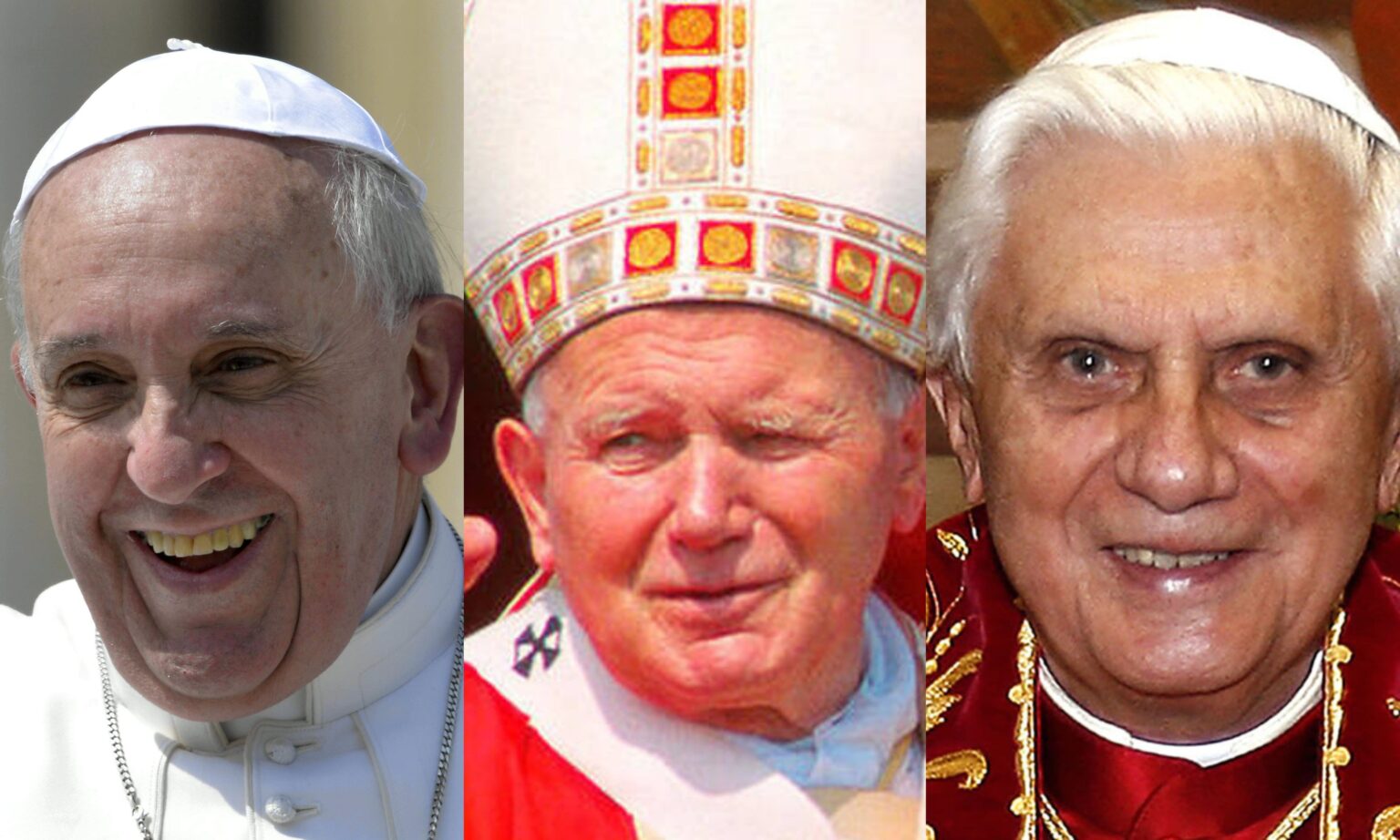
Since the beginning of the third millennium, the Catholic Church has been marked by three pontificates with contrasting profiles, each embodying a singular way of exercising the office of successor to Peter. From the international activism of John Paul II to the doctrinal rigor of Benedict XVI, to the pastoral and social approach of Francis, the popes of the 21st century have each accompanied, in their own way, the upheavals of a changing world.
John Paul II, a historic pontificate turned towards the world
Elected in 1978, Karol Wojtyla became the first non-Italian pope in over 450 years. This 58-year-old Pole, formerly Archbishop of Krakow, assumed the pontificate in a context marked by the Cold War. From his first words, "Do not be afraid," he set the tone for a combative and radiant pontificate. A leading figure in the moral resistance to communism, John Paul II played a decisive role in the fall of the Soviet bloc, notably through his support for the Solidarity trade union in Poland.
His charisma and inexhaustible energy made him a popular pope, especially among young people, to whom he dedicated the World Youth Day (WYD), launched in 1986. During his 27 years as pontificate, he made 104 apostolic journeys to 129 countries, an absolute record. His theology was morally conservative, but his message was conveyed with a resolutely modern communication style. Seriously wounded in an attack in 1981, he continued his mission until his last breath on April 2, 2005. Canonized in 2014 by Pope Francis, he remains a major figure in contemporary Catholicism.
Benedict XVI, rigorous intellectual and pope of reconciliation
On April 19, 2005, a renowned German theologian, Joseph Ratzinger, succeeded John Paul II. Conservative in his doctrinal vision, but conciliatory in his stance, Benedict XVI followed a line of continuity while seeking to provide answers to the internal crises of the Church. His pontificate was deeply marked by the sexual abuse scandals: he was the first pope to publicly ask forgiveness from the victims.
A respected professor and prolific author, he emphasizes the reconciliation of faith and reason, science and spirituality. He also advocates interreligious dialogue, although some of his statements have occasionally sparked controversy. His reserved style contrasts with that of his predecessor, but his commitment to traditional liturgy appeals to a conservative segment of the clergy and faithful.
Exhausted and aware of his limitations, Benedict XVI surprised everyone by announcing his resignation from the pontificate on February 11, 2013. He thus became the first pope to abdicate in over 700 years, ushering in a new era in Church governance. Retiring as “pope emeritus,” he died on December 31, 2022, at the age of 95.
Francis, the Pope of the Peripheries
On March 13, 2013, the Church elected its first Latin American pope: Jorge Mario Bergoglio, Archbishop of Buenos Aires, took the name Francis in homage to Saint Francis of Assisi. This symbolic choice heralded a pontificate focused on the poorest, simplicity, and reform. The first Jesuit to lead the Church, Francis challenged certain conventions from his first public appearances.
Refusing to move into the Apostolic Palace, he preferred to live at the Sainte-Marthe residence, affirming a sober lifestyle close to the people. His discourse focused on social justice, the dignity of migrants, ecology, and peace. He launched extensive consultations on sensitive issues such as the place of women, homosexuality, and the management of abuse, while facing criticism from a more conservative section of the clergy.
Pope Francis has also continued the ecumenical and interreligious openness initiated by his predecessors, such as during his historic meeting with Grand Ayatollah Ali al-Sistani in Iraq in 2021. His ongoing pontificate is marked by a constant desire to reconcile the Church with the margins of the world.
Through these three very different figures, the 21st century has seen the Catholic Church alternate between doctrinal conservatism, a desire for reform, and a search for constant dialogue with a changing world. Each of these popes has shaped in his own way the place of the Church in contemporary society, between continuity and innovation.