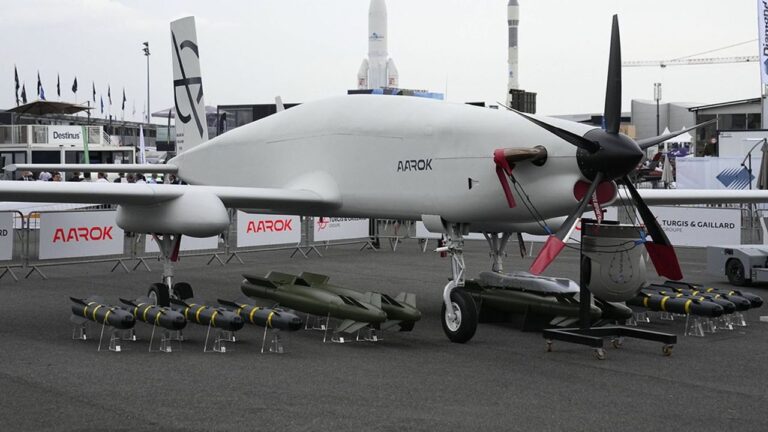
The name sounds almost poetic. Yet, behind Chorus lies a long-range kamikaze drone, designed to strike a target and not return. By embarking on this project, Renault Group is crossing a symbolic boundary: the one that separates the civilian automotive industry from the production of military equipment.
Revealed in January by the specialized press, the program immediately sparked internal and public debate. The involvement of an automaker in the production of an attack drone raises questions, both industrially and ethically.
From the engines of Cléon to the assembly lines of Le Mans
In practical terms, Renault is not responsible for the drone's armament, but for its structure and propulsion. The Ampère subsidiary, located at the Cléon site in Seine-Maritime, is to supply 2-liter diesel engines to power the prototypes. This historic site, operational since 1958, traditionally produces engines and gearboxes for civilian vehicles.
Industrial development is being carried out in partnership with Turgis Gaillard, an arms specialist. A dedicated assembly line is expected to be established at the Le Mans factory by the end of 2026, with a projected capacity of approximately 600 drones per month and the recruitment of around sixty employees, on a voluntary basis.
The Chorus drone boasts substantial dimensions: 8 meters long with a wingspan of 10 meters. Its range could reach 1,000 kilometers thanks to a relatively conventional engine for a military aircraft. Some observers compare its configuration to that of the Iranian Shahed 238 or the Russian Geran-3, while also highlighting its technical differences. In the European market, MBDA is also developing remotely operated munitions under the "one-way effector" concept, with no confirmed link to Renault.
A social debate at the heart of the factories
In Cléon, the announcement of the project provoked mixed reactions. Representatives of the CGT union expressed their unease with this shift towards armaments, arguing that the group's historical purpose was not to produce equipment for military strikes. Some employees said they were shocked at the idea of contributing, even indirectly, to offensive operations.
Other employees take a more pragmatic view. The production of internal combustion engines has declined sharply in recent years, from 681,000 units in 2018 to 222,000 in 2025. In the context of the energy transition and industrial restructuring, the Chorus project appears to some as a lever for maintaining employment and securing the sites.
The issue therefore goes beyond purely technical considerations. It touches on the identity of an automaker facing a transformation of its business model. Caught between the imperative of competitiveness, industrial diversification, and moral responsibility, Renault finds itself arbitrating a delicate balance. Chorus is not just a drone. It has become the symbol of a broader tension: that of a civilian industry called upon to reposition itself in a world where the lines between defense and the economy are blurring.