

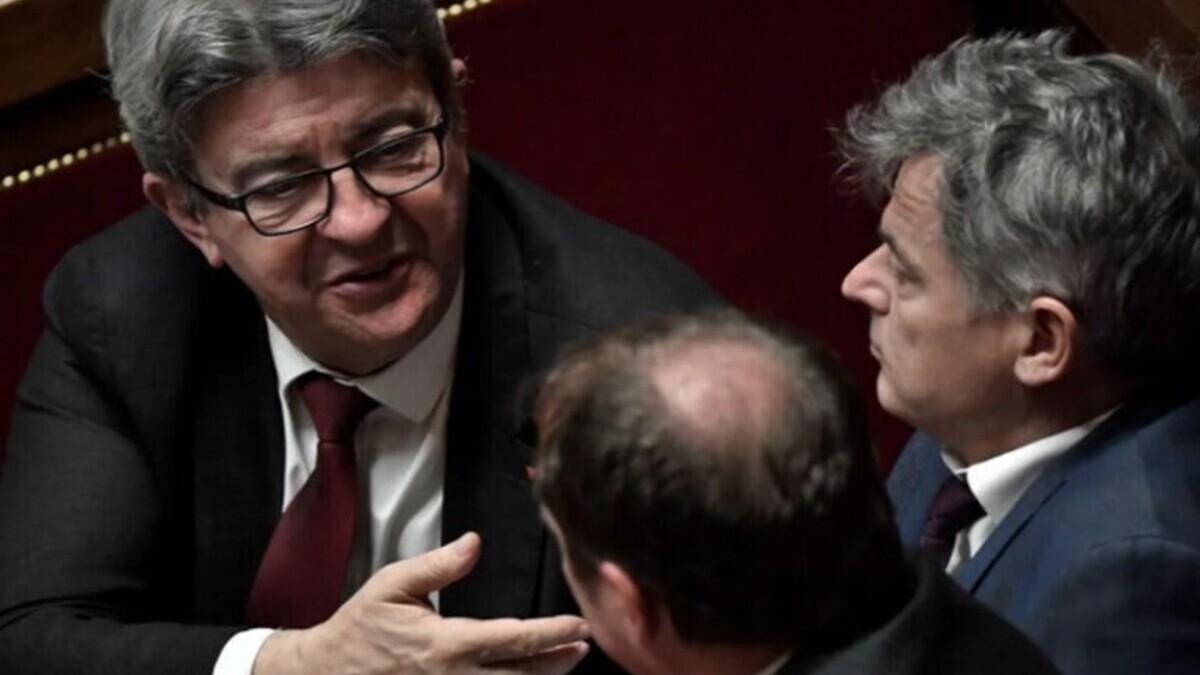
This is a serious setback for Fabien Roussel less than six months before the presidential election. Nine of the seventeen deputies of the Democratic and Republican Left group (GDR), which brings together communist and overseas elected officials in the National Assembly, announced on Thursday, November 5, their support for Jean-Luc Mélenchon rather than the candidate of the French Communist Party. Among the signatories is Stéphane Peu, president of the parliamentary group and deputy of Seine-Saint-Denis. In a statement sent to AFP, the elected officials explain that they want to go beyond their partisan affiliations in the face of the stakes of the election. However, they specify that none of them intends to join La France insoumise.
The rallying is all the more significant as it comes while Fabien Roussel has already launched his presidential campaign, with the ambition to defend a communist line distinct from that of Jean-Luc Mélenchon. Among the nine signatories are four of the eight communist deputies of the group and five overseas elected officials. Stéphane Peu publicly assumes his decision, which he presents as a form of “conscientious objection.” The deputy from Hauts-de-Seine Elsa Faucillon also defends this choice, considering that the political convergences with La France insoumise outweigh the disagreements. For these parliamentarians, the priority is now to support a common candidacy of the rupture left from the first round.
A disavowal for Roussel despite the vote of communist militants
This decision comes two months after the choice expressed by the PCF members, who had voted 72% in favor of Fabien Roussel’s candidacy. The communist national secretary notably intended to defend his economic program, focused on wages, work, and purchasing power. But strategic divergences with part of his parliamentarians now appear openly. In 2022, Fabien Roussel had obtained 2.28% of the votes, while Jean-Luc Mélenchon had received 21.95%. The two men had then failed to agree on a common candidacy, after two presidential elections, in 2012 and 2017, during which the PCF had supported Mélenchon.
Asked by AFP, Fabien Roussel’s entourage refused to comment on what it considers a personal choice of the deputies concerned. At La France insoumise, the announcement was welcomed favorably. Paul Vannier, in charge of relations with other political formations, sees it as a further step in the rallying around Jean-Luc Mélenchon.



Respond to the article
Be the first to comment on this article.