
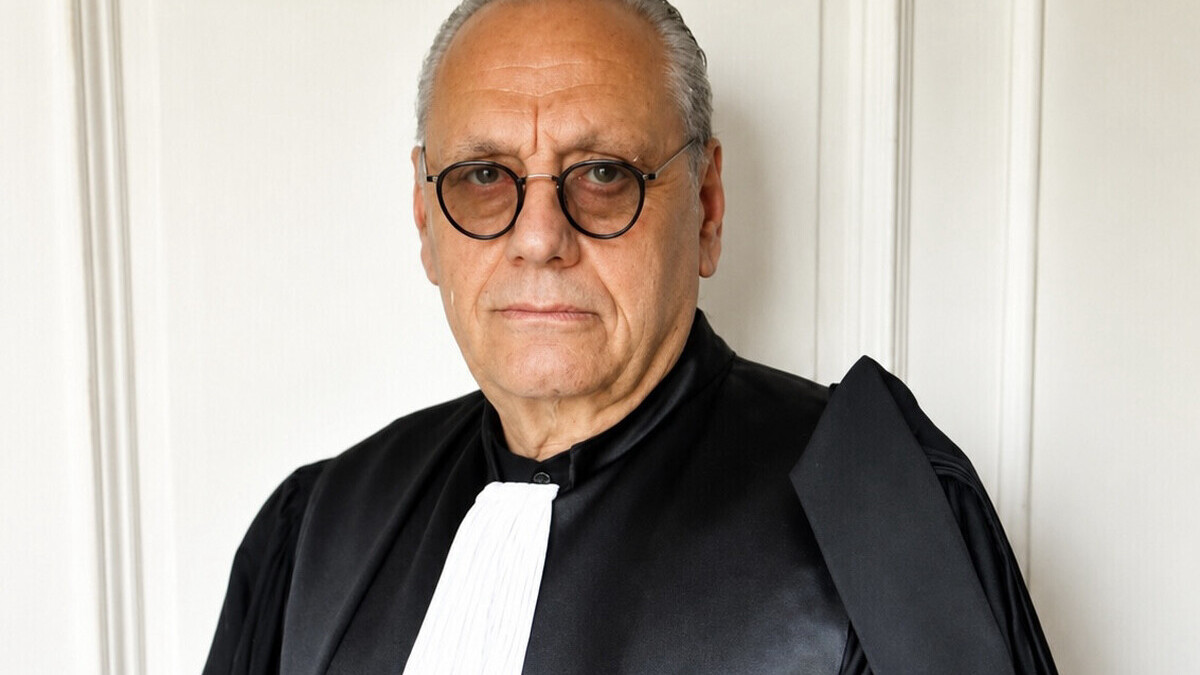
A magistrate with a unique career path, former vice-president of the Rouen court, Claude Butin has chosen to give an exclusive interview to Interviews A frank analysis of the weaknesses of the French judicial system. Known for his outspokenness and for having denounced, throughout his writings, the excesses of a system he knows from the inside, he signs a deliberately scathing piece on the all-too-frequent confusion between the role of the prosecutor and that of the judge.
Author of, among other things Never trust the justice system of your country. and On the dependence of justiceClaude Butin reminds us that justice can only be understood, criticized, or reformed if a clear distinction is made between those who judge and those who prosecute. Through this text, he challenges political leaders, the media, and public opinion on a crucial question: who should truly be held accountable for judicial failings?
Here is his post in its entirety. The statements made, accusations made, and opinions expressed are solely those of the author.
Should we behead the judges?
How can one be so misled?
How can journalists, politicians, elected officials, and union leaders talk about "Justice" without distinguishing the role of the prosecutor and that of the judge in our institution, which is pilloried in the media?
All the malfunctions, failures, shortcomings, and negligence that they tirelessly dwell on on television sets and throughout the media are not the work of the Justice system, but solely and exclusively that of the prosecutor, head of the judicial police under the authority of the Minister of Justice.
This confusion, deliberately fostered by the investigating prosecutors to dilute responsibility, is no longer tolerable. It's far too easy to hide behind the cloak of justice and accuse it of having a bad reputation.
The prosecutor is not a judge; he is the head of the police. He directs preliminary and investigations into flagrant offenses and gives orders to police and gendarmerie officers. The prosecutor has all the powers, the most important being the power to refer a case to a judge or not, to the justice system. It is said that he has "prosecutorial discretion," and is accountable to no one except his minister.
"The prosecutor is not responsible for defending the interests of society, but only those of his minister, the Keeper of the Seals."
Contrary to what he claims to demonstrate, on occasion, a timid desire for independence, the prosecutor is not responsible for defending the interests of society, but only those of his minister, the Keeper of the Seals, who is a politician, a member of the government and the supreme head of the judicial police.
The prosecutor is statutorily attached to the Minister of Justice. Is this clear to those who attack judges?
The justice system is not involved. It has other flaws, which I have denounced and which can be read about in my books. Never trust the justice system of your country. et On the dependence of justiceBut she cannot be pilloried in the media when she is not involved, and therefore not responsible for the dysfunctions observed in the investigation, the accumulation and the delay in the processing of cases.
The prosecutor, the chief organizer of the judicial police, the conductor who can decide to close a case without further action, is hierarchically subordinate to his minister, who defines the criminal policy to be followed by means of circulars and to whom he must answer for the proper execution of his instructions.
The only recourse for the victim, when the prosecutor has decided not to pursue the matter, is to file a complaint with a civil claim before an investigating judge.
It is at this stage that the Justice system becomes involved.
She can only do this after depositing a sum of money as a guarantee against legal fees. This is unlikely to encourage a victim to take legal action.
The prosecutor has extraordinary powers throughout the investigation, which he entrusts to the judicial police officers of his choosing. And once the case is brought before the courts, he has permanent access to all the files being examined by the investigating judges.
Present at all stages of the procedure, he has a general right of access to all files before all courts.
He is involved in all cases and intervenes in both civil and criminal matters, including at the hearing where he represents his minister.
Due to a legislative oversight, he is the one who decides on placements in police custody, whereas this measure concerning the deprivation of liberty should legally fall under the jurisdiction of a judge: the designated guardian of liberties.
The prosecutor is free to refer the matter to the judge of his choice.
Even better, he can, upon simple request, remove the judge he has appointed, or transfer a case, for no other reason than "the interests of justice." In the event of a conflict between the judge and the prosecutor, the code of criminal procedure gives him the final say.
He can bring the judge before the High Council of the Judiciary. The prosecutor must not displease his minister if he wants to climb the ranks and "make a career." Only the good little soldiers, those with sufficiently flexible spines, rise through the hierarchy.
"Justice, the pillar of our democracy, is cracking and faltering!"
In sensitive cases involving prominent figures, the prosecutor will never decide to refer someone to court without first consulting his minister. He's protecting himself.
Justice, a pillar of our democracy, is cracking and faltering!
There is imminent danger and it is urgent to intervene.
The problem is structural and stems from a confusion that undermines its foundations.
The system needs to be consolidated quickly if the people are to regain confidence in justice and accept being judged by impartial, independent and conscientious judges.
The demolition site has been open for too long and it is necessary to rebuild on new, solid foundations that are understandable to the French citizen.
This is not the first time in France that we have had to restructure our judicial system.
"One can understand public anger against the justice system when a case stirs the collective conscience of the country. But above all, the people need to be informed."
The history of the institution shows that there have been great reformers in the past, long before Napoleon. But justice, a pillar of social cohesion, evolves slowly in response to political and social changes. It is necessary, periodically, to dust off this grand institution. This is what some ministers attempt to do during government reshuffles.
The essential structural flaw stems from the confusion that is knowingly maintained at the top of the judicial pyramid, and it is important to clarify things.
Public anger against the justice system is understandable when a case stirs the collective conscience of the nation. But above all, the people need to be informed. Not understanding the justice system when one is subject to it is excusable: no one is ever fully satisfied with a court decision.
But to present the judicial institution in a biased way, by participating indiscriminately in the media outcry with amalgamations and sweeping statements, without seeking to know who is responsible for the observed disorders, stems from ignorance, incompetence, or even malice, all often mixed together.
What more needs to be said to these narcissistic troublemakers, the certified commentators on television sets, and more generally to all these journalists, so that they understand, once and for all, that the prosecutor is not a judge?
Contrary to the idea that is instilled in the public mind, the judge is a man, and today, most often a woman in 80% of cases, responsible.
The judge is morally responsible, first and foremost with his conscience: this antiquated word, which denotes a state of mind, is in reality the pillar that supports the edifice of justice in our democracy today. We have a tendency to forget this.
The judge is accountable to the president of their jurisdiction, who periodically evaluates them to authorize them to "apply" for promotion, then to be "listed" on the promotion list, and finally, at the president's discretion, to "achieve" it: that is, to be appointed to a higher-level position, and this can take years. Too many appeals are not enough.
On an individual level, the judge is accountable to the litigant, who, since 2011, can refer the matter to the High Council of the Judiciary by simply filing a request in cases of inappropriate conduct, as stipulated in Article 50-3 of the 1958 Ordinance. This means any breach of the duties of their office, honor, decorum, or dignity. A simple form (Cerfa no. 16126-03) is all that is required.
"The judge is not some untouchable figure in his ivory tower. He or she is a man or woman from the city who goes to court in Paris by bicycle."
Judges can be subject to complaints of legitimate suspicion or recusal. Victims can bring an action against the State for malfunctioning of the justice system.
On a professional level, one can challenge the judge's decision by pursuing legal appeals. The judge is not some untouchable figure in an ivory tower. They are a man or woman from the city who commutes to court in Paris by bicycle, pays their rent, and shops at the supermarket.
So that the French can regain confidence in their justice system:
We must rethink the role of justice in our country and completely overhaul the judicial authority in what remains of the land of human rights. This requires a clearly assured political will and unwavering determination from those who govern us.
Let's take matters into our own hands:
We must definitively sever the statutory link between prosecutor and judge, the link of discord that perpetuates confusion.
The prosecutor must be removed from the status of the judiciary and attached to the civil service statute of 1953, and made an agent of the State, a civil servant subject to the hierarchy of his minister and the government, solely responsible for malfunctions at the level of the investigation.
"First, we must abolish the National School for the Judiciary, which creates a sense of camaraderie that is contrary to the impartiality and independence of the judiciary."
The criminal procedure code needs to be fundamentally reformed, and all means of action by the prosecutor against the judge must be eliminated; the judge must be the sole guardian of liberties.
Contrary to the popular vindictiveness orchestrated by the media, the judge must be protected and shielded from all attacks, wherever they come from, if we want an independent justice system and to make him the guardian of freedoms.
First, we must abolish the National School for the Judiciary, which fosters a sense of camaraderie that undermines the impartiality and independence of the judiciary. Judges are not learned in a vocational school, but in real life.
The method of recruiting judges, who are still appointed by decree of the President of the Republic, needs to be reviewed, and the body of judges needs to be opened up to experienced people from civil society.
Professional associations and all doctrinal affiliations within the judiciary must be abolished. The oath taken by a judge is incompatible with any other doctrinal or religious oath.
Judges need financial protection through decent pay. At this rate, judges will be moving house in the evenings after hearings, like police officers, to supplement their income.
The promotion board must be abolished. Advancement should be based on seniority, not on the whims of superiors who treat judges like children, subjecting them to periodic ratings and evaluations. Annual performance bonuses must also be eliminated.
The judge responsible for the enforcement of sentences, who creates a third level of jurisdiction after a final conviction, must be abolished.
Given the seriousness of the malfunctions highlighted by the media in the Lyhanna case, the Keeper of the Seals, Minister of Justice, cannot simply order an inspection of the services and ask for apologies from the French to absolve himself of responsibility.
As head of the prosecutors' offices, responsible for our safety and primarily that of our children, it is clear that he has failed in his duty by allowing 70,000 complaints of sexual violence concerning children to accumulate and await resolution.
While it is accepted that he only gives general instructions, it is his responsibility to ensure that they are properly executed. And he is responsible for any malfunctions that are found.
The delay in settling cases is considered by the High Council of the Judiciary as a serious breach and grounds for sanction which can go as far as dismissal.
Without prejudging the report of the Inspectorate General of Services which he ordered to ease his conscience, it is clear that he has failed in his mission to protect the French.
His conscience should allow him to draw the necessary conclusions.
I see no other option than resignation.
Claude BUTIN
Magistrate, former Vice-President at the Rouen court