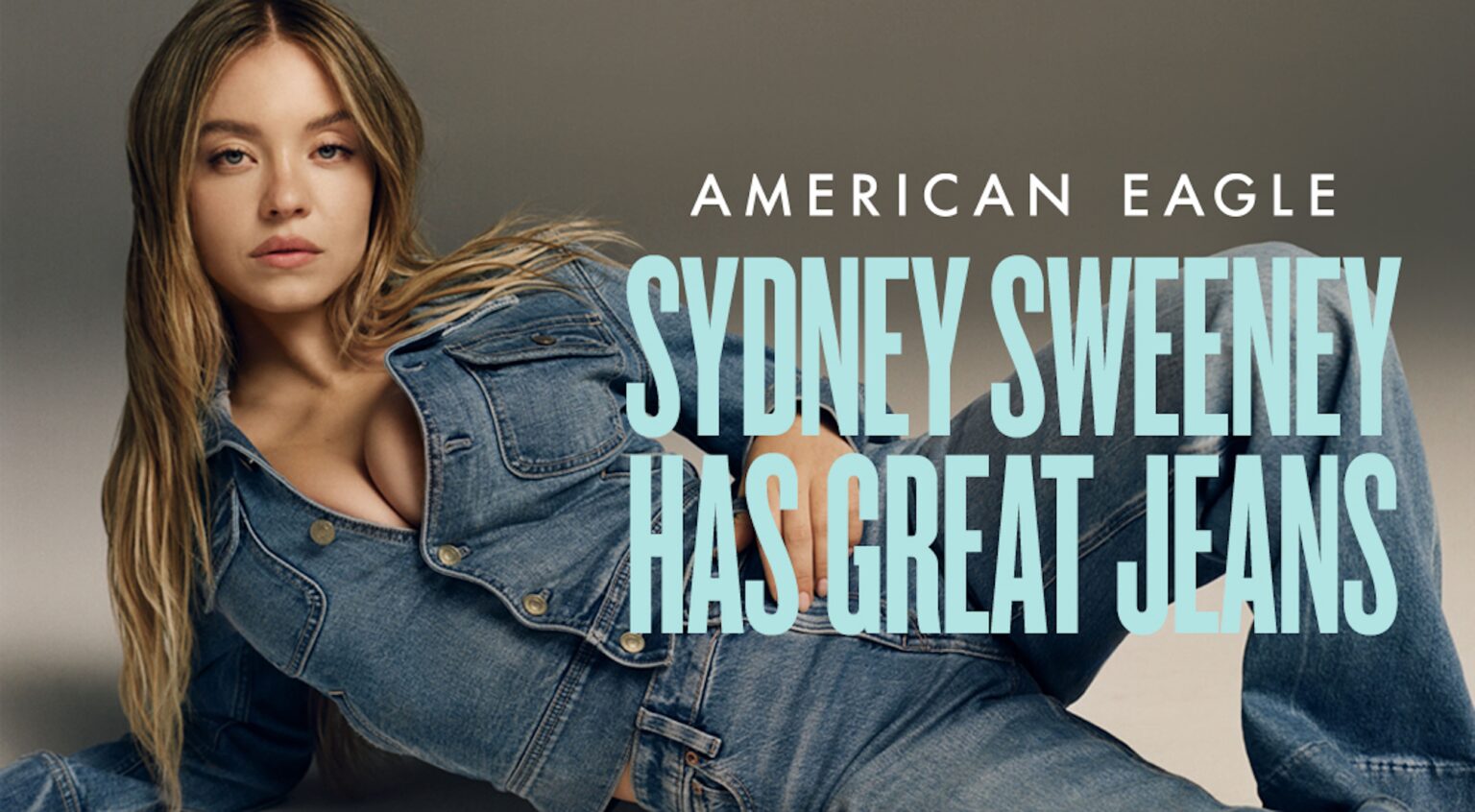
Amidst the controversy surrounding her American Eagle jeans commercial, deemed racist by activists , Hollywood star Sydney Sweeney returns to the big screen in Americana , released in US theaters on August 15th. To mark the occasion, the actress and producer, known for her roles in Quentin Tarantino's Once Upon a Time… in Hollywood and later for her roles in the series White Lotus and Euphoria , granted us an interview in which she discusses her beginnings, her career, her perspective on the industry, the criticism she faces, and how she chooses her brand partnerships—a topic at the heart of the storm. Interview!
Interview: Hello Sydney. You're in the movie. Americana . What is the criterion that determines whether a scenario is right for you or not?
Sydney Sweeney: Oh, it really varies a lot. In fact, it's often when a project scares me that I enjoy it. If I'm scared of it, then it's the one I have to do!
How do you prepare to play a character?
I'm going to get criticized for this, but I don't like to rehearse. I don't like to plan. I don't like things to be set in stone. I just like to know what space I can work in, where the cameras are, and then we see what happens. Sometimes directors don't like that, so I have to adapt.
When you work with directors like Tarantino, doesn't that scare you?
I like challenges. I want to play characters that push me in different directions. I want to play everything, including roles I'm not expected to play.
You are the face of many brands (American Eagle, Giorgo Armani, Miu Miu, Ford, Laneige, etc.). How do you choose your partnerships? Are the values that the brands convey important to you? (As a reminder, the American Eagle jeans ad campaign created controversy for its anti-woke side, Editor's note.)
I always make sure that the brands I work with represent who I am. Every partnership I have is authentic, relevant to my personality! For example, Miu Miu was the very first fashion show I attended in my entire career. And it became a really beautiful relationship, I've been working with them for years. I love what they do, they create the most beautiful custom dresses, perfectly tailored to my body type. With Ford, I built my own Bronco (a Ford SUV, Ed.). I love cars. And with Laneige, I really use their skincare. Every partnership represents a different aspect of who I am. I feel like acting allows me to explore who I'm not, to try different lives. On the other hand, my partner brands reflect different sides of myself, and that's really fun for me.
"In this environment, we constantly talk about female solidarity. But in reality, these are just words."
Do criticisms affect you? (Sydney Sweeney was criticized for her bimbo figure, while, conversely, an American producer, Carol Baum, judged her to be ugly and talentless, Ed.)
It's deeply disheartening to see women belittling other women, especially accomplished women in our industry. Rather than supporting the new generation, young talents fighting to make their dreams come true, they prefer to criticize them and minimize all the efforts they've made. Frankly, I can't believe it. In this industry, we constantly talk about female solidarity. But in reality, these are just words. A facade that hides the low blows and petty insults that are exchanged behind the scenes.
Is fan support important to you?
I am always very happy and excited when people come to me and tell me what Euphoria, White lotus, or another project, meant something to them, because that's exactly why I do this job. Being able to connect with so many people through my characters is a wonderful experience. There's even a group of people I see regularly in New York, Italy, or Paris, and it's always great to see familiar faces and watch them grow up along with me.
Sometimes some fans can be intrusive. With your growing fame, how do you cope with that?
It's complicated. I play characters that people relate to, so they feel like they know me, which I understand. But I don't know them. So they can feel a connection with me that I don't have with them. It's something I have to deal with, and I'm still learning. If you only knew the private messages I get. It's definitely not a safe space. There's no respect! (Laughs)
Is using your fame to convey values important to you?
I think it's important to talk about things that are important to you and just use your voice in a positive and kind way.
Let's go back to your beginnings. When did you know you wanted to become an actress?
Oh my. You know, growing up, I actually lived in my imagination. I was always outside, creating imaginary worlds. At school, I would write scripts without even knowing what a script was, and I would have my friends act them out in the playground. And I think when I understood what movies, TV shows, actors were, and that you could live in these made-up worlds and be lots of different characters, that's what got me going. I'm fascinated by so many movies and actors, but deep down, it was the idea of being able to be more than myself that motivated me.
Do you remember the first moment you said to yourself, “I deserve my place in this industry”?
I think that feeling only came much later. I always had this motivation to never accept a "No," even at 10 years old. But this feeling of "I'm here, I deserve it, I feel like I belong," that only came to me much later.
"For my parents, wanting to become an actress was like wanting to become a princess. It was an unrealistic dream. They told me it would pass."
And at that time, what was the first step for you to realize this dream?
I was very young, so I knew absolutely nothing about this industry. I came from a small town, Spokane, Washington, which has nothing to do with this environment, and my parents didn't know anything about it either. For them, wanting to be an actress was like wanting to be a princess. It was unattainable, an unrealistic dream. They told me it would pass. And one day, when I was 10, a small independent film came to shoot in my town, I found out about it, and I really wanted to audition. My parents were a little lost: "What? What's this story?" So I prepared a presentation with a 5-year career plan to explain what could happen if they let me audition. In it, I wrote: “If I audition and get the part, I’ll meet people on set who will introduce me to an agent, who can then get me auditioned for commercials, short films, and I can build a resume. We can go to LA for pilot season…” (when that season still existed)My parents then understood that I was very serious.
Of your first series or films, which one helped you the most to understand the types of stories you really wanted to tell, and what types of sets you wanted to work on?
It would be Sharp Objects et The Handmaid's TaleI shot them the same year. Sharp Objects was one of the first projects where I landed a real role, not just a walk-on or a small supporting role. And I will never forget Jean-Marc Vallée. He saw in me what I hoped others would see too, and I will always be grateful to him. Around that time, I also acted in Everything Sucks, directed by Michael Mohan (who also directed Immaculate), he was the first to give me a lead role in a series. All this allowed me to start feeling more confident and to play characters that really mattered to me.
Was there anything that surprised you the first time you were on set?
How small this world is. Really. It's a universe where you constantly run into people you know.
Let's talk about Euphoria. What do you think is the biggest misconception about a role that reveals you to the public?
Wow, good question. I think one of the biggest misconceptions is that your life changes overnight, but that's not true. At least, for me, it didn't happen that way. I still had auditions afterward. Euphoria. White lotus and all the other projects. It opened more doors for me, sure, but I still had to keep working hard to do what I love.
You were talking about opening doors. What really changed for the better after the success of Euphoria ?
The connection with the fans. It's amazing to be able to walk into a room and have people want to talk to you about your character, the story, what the project meant to them. It's wonderful to have that connection with people now.
"I'm still in denial about what happened to me. I still have a bit of imposter syndrome."
And how did you feel about being nominated for an Emmy for your roles in Euphoria et White lotus ?
I think I'm still in denial about what happened to me. I was filming at the time, so I didn't even give myself time to realize it. Even during the ceremony, I don't think I understood what was happening. I always have a little imposter syndrome in these kinds of situations. But it's incredible. Olivia in White lotus and Cassie in Euphoria mean a lot to me. I loved playing them, and the teams I worked with on both projects were amazing. The fact that both shows are being recognized, and the characters as well, is crazy. It's everything you dream of as an actress.
Tell us about your journey to becoming a producer. Where did this desire come from?
It was when I was working with Michael Mohan. He's really amazing, and I always felt comfortable and safe, let's say, pitching an idea. Whether he accepted it or not wasn't the most important thing. He just gave me the space to express myself, share my ideas, and feel involved in the process. And that really encouraged me. I was 19 years old. Everything Sucks, and at that point, I told myself that I wanted to do more than just be an actress.
What does being a producer mean to you?
When I put my name as a producer on a project, it means I'm involved from start to finish. I don't want to miss a single step. I want to be involved in everything I can touch. I don't like the idea of just putting my name on it and taking credit when it's not deserved. I want to conceptualize the project and see it through to the end. So for me, being a producer is like being a parent and helping a project grow.
You're currently starring in a psychological thriller. What was the first movie you saw that kept you up all night?
Friday 13 ou The ExorcistI was really young. My dad loved horror movies and showed them to me way too early. (Laughs)He said, "Yes, you can look at this."
And do you remember the first time a horror movie made you want to make one yourself?
Probably Rosemary's Baby ou ShiningThey're psychological horror films. I think they really respected that genre. I feel like a lot of films today aren't cinematic anymore. The characters aren't as deep. I don't know what happened to the storytelling, but it feels like the horror genre doesn't offer such rich films anymore.
Which director, with whom you haven't worked yet, do you dream of meeting?
Every time I answer this question, I think, "Oh my God, I have to choose someone good to make this a reality!" (Laughter) Martin Scorsese is incredible. I just worked with Ron Howard, and it was a dream come true for me. So one of my dreams has already come true.
“I want to be 50/50 with all my partners, so they feel equal around the table.”
How has your business background helped you in your on-screen career so far?
I think it's essential. I think school is very important. My mother and father always emphasized the importance of education. You're a business. Every actor is their own company. And it's really important to know how to run that business.
Is there a project that you wanted to turn down but ultimately accepted, and that brought you something?
I was really scared to do RealityMy agent, Jen, really pushed me to accept it. And I was scared because I'm usually very free with my words, I often work with directors who like to improvise or rework scenes with me. But this project was based on the exact transcript of an FBI interrogation, so I had to make sure I said every word exactly as it was written. It was a big challenge. We shot it in 16 days, on a million-dollar budget. We were shooting 25 pages of script a day, all dialogue. It was a real challenge, and it scared me. And I'm really glad my agent pushed me to do it.
Where does the name of your production company, Fifty-Fifty Films, come from?
I truly believe it takes a whole group to create something. It's never just one person's work. I want to be 50/50 with all my partners. I want everyone to have a fair contract, to feel equal around the table. I want to make sure everything is equal.
Finally, would you be interested in directing in the future?
Maybe. It would have to be the right story. And then maybe, yes...
Interview by Jenny Davis