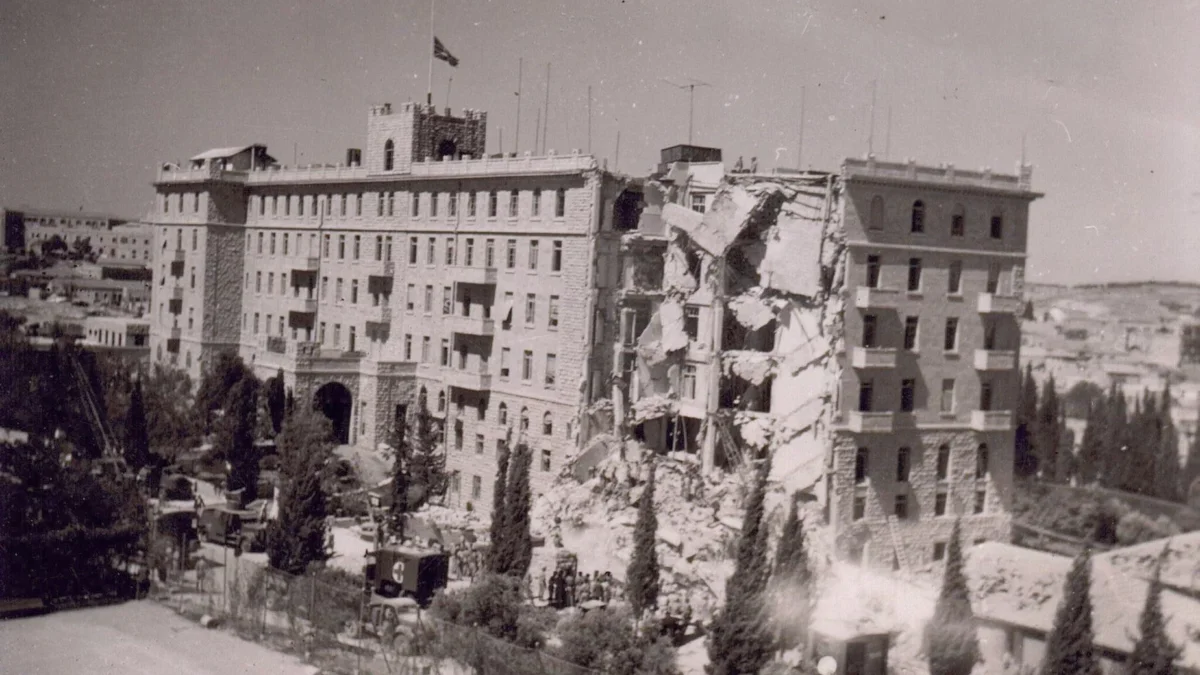
On July 22, 1946, a violent explosion destroyed part of the King David Hotel in Jerusalem, killing 91 people and injuring dozens. Claimed by the Irgun, a clandestine Zionist organization, this attack targeted the seat of the British administration in Palestine. The bombing, one of the deadliest of the final years of the British Mandate, accelerated the questioning of London's presence in the region and contributed to the events that would lead to the creation of the State of Israel two years later.
A Palestine under high tension
At the end of World War II , Palestine was administered by the United Kingdom under a mandate granted by the League of Nations in 1922. Tensions there increased. British authorities restricted Jewish immigration in order to maintain a balance with the Arab population, a policy strongly contested by a segment of the Zionist movement, particularly after the Holocaust and the plight of survivors seeking to reach Palestine.
Facing London, several clandestine Jewish organizations pursued different strategies. The Haganah, closely aligned with the Jewish Agency led by David Ben-Gurion, generally favored a more measured approach. Conversely, the Irgun, commanded by Menachem Begin, and the Lehi believed that armed struggle had become essential to ending the British Mandate.
On June 29, 1946, British authorities launched Operation Agatha. Thousands of people were arrested and important documents were seized from the offices of the Jewish Agency. For underground groups, this large-scale operation marked a turning point and led to preparations for a spectacular counterattack.
An attack on the heart of British power
The King David Hotel was therefore much more than a prestigious establishment. Its south wing housed the British government secretariat, the military headquarters, and the intelligence services. It thus represented a symbol of British authority in Palestine.
On July 22, shortly before noon, Irgun members disguised as deliverymen entered the hotel's basement with several drums containing explosives. After planting the charges, they left. At 12:37 p.m., an extremely violent explosion caused part of the building to collapse.
The attack killed 91 people and injured 46. The victims were of various nationalities: British, Palestinian Arabs, Palestinian Jews, as well as Armenians, Greeks, Russians, and Egyptians. The Irgun claimed to have tried to warn the authorities to allow for an evacuation before the explosion. British officials have always disputed this version, stating that they received no usable warning before the detonation.
A turning point towards the end of the British mandate
The attack sparked outrage around the world. David Ben-Gurion and the Haganah condemned the operation and distanced themselves from the Irgun, which took sole responsibility for the attack.
For the British government, this attack illustrated the impasse in which the Palestinian mandate found itself. Maintaining tens of thousands of troops on the ground was becoming increasingly costly and politically difficult. In February 1947, London decided to entrust the Palestinian question to the United Nations.
A few months later, the UN adopted a partition plan for Palestine. The British Mandate officially ended on May 14, 1948, the date on which David Ben-Gurion proclaimed the establishment of the State of Israel. The bombing of the King David Hotel remains one of the most significant and controversial episodes of this period, both for its heavy human toll and its impact on the history of the Middle East.