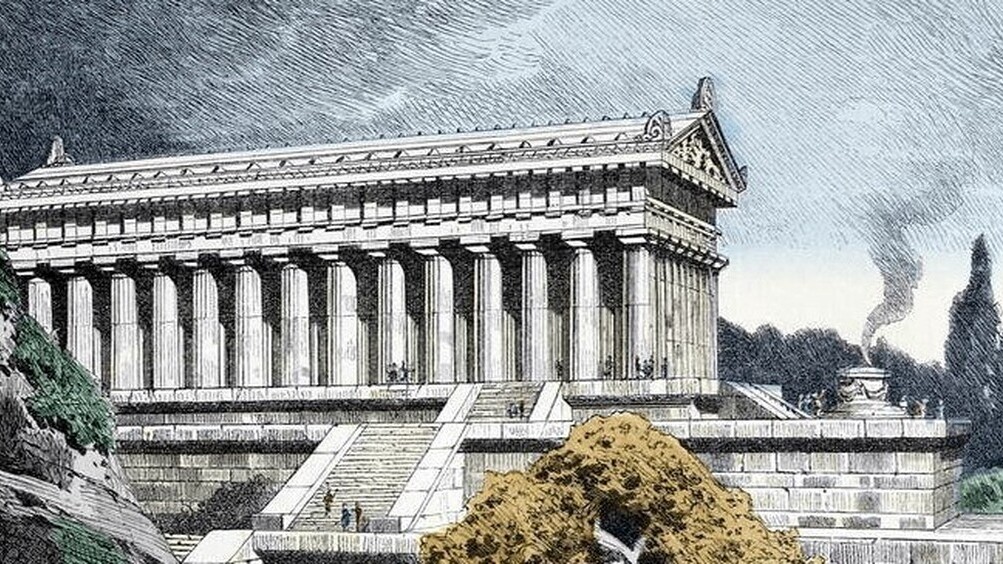
On the night of July 21, 356 BC, the Temple of Artemis at Ephesus, one of the Seven Wonders of the Ancient World, was reduced to ashes by arson. The perpetrator, a man named Herostratus, claimed responsibility for the act, stating his sole aim was to immortalize his name.
An arson attack claimed in order to achieve notoriety
According to ancient sources, Herostratus set fire to the temple with no other motivation than to etch his name in history, whatever the cost. To punish him, the authorities of Ephesus condemned him to death and decreed a damnatio memoriae, forbidding under penalty of death anyone to pronounce or write his name—a sanction intended to deprive the arsonist of the posterity he sought.
This prohibition, however, did not prevent Herostratus's name from surviving through the centuries, notably thanks to the Greek historian Theopompus, who mentioned him in his writings despite the ban. The episode has since given rise to the expression "Erostratus complex," used to describe those who seek fame through destructive acts.
A temple associated by legend with the birth of Alexander the Great
Ancient tradition recounts that the burning of the Temple of Ephesus occurred on the same night as the birth of Alexander the Great in Pella, Macedonia. According to this legend, repeated by several ancient authors, the goddess Artemis deserted her temple that night to attend the birth of the future conqueror, leaving the sanctuary unprotected against the flames.
The temple, rebuilt several times throughout its history, was reconstructed once again after this fire, before being definitively destroyed in the 3rd century AD. Its ruins, located in present-day Turkey , remain today a major archaeological site testifying to the scale of this ancient sanctuary.