
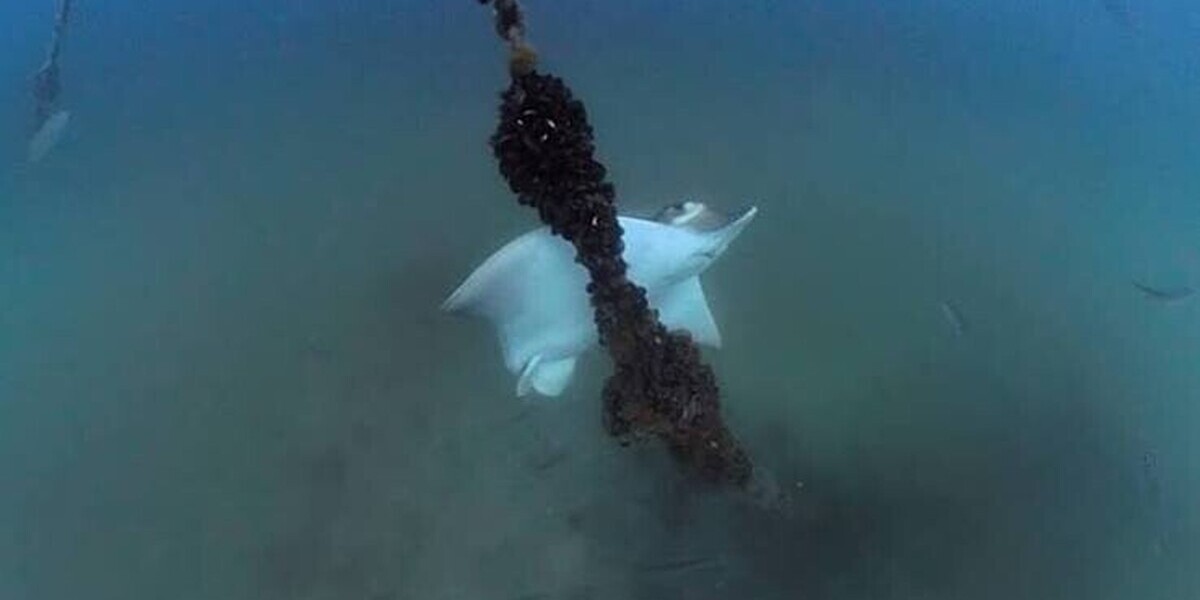
Groups of eagle rays, among the largest in the Mediterranean, have been congregating in the Gulf of Trieste for the past three years, damaging mussel farming operations. This unprecedented phenomenon in the Mediterranean has mobilized researchers and fish farmers to develop experimental solutions.
Schools of up to fifty specimens: this is what scientists are now regularly observing in the Gulf of Trieste. Vaccarella, cartilaginous fish of the Miliobatidae family that can reach two meters in width, have been frequenting these coastal waters with increasing intensity for the past three years. No other Mediterranean location has documented such a phenomenon on this scale.
“This is the first year we’ve observed such a high number of individuals gathered in schools of up to 50,” says Saul Ciriaco, head of monitoring activities for WWF in the Miramare Marine Protected Area and vice-president of the Shoreline cooperative. The area in question stretches along approximately 20 kilometers of coastline, from Grignano to the outskirts of Monfalcone.
Two factors combined explain this long-term establishment. Stricter European fishing regulations have reduced accidental catches of vaccarella, improving their reproductive success. Warming waters also play a decisive role: the vaccarella tolerates temperatures between 11 and 28 degrees Celsius, and the winter temperature in the Gulf no longer falls below 10 degrees. "While the Gulf of Trieste was previously just a transit point, it has now become conducive to a permanent presence," Ciriaco summarizes.
The species is nevertheless classified as critically endangered in the Mediterranean. It benefits from the protection of the Barcelona Convention, the UN Bonn Convention on Migratory Species, and is listed on the International Union for Conservation of Nature Red List. Similar sightings have been reported in Greece, Turkey, and Olbia, but without the systematic documentation carried out in Trieste.
The problem is that these animals, known as "hard-shelled shellfish" because they naturally feed on hard-shelled mollusks and crustaceans, have discovered a prime food source in mussel farms. "The animals have more time to realize that it's simpler and more efficient to eat the mussels directly on the ropes," explains Ciriaco. Simona Clò, a marine biologist and scientific director of the MedSharks association, specifies that these animals are "opportunistic": "The presence of easily accessible farms represents an ideal situation for them." Mussel farmers are suffering economic losses that are difficult to quantify, as other factors such as warming waters and sea turtles are also impacting their farms.
"We had never before observed this type of interaction between the vaccarelles and human activities," emphasizes Clò, who insists on the need to find non-invasive technologies that protect both farmers and the protected species.
This is the aim of the European Life Prometheus project, led by Shoreline in collaboration with the Miramare Marine Protected Area, the University of Padua, and the Polytechnic University of Marche. Electromagnetic deterrent devices have been installed on the lines: small magnets designed to disturb the animals without harming them. "It remains to be seen whether the system will actually work," cautions Ciriaco, who emphasizes that the cost and labor required for large-scale deployment represent a considerable effort, the effectiveness of which remains to be assessed.
Meanwhile, the Life EU Sharks project is funding drones for photo-identifying specimens, each shark being recognizable by the characteristic lines on its back. "We have the ability to identify the animals individually thanks to the distinctive markings of the lines on their backs," explains Clò. The largest group recorded to date numbered around fifty individuals, but the actual numbers could be higher.
A consultation table involving the Friuli-Venezia Giulia region and the port authority is to be established soon. Designated areas for snorkeling and underwater photography with these rare rays are being considered as a way to provide economic compensation for fish farmers, while also highlighting the presence of these animals near the coast.


Community
Comments
Comments are open, but protected against spam. Initial posts and comments containing links undergo manual review.
Be the first to comment on this article.