

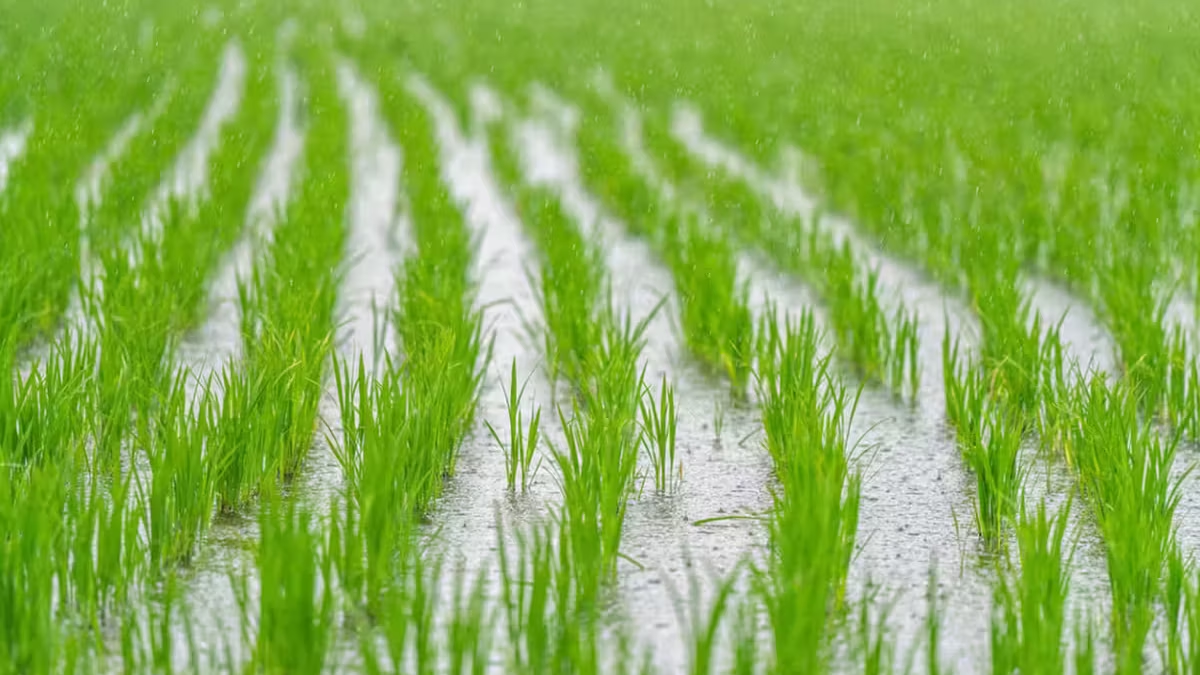
What if plants could react to the sounds in their environment? Scientific research attributed to the Massachusetts Institute of Technology (MIT) suggests that rice seeds could germinate up to 40% faster when exposed to the sound of rain. This hypothesis reignites interest in the effects of sound vibrations on plant development and their potential applications in agriculture.
Seeds may be sensitive to their sound environment long before the first leaves appear. According to research findings suggesting that the sound of rain accelerates rice germination, acoustic vibrations could play a role in the early stages of plant development. This idea is based on a phenomenon that biologists have been studying for several years: some plants react to mechanical stimuli, particularly vibrations transmitted through the air or their growing medium. In the case of rice, exposure to sounds reminiscent of a downpour could alter the rate at which the seeds begin to germinate. However, the figure of 40% cited to describe this acceleration should be interpreted with caution, as it would necessarily depend on the experimental conditions and how germination was measured.
Germination is a complex biological process that begins when the seed absorbs enough water to reactivate its metabolism. Temperature, oxygen, humidity, and substrate quality all play a crucial role in this stage. Researchers are also interested in the influence of vibrations on plant cells and the mechanisms that regulate their growth. Unlike humans and animals with auditory organs, plants have neither ears nor a nervous system that allows them to hear in the usual sense. However, they do possess cellular structures capable of responding to certain mechanical stresses. It is therefore more accurate to speak of vibration perception than hearing. The sound of rain could constitute a relevant environmental signal, since it generally accompanies conditions favorable to seed hydration.
A promising avenue for agriculture, but still experimental.
Studying plant responses to sound could open new perspectives for agricultural practices. If certain types of vibrations do indeed accelerate germination, they could also contribute to improving the uniformity of crop emergence or reducing the time required for seedling production. Rice is a particularly interesting subject of study due to its importance in the global food supply. This cereal is an essential resource for billions of people, especially in Asia , where its cultivation plays a central role in agricultural systems. Improving the early stages of growth could be beneficial to producers, provided that the effects observed in the laboratory can be reproduced on a large scale. However, faster germination alone does not guarantee a better harvest.
Several scientific questions remain to be clarified before concrete applications can be considered. In particular, it would be necessary to determine which sound frequencies produce the most significant effects, what exposure time is required, and whether the results are consistent across different rice varieties. Researchers should also verify that the vibrations do not negatively impact subsequent plant development. Distinguishing between accelerated germination and an increase in the total number of germinated seeds is also crucial for assessing the agronomic value of such a method. Finally, the precise attribution to MIT and the reported 40% result require confirmation through the original scientific publication. Despite these caveats, this research illustrates a rapidly developing field: the interactions between plants and the physical signals in their environment. It serves as a reminder that the plant world possesses far more diverse response mechanisms than those generally perceptible to the naked eye.








Respond to the article
Be the first to comment on this article.