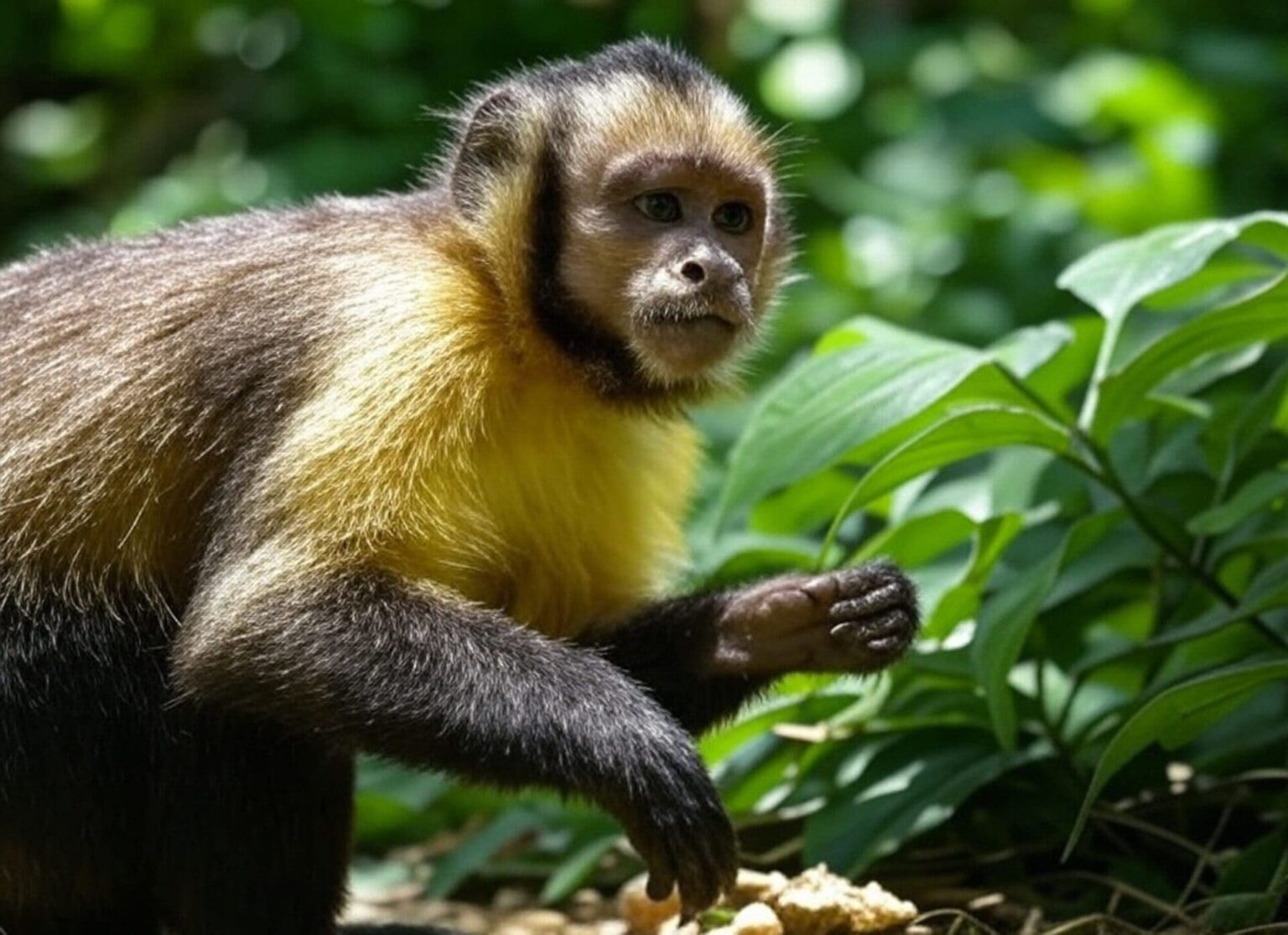
Yellow-breasted capuchins, a critically endangered monkey species, have just demonstrated an incredible capacity for adaptation. According to a team of Brazilian researchers, these primates have managed to survive outside their natural habitat by using stone tools , a practice reminiscent of our prehistoric ancestors. This discovery, published in Springer Nature , offers renewed hope for the survival of the species, which is threatened by the destruction of the Atlantic Forest in Brazil.
A wider distribution area than expected
It all started with an observation made by Waldney Martins, one of the authors of the study. While exploring an area outside the Atlantic Forest in Brazil, he came across a group of yellow-breasted capuchins living in a drier environment than their known habitat. Intrigued, he wanted to know more about the extent of their territory. As a result, his team estimated that these primates now occupy an area of about 20 km², well beyond the limits of the rainforest.
“For an endangered species, any expansion of its range, however small, is crucial for its survival,” the researcher emphasizes. And that’s not all: the study also reveals a surprising behavior that likely facilitated this colonization of new territories.
Stone tools for breaking fruit and eating
In these more arid regions, capuchins had to find a way to feed themselves differently. Their solution? Using stones to break the palm fruits that they love. What is fascinating is that in their original habitat, where these stones are also present, they do not use them. This means that their change of environment directly influenced the adoption of this tool. This phenomenon recalls the evolution of the first hominids, whose mastery of stone tools played a key role in their migration and survival in varied conditions.
A mystery yet to be solved
But scientists remain cautious: did they start using these tools after migrating to drier habitats, or were they already there and simply adapted their behavior when climate conditions changed? Further studies will be needed to answer this question….