
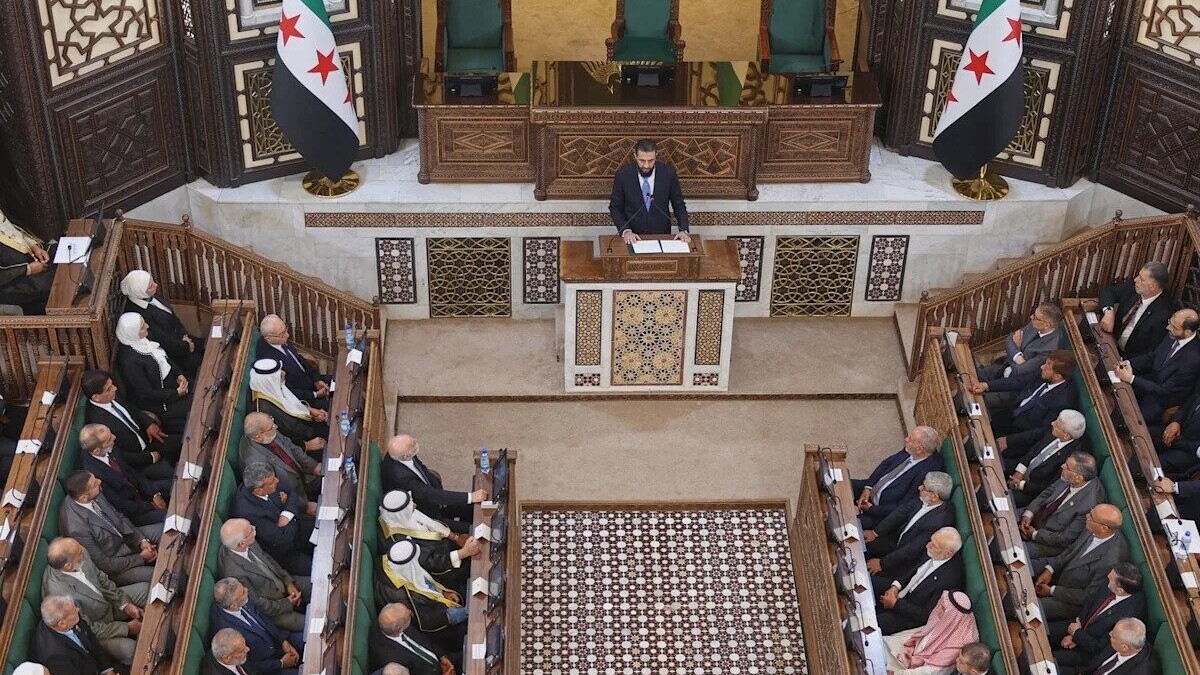
On July 12, Syria held the first session of its new People's Assembly in Damascus, an institution designed to support the presidency rather than compete with it. Neither a democratic chamber nor a mere rubber-stamp body, this parliament could nevertheless become a center of power in its own right.
In the days leading up to the opening of the session, the trees around the People's Assembly building in the heart of Damascus had been freshly trimmed, the facade cleaned, and illuminated at night. For six decades under the Baath Party, Syrians had walked past it without stopping. There was nothing to see inside. This time, the building was polished in anticipation of a parliament that many Syrians felt had been too long in coming.
On July 12, the session finally took place. The surrounding roads were blocked for hours, the security presence was heavy, and the members took the oath collectively, as a single group. The chairman of the Supreme Electoral Committee explained that this procedure saved time and ensured the security of the session, thus acknowledging, frankly, the continued fragility of the situation in Syria.
The debates quickly devolved into the most basic questions: should the vote be by a show of hands or by standing opposition? The assembly's oldest member, acting as interim chair, finally lost his temper. "Please," he exclaimed, "everyone wants to lecture me on procedure and law. We have neither procedures nor laws. This is entirely new." Few moments better encapsulated the day.
The composition of the assembly is open to criticism. Of its 210 members, 70 were directly appointed by President Ahmed al-Sharaa. The others were designated by electoral colleges themselves formed by a committee that Sharaa had appointed. No popular vote took place. Candidates could only run as individuals, without parties or lists. As a result, most members never conducted anything resembling a campaign, and many only introduced themselves to the public after their appointment, via social media. When questioned over the past month, the majority of Syrians were unable to name a single member of parliament.
The powers of the assembly remain strictly limited by the constitutional declaration. Article 30 allows it to propose and adopt laws, ratify treaties, approve the budget, and hold ministers accountable. However, there is neither a vote of confidence in the government nor any binding mechanism for the executive branch. The hearings allow ministers to explain themselves, not the parliament to sanction them.
Representation suffers from other shortcomings. The three seats in Suwayda, a Druze-majority southern governorate, remain vacant. Some Kurdish parties have rejected the method of appointing representatives from Kurdish areas, arguing that the number of seats reserved for them is far too small. The first elected speaker of the assembly, Abdul Hamid al-Awak, is a judge who helped draft the constitutional declaration and is perceived as close to the presidency. In his acceptance speech, he promised to "cooperate" with the executive branch and to "facilitate legislation to the greatest extent possible." The word "oversight" was not uttered all day.
However, it would be a mistake to call this parliament insignificant. Even before the first session, coalitions were forming around the race for the speakership, some regional, others ideological. Three candidates vied for the position. Al-Awak won with 99 votes out of 205, compared to 75 for Mouayad al-Qablawi and 31 for a third candidate. In a chamber where a third of the members owe their seats directly to the speaker, the palace's preference, whatever it may have been, was not enough to determine the outcome.
Two details from this first day deserve attention. The entire session was broadcast live on state television, with its arguments, confusion, and contested votes. Under the old regime, parliament appeared on screen to stage a display of unanimity. This time, Syrians watched their representatives argue in real time. Another telling sign: when Charaa took the floor, no one applauded. The members applauded their own votes, their new speaker, and their procedures. For the president of the Republic, there was only silence.
Of the 210 members, only 22 are women, 15 of whom were appointed rather than elected, a fact that drew criticism as soon as the lists were published. But during the race for the two vice-presidential positions, four out of ten candidates announced their candidacies from the podium. Madonna Bishara won the second vice-presidential post and spoke of her interest in women's rights. Women represent one-tenth of the chamber but made up nearly half of the candidates for leadership positions.
The coming weeks will provide several indicators. The assembly has a month to draft its own rules of procedure: will it simply copy what is submitted to it, or will it negotiate something of its own? If ministers appear for hearings and these sessions gradually transform into genuine examinations, something new will have occurred in Syrian politics. If the members establish themselves in their constituencies and return to Damascus with concrete demands, they will build a legitimacy that is independent of the presidency.
The international community has a role to play. Governments, parliaments, and organizations dealing with Syria should engage with this assembly as an institution, rather than channeling everything through the presidential palace. Inviting its committees, training its staff, and answering its questions will not make it independent, but treating it as an extension of the executive branch ensures that it remains so.
At the end of the first session, the newly elected secretary of the assembly addressed the members. “History will not record who won today,” he said. “It will record how this session was conducted, how Syrians gathered once again under the dome of parliament. The parliaments that come after us will follow in our footsteps. If we are weak, they will be weak. If we are strong, they will be strong.”
Community
Comments
Comments are open, but protected against spam. Initial posts and comments containing links undergo manual review.
Be the first to comment on this article.