
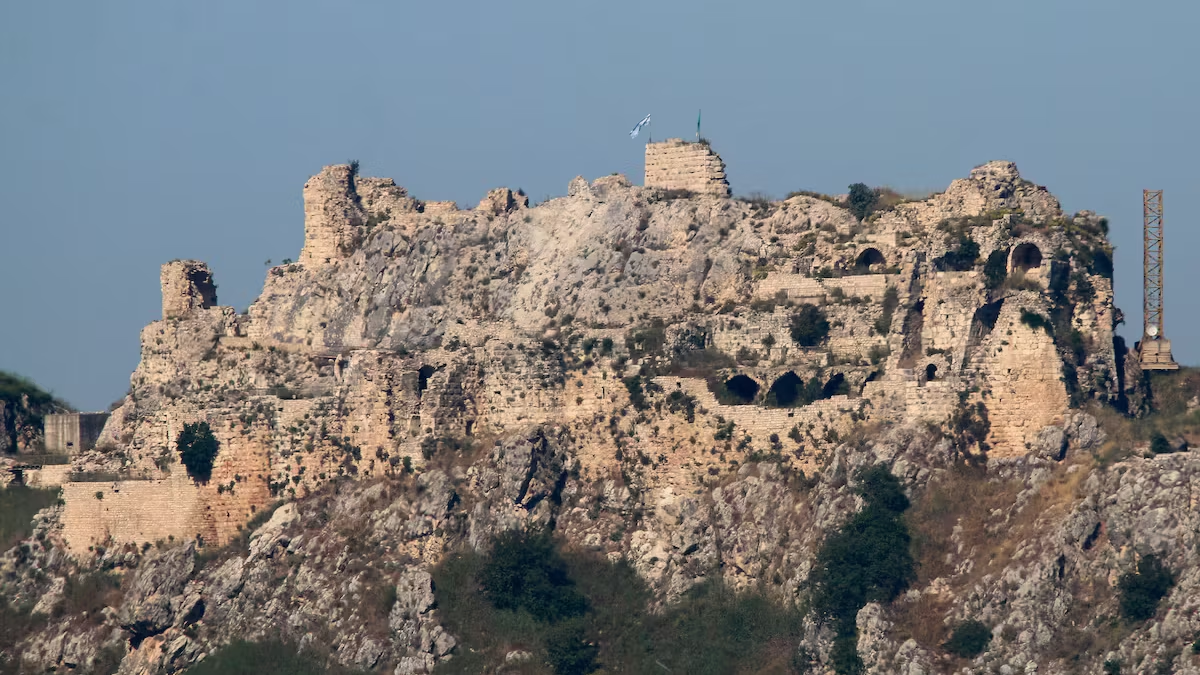
Dominating the hills of southern Lebanon for nearly nine centuries, Beaufort Castle has once again become a major military and symbolic prize after falling under Israeli control on Saturday. This capture marks Israel's return to a fortress it previously occupied during its military presence in southern Lebanon between 1982 and 2000.
Perched above the Litani River, the castle offers an exceptional strategic position. From its ramparts, one can see the Golan Heights occupied by Israel to the east and the Mediterranean coast to the west. This geographical location has made the site a coveted control point for many powers throughout the centuries.
The return of Israeli troops to this fortress comes amid the ongoing conflict with Hezbollah, a Shiite movement supported by Iran. The surrounding region has been heavily affected by the fighting, displacing hundreds of thousands of residents of southern Lebanon.
Israeli Prime Minister Benjamin Netanyahu hailed the recapture as a symbol of national resolve. Referring to a battle fought at the site more than forty years ago, he asserted that Israel had returned to Beaufort "united, determined, and stronger than ever."
For its part, Hezbollah indicated that it had no military presence in the castle at the time of the arrival of Israeli forces, while asserting that fighting continued in the surrounding area.
Built in the 12th century by the Crusaders on the site of older fortifications, the castle has had a turbulent history. It was notably conquered by Saladin before passing under the control of the Knights Templar and then the Mamluk dynasty of Egypt. Today, it is considered by UNESCO to be one of the best-preserved medieval castles in the Middle East and enjoys enhanced protection status.
According to several analysts, despite the evolution of military technologies and the increasing importance of drones on modern battlefields, Beaufort Castle's commanding position still gives it significant strategic value. Its history, intertwined with crusades, regional conflicts, and contemporary clashes, makes it one of the most emblematic and contested sites in southern Lebanon.




Community
Comments
Comments are open, but protected against spam. Initial posts and comments containing links undergo manual review.
Be the first to comment on this article.