

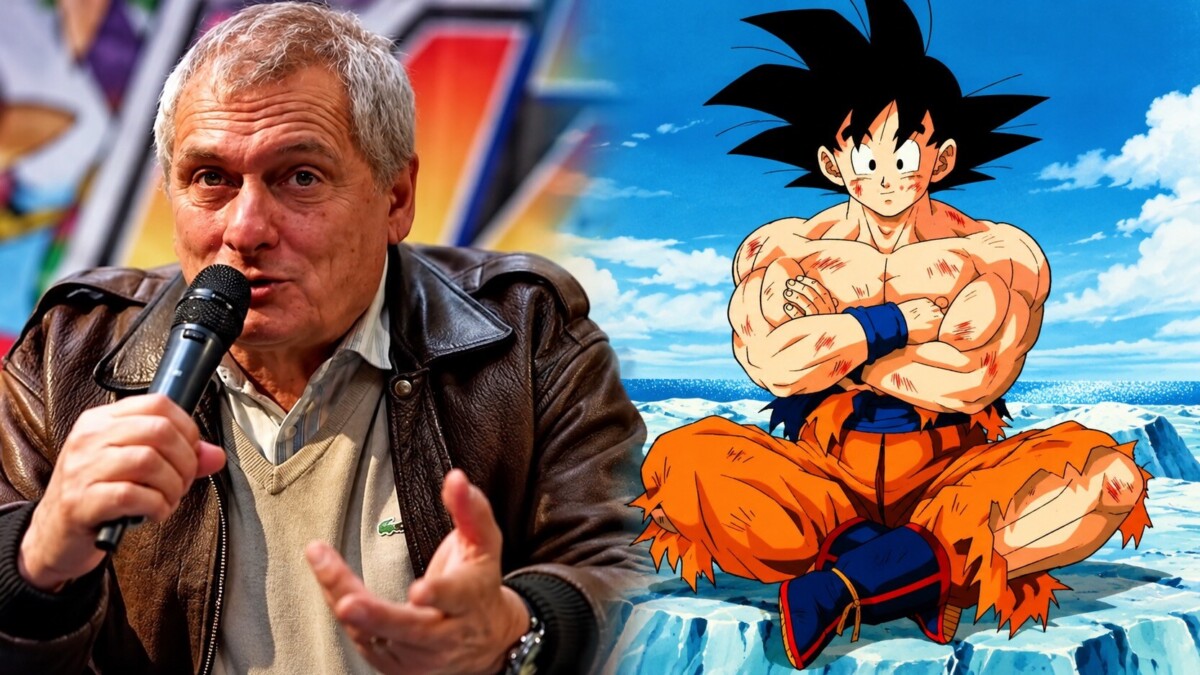
Patrick Borg, the longtime French voice of adult Goku, has decided to reveal the reasons for his removal from Dragon Ball Daima . The actor accuses Toei Animation of trying to impose restrictions on voice actors' freedom of expression, interviews, and interactions with fans. He also reveals that he refused to audition again for a character he has voiced for nearly 40 years.
Following the replacement of the five original French voice actors for Dragon Ball , Patrick Borg has decided to break his silence to explain the reasons for the conflict with Toei Animation. In a lengthy Facebook post , the actor, who has voiced adult Goku for nearly four decades, directly criticizes the contractual terms offered by the Japanese studio.
Patrick Borg asserts that Toei Animation's demands were incompatible with the actors' profession and the relationship they have cultivated with their audience for years. He details several restrictions that allegedly governed their public statements, appearances, and participation in conventions.
No talking about Dragon Ball allowed, interviews controlled, conventions subject to authorization
In his message, Patrick Borg explains that discussions with Toei Animation stalled over clauses that strictly regulated the actors' public activities. According to him, they would have had to obtain permission from the studio to discuss their characters, give interviews, or participate in conventions.
"The conditions were not right with Toei to continue to freely practice our profession, our freedom of expression, or our relationship with you, our audience," the actor stated.
He then details the restrictions that were allegedly imposed on them: "It became impossible for us to talk about your favorite characters. No interviews, no content without Toei's authorization. No longer possible to participate in conventions without their permission. Forced to police conventions for Toei."
These requirements would have directly affected the meetings between voice actors and Dragon Ball fans . For several decades, French voice actors have regularly participated in conventions dedicated to manga, animation, and Japanese culture, where they interact with the public and discuss their characters.
Patrick Borg also claims that discussions lasted two years before the actors were pressured into accepting these new terms. "We waited two years for answers and were then pressured into signing these new conditions, as if it were a mere formality ," he denounces, describing the proposed conditions as "unbelievable and unacceptable to any actor . "
"Why should I audition?": Patrick Borg refuses to audition again after 40 years
Patrick Borg reveals another point of disagreement with Toei Animation: the request for rehearsals for Dragon Ball Daima . Having voiced adult Goku for nearly four decades, the actor explains that he personally refused to submit to this procedure.
“Yes, I personally refused to audition for DAIMA. Why should I audition? Neither my voice nor my performance will change. Toei has 40 years of recordings with my voice and my acting…” he wrote.
The actor went on to question the need to reassess his performance after such a long collaboration: "If Toei didn't appreciate my voice or my acting... or both!? It would have been better to replace me a long time ago!"
This statement adds an important detail to the conflict. Patrick Borg acknowledges refusing the requested tests for the new series, while maintaining that the main disagreement concerned the new contractual terms. His personal refusal to undergo these tests, however, does not mean that his four colleagues adopted the same position.
"Why replace us in Europe?": The comparison with Goku's Japanese voice
Patrick Borg also highlights the difference in treatment between the French and Japanese voice actors of the franchise. He points out that Masako Nozawa, the original voice of Goku in Japan since 1986, recently celebrated her 90th birthday and continues to voice the character.
"Masako Nozawa is 90 years old. Why replace us in Europe !?" he asks, thus contesting the decision to renew the French voices while the continuity of the historical cast remains preserved in Japan.
The replacement involves five voice actors particularly associated with the French history of Dragon Ball . Brigitte Lecordier notably voices young Goku, young Gohan, and Goten. Philippe Ariotti is the voice of Piccolo and Frieza, Céline Monsarrat that of Bulma and Chi-Chi, while Mark Lesser notably voiced adult Gohan, Trunks, and Broly.
In the new French version of Dragon Ball Daima , adult Goku is voiced by Pierre Lognay, while Sophie Pyronnet lends her voice to child Goku. This change has provoked numerous reactions from fans of the saga, who have been accustomed to the original French dubs since the late 1980s.
Two years of discussions before the complete replacement of the actors
Patrick Borg states that the five original voice actors did not believe Toei Animation would go so far as to replace them all. Despite contractual disagreements, they still hoped to find a way to keep their characters.
"We honestly didn't think they would go all the way, with a full replacement ," the actor admitted, explaining that the group video released on October 26 was a last resort to warn fans.
The anger of the French voice actors had already erupted when Brigitte Lecordier, Patrick Borg, and their three colleagues publicly denounced their dismissal . In a joint video, the five artists expressed their incomprehension at Toei Animation's decision, while calling on fans of the franchise to show their support.
The actors also disputed the financial explanations given for their replacement. Céline Monsarrat asserted that their absence from the new series was not related to salary demands. Brigitte Lecordier confirmed that the actors were not asking for a raise.
The actress also stated that the new dubbing was done in Belgium , where costs are lower than in France. Toei Animation has not publicly explained the reasons for its choice nor specifically addressed the accusations regarding contractual restrictions.
Patrick Borg now fears that actors will be replaced by artificial intelligence.
Beyond his dismissal from Dragon Ball Daima , Patrick Borg expresses concern about the future of dubbing and the growing role of artificial intelligence in artistic professions.
"The questions of replacement for more control (possibly by AI) worry us!" , he writes, before mentioning the progress of these technologies in dubbing, video games and music.
The actor fears that new technologies will eventually make it easier to replace human voice actors and increase producers' control over voices and artistic performances. However, he does not claim that artificial intelligence was used to dub Dragon Ball Daima.
"We are not pawns and the continuity of the work strongly affects the public ," insists Patrick Borg, who also points out that the historical actors practice their profession well beyond the Japanese franchise.
No calls for hatred against the new Belgian voice actors
Despite his anger towards Toei Animation, Patrick Borg is keen to distinguish between production decisions and the work of the new voice actors. He specifically asks fans not to target the actors recruited for Dragon Ball Daima.
"We don't want any hate on social media or elsewhere against the Belgian cast ," he specifies, as the voice changes have sparked much criticism since the release of the first French images.
The actor also remains hopeful of one day reprising his role. He even envisions the possibility that another broadcaster might support a new French version of the series reuniting the original cast.
"We hope to take up the torch for the future... Perhaps a broadcaster will want to make history with a true French version with the original team ," he wrote in conclusion to his message.
However, no plans for a new dubbing with the original team have been announced.
Dragon Ball Daima arrives on Gulli on November 4th, without its original French voice actors.
The broadcast of Dragon Ball Daima on Gulli is scheduled to begin on Wednesday, November 4, 2026 at 9:15 AM. The series, launched in Japan in October 2024, tells a new adventure in which Goku and his companions are transformed into children and must explore the demon realm.
This is one of the last projects in which Akira Toriyama, creator of Dragon Ball who passed away in March 2024, was personally involved. The series therefore holds a special place in the franchise's history, which only adds to the disappointment of fans attached to its original voice actors.
For French viewers, this launch will mark a break with nearly 40 years of dubbing. Patrick Borg, Brigitte Lecordier, Philippe Ariotti, Céline Monsarrat, and Mark Lesser will not reprise their roles in this new production. And despite Patrick Borg's now detailed explanations, Toei Animation has still not provided a clear public response to the criticisms voiced by the five actors.



Respond to the article
Be the first to comment on this article.