
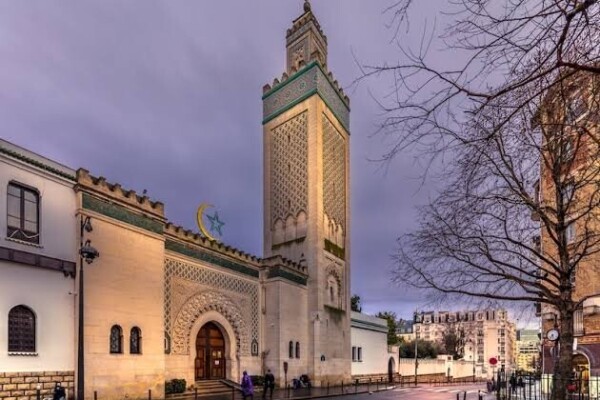
Inaugurated in 1926 as a tribute to the Muslim soldiers who fell during the First World War, the Great Mosque of Paris is celebrating its centenary. Historian Naïma Huber-Yahi reflects on the dual role of this place, both a colonial instrument and a link between France and its Muslim community.
A century after its inauguration, the Great Mosque of Paris remains a complex historical object. Built in 1926, it arose from an official desire to pay tribute to Muslim soldiers who died for France during the Great War. But behind this tribute, historian Naïma Huber-Yahi, a contributor to the collective work The Great Mosque of Paris published by Éditions du Cherche-Midi, identifies a more ambivalent logic.
“The Great Mosque, a colonial tool, will become a tool of emancipation,” she summarizes. This gradual transformation says a great deal about the evolution of the relationship between France and Islam, and about the place this building has occupied in diplomatic relations between Paris and Algiers over the decades.
Beyond its religious symbolism, the mosque functioned as a political tool, used sometimes to control the Muslim populations of the empire, and sometimes to maintain ties with the states of the Arab world. Its history thus reflects the major upheavals of 20th-century France: colonization, the Algerian War, immigration, and the construction of a Muslim identity in France.
The centenary offers an opportunity to revisit this journey. For Naïma Huber-Yahi, the mosque is not a monument fixed in a single function: it has survived regimes, conflicts and identity recompositions to establish itself today as a landmark of Muslim life in France, charged with all these contradictions.


Community
Comments
Comments are open, but protected against spam. Initial posts and comments containing links undergo manual review.
Be the first to comment on this article.