
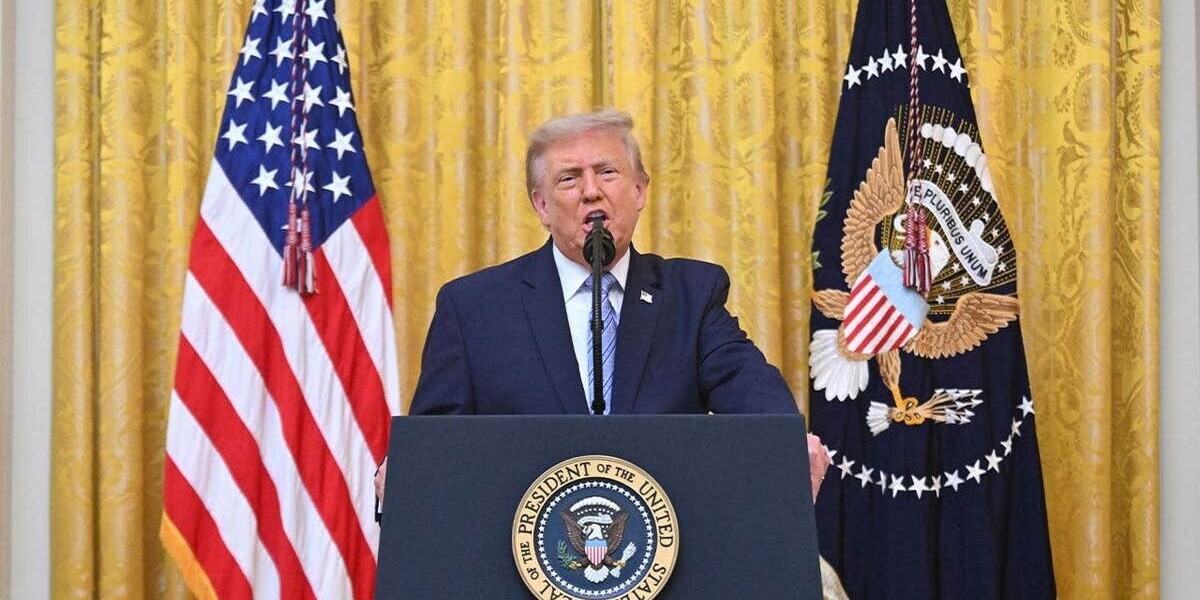
As a haze of smoke blanketed Washington on Friday, Donald Trump blamed Canada for the deteriorating air quality in several major American cities, brandishing the threat of new tariffs.
The Capitol building was shrouded in thick fog Friday morning. Active wildfires in northern Ontario sent smoke drifting as far as the East Coast of the United States, hitting Chicago, New York, and Washington, where authorities advised millions of residents to stay indoors.
Donald Trump wasted no time in pointing fingers. On his Truth Social network, the US president wrote that the United States was being "unnecessarily invaded by dirty, polluted, and unhealthy air of dangerous and totally unacceptable quality," blaming the situation on the lack of forest management on the Canadian side. He added that he intended to call Prime Minister Mark Carney later that day to ask what his government planned to do, specifying that the cost of this pollution "must necessarily be added to the tariffs that Canada is currently paying."
EPA Administrator Lee Zeldin echoed this sentiment, stating that if Canada did not change its approach to wildfires, "this will continue to happen in the future." On Friday morning, several cities as far south as Washington, D.C., had an air quality index of "purple," meaning "very unhealthy" according to the federal agency's monitoring tool.
On the Republican side in Congress, punitive initiatives are multiplying. Senator Bernie Moreno (Ohio) announced the upcoming introduction of a bill aimed at sanctioning Canada and certain Canadian government officials. The bill would also include visa restrictions. Four Republican representatives from Michigan had previously sent a letter to Mark Carney, criticizing him for a "chronic underinvestment" in forest thinning and fuel reduction. One of them, Representative Tom Barrett, even raised the possibility of delaying the opening of the new Gordie Howe Bridge until Canada "takes responsibility."
Ottawa responded by highlighting the long-standing cooperation between the two countries. Canadian Emergency Management Minister Eleanor Olszewski pointed out that Canada has invested $12 billion since 2020 in forest sustainability and fire prevention. She noted that Canadian firefighters and equipment were deployed last year to help fight the Los Angeles wildfires. U.S. Ambassador to Canada Pete Hoekstra himself praised the "remarkable cooperation" between the two governments on Wednesday, noting that they share information in real time.
Nearly 900 wildfires are currently burning in Canada, and more than 150 in the United States, including 15 in Michigan alone. The fine particulate matter carried by the smoke poses serious health risks, particularly for the elderly, children, and those with chronic illnesses. Laura Kate Bender, public policy officer at the American Lung Association, points out that even chronic exposure to low levels of particulate pollution contributes to premature death, heart disease, and lung problems.
Climate scientists, however, point to another cause. Daniel Swain, a climatologist at the California Institute of Water Resources, explains that the current fires are a direct result of a record-breaking heat wave that "dried out the forests and increased thunderstorms and lightning." On July 13, the day the major fires in Ontario and Minnesota broke out, temperatures in the Canadian province were 14 degrees Celsius above the seasonal average. Shel Winkley, chief meteorologist at Climate Central, believes that these temperatures "would be virtually impossible without the influence of climate change."
In the United States, the area burned by fires since the beginning of the year already exceeds 14,860 square kilometers, which is 31% more than the average of the previous ten years at the same date, according to the National Interagency Fire Center.




Community
Comments
Comments are open, but protected against spam. Initial posts and comments containing links undergo manual review.
Be the first to comment on this article.