
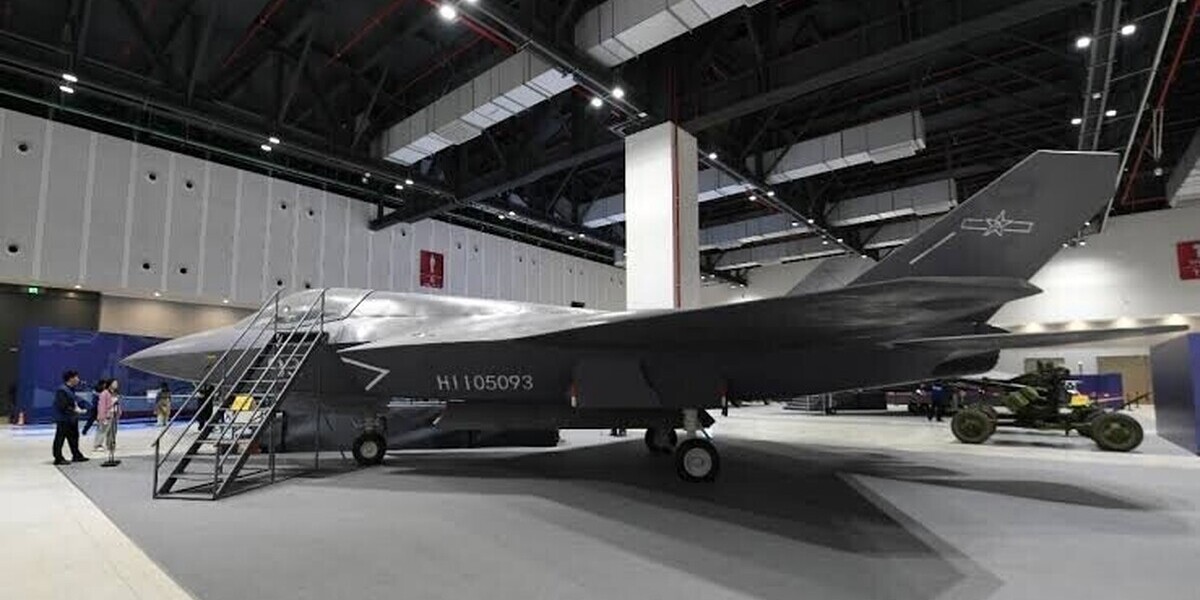
Rumors have been circulating since 2024 about a possible acquisition by Pakistan of around forty fifth-generation Chinese J-35 stealth fighters. No contract has been signed to date, and several fundamental obstacles make this sale unlikely in the short term.
For over a year, the possibility of a sale of 40 Chinese J-35s to Pakistan has resurfaced periodically in specialist circles. This scenario would have the potential to disrupt the military balance in South Asia: neither Pakistan nor its Indian rival currently possesses fifth-generation aircraft. However, Beijing is not yet ready to take this step.
The first reason lies in China's strategic caution regarding regional stability. For a decade, Beijing has provided massive economic and military support to Islamabad, using it as a counterweight to India. This pressure forces New Delhi to disperse its resources, thus relieving pressure on the Sino-Indian border and protecting the economic corridor that runs through Pakistani-administered Kashmir. But giving Pakistan too decisive an advantage would be another matter. Clashes along the Line of Control are already frequent. During the 2025 conflict, Pakistan shot down five Indian fighter jets without losing a single aircraft, despite being outnumbered. Prime Minister Shehbaz Sharif himself stated that his country could have inflicted even heavier losses but deliberately refrained. Delivering J-35s in this context could incite Islamabad to try to change the territorial status quo in Kashmir, with the risk of drawing two nuclear powers into an escalation that Beijing does not want to manage as its priorities are concentrated in East Asia.
The second constraint is industrial. China has three aircraft carriers, a fourth is under construction, and up to five more are planned. The J-35 is the only Chinese fifth-generation fighter capable of operating from an aircraft carrier. The aircraft only made its official debut two years ago, and the production rate is not yet sufficient to fully equip the existing ships. Transferring some forty aircraft to Pakistan would further delay the development of the People's Liberation Army Navy, which must be able to confront the eleven American aircraft carriers and their seven amphibious assault ships. Even a single missing squadron could weaken the Chinese force in the event of a naval confrontation with Washington.
A third, less visible factor concerns technological security. Pakistan operates a fleet of approximately 75 American F-16 fighter jets, the maintenance of which can only be carried out by American technicians permanently stationed at Pakistan Air Force bases. If J-35s were to be stationed at these same bases, American technicians would find themselves in close proximity to an aircraft representing the pinnacle of Chinese military aviation. Even an export version, stripped of its most sensitive features, would retain fundamental characteristics, such as its radar signature, the slightest leak of which would benefit the United States and its allies. The risk is of a different nature than that posed by the sale of the J-10, an older model with less critical technologies.
Finally, the state of Pakistan's finances makes the operation virtually impossible to fund. After a slight improvement, the country's economy has once again taken a turn for the worse. The war between Israel, the United States, and Iran, which began in February, has driven up oil and gas prices while simultaneously causing a sharp drop in remittances from the diaspora. Pakistan is once again grappling with high debt, persistent inflation, a large deficit, and sluggish growth. More than half of its tax revenue is used to repay loans, leaving little room for defense spending. Even maintaining 40 J-35s would be difficult, let alone acquiring them.
Beijing could theoretically finance the purchase with loans, as it did for the 36 J-10s currently in service. But the situation is different: at the time, the balance tipped heavily in India's favor, and Pakistani F-16s, subject to US usage restrictions, could not legally be deployed against New Delhi. The J-10s have restored a sufficient balance. For now, Beijing has no pressing strategic incentive to go further.
A sale is not ruled out in the longer term. Pakistani pilots are already training on the J-35, a sign that preparations are underway. Two events could accelerate the decision: India's acquisition of fifth-generation fighters, or a Pakistani defeat in a future conflict. In either case, Beijing could intervene, either at a reduced price or through loans, to prevent its partner's defeat and preserve its regional influence.


Community
Comments
Comments are open, but protected against spam. Initial posts and comments containing links undergo manual review.
Be the first to comment on this article.