
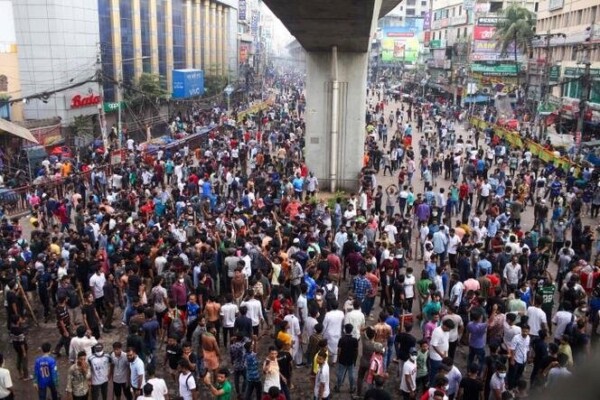
Less than five months after the installation of an elected government, thousands of Bangladeshi high school students demonstrated in at least thirteen districts of the country, denouncing the management of national exams in the middle of the rainy season and the remarks deemed insulting by their Minister of Education.
History seemed to be repeating itself. In July-August 2024, Generation Z had overthrown Sheikh Hasina's autocratic regime through a historic mobilization. Eighteen months later, these same young people are back in the streets of Dhaka and other major cities across the country, but for a different battle: the right to fair examinations.
It all started with the monsoon rains. On July 2, approximately 1,3 million students began taking the Higher Secondary Certificate (HSC) exams, the Bangladeshi equivalent of the baccalaureate, the key to university admission. By the second week, severe flooding had struck the Chittagong region, while Dhaka and other cities experienced significant urban flooding. The Ministry of Education suspended the exams in five districts under the Chittagong School Board but continued them in other areas, including the hard-hit Comilla. Candidates had to wade through knee-deep water, soaked through, to reach their exam centers during the storms.
The anger might have remained contained if the Minister of Education, ANM Ehsanul Hoque Milon, hadn't exacerbated the situation. An audio recording of his phone conversation with the parent of a candidate circulated on social media. In it, he can be heard saying: "In a meeting, someone was saying that if my daughter gets a little wet, she'll catch a fever. I said they're like factory-farmed chickens. If they get a little wet, they catch a fever." The phrase "factory-farmed chickens" ignited the controversy.
High school students flooded the streets in at least thirteen districts, including Dhaka, Chittagong and Comilla, blocking strategic intersections, surrounding school board headquarters and chanting sarcastic slogans: "Who are you? Who are we? Farm chickens!" They demanded the resignation of the minister and make-up sessions for students prevented from taking exams due to bad weather.
On July 14, images of police officers using batons to charge protesters outside the parliament building revived painful collective memories. That same day, Prime Minister Tariq Rahman convened an emergency meeting with Milon. The following day, the minister apologized to the national parliament, acknowledging that students had suffered greatly due to the rains and floods. He announced that arrangements would be made to allow those who had missed exams to retake them.
Mahdi Amin, the Prime Minister's education advisor, detailed five concrete measures: organizing make-up sessions for students who were absent on July 13, awarding the maximum grade to all candidates for two incorrect questions in the physics exam, temporarily suspending four teachers involved in drafting the faulty exam paper, and delegating to local administrations the power to postpone, move or adapt exams in case of difficult weather conditions.
On July 16, students returned to their exam rooms and left the streets. But the controversy remains heated on social media. Interior Minister Salahuddin Ahmed warned against attempts to politically exploit the movement, citing the Awami League, a party banned since the fall of the regime in 2024, and its student wing, the Chhatra League, which he accused of spreading disinformation to incite tensions.
The concessions obtained by the protesters essentially validate their initial demands. The question that remains is simple: if these measures had been proposed in the first days of the flooding, would the mobilization have reached this scale?


Community
Comments
Comments are open, but protected against spam. Initial posts and comments containing links undergo manual review.
Be the first to comment on this article.