
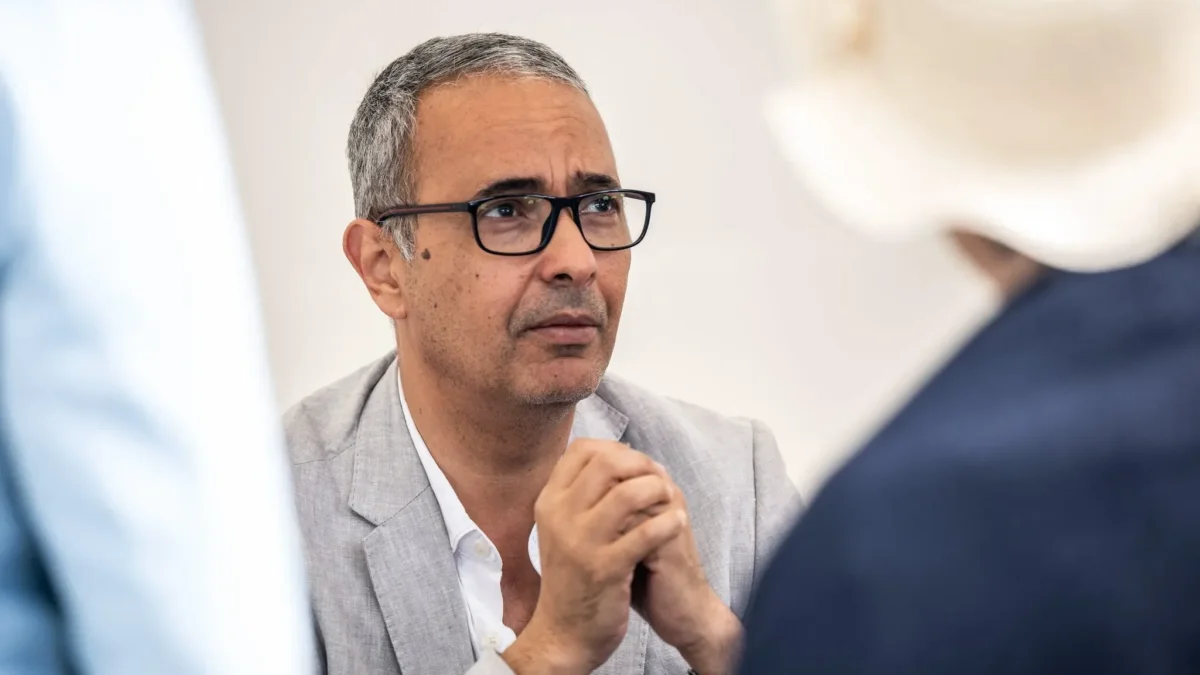
The Paris prosecutor's office on Friday requested the acquittal of Franco-Algerian writer Kamel Daoud, who is being sued for defamation by Saâda Arbane, an Algerian woman who accuses him of using her personal story as inspiration for his novel. Houris, which was awarded the 2024 Goncourt Prize. The decision of the Paris Criminal Court will be handed down on September 8th.
The case is part of a broader dispute that has pitted the author against this 32-year-old woman from Oran for several months. A survivor of a massacre during Algeria's "Black Decade" and a former patient of Kamel Daoud's psychiatrist wife, Saâda Arbane claims that the novelist appropriated elements of her personal history to construct the plot of his book. The writer has always denied these accusations.
A defamation lawsuit related to an interview
The proceedings examined on Friday, however, did not directly concern the content of the novel. Saâda Arbane criticizes Kamel Daoud for remarks made in an interview given to Figaro at the beginning of April. In this interview, the writer notably stated that "Algiers can file a complaint against Kamel Daoud in France."
The plaintiff's lawyers argued that this wording clearly identified their client, despite the absence of her name. They maintained that this statement was intended to portray her as a mouthpiece for the Algerian authorities and to discredit her legal proceedings against the perpetrator.
According to lawyers Colomba Grossi and William Bourdon, this statement constituted an attack intended to undermine Saâda Arbane's credibility, even as several legal proceedings are underway in France and Algeria concerning the origin of the narrative developed in Houris.
A defense that denounces judicial harassment
For his part, Kamel Daoud's defense rejected the accusations. The lawyer for FigaroChristophe Bigot, the lawyer, believed that this defamation lawsuit was part of a strategy to increase media and legal pressure on the writer and his novel.
The author's lawyer, Jacqueline Laffont, denounced the proliferation of legal proceedings initiated against her client on both sides of the Mediterranean. According to her, Kamel Daoud is facing a form of judicial harassment aimed at exhausting him morally, professionally, and financially.
The prosecution favors an acquittal.
During the hearing, the public prosecutor argued that the statements in question were expressions of opinion and did not constitute defamation in the legal sense. She noted, in particular, that Saâda Arbane was not sufficiently identifiable in the passage in question and that no specific act likely to damage his reputation was directly attributed to him.
The court will now have to decide this legal question on September 8. This decision will be closely watched as several other related proceedings are underway. Houris are still ongoing.
In parallel with this French case, Kamel Daoud announced in the spring that he had been sentenced in Algeria to three years in prison following a complaint filed by an organization representing victims of terrorism. This conviction is linked to his portrayal of the Algerian civil war in his novel, a particularly sensitive subject in a country where legislation strictly regulates public discussion of the "Black Decade."



Community
Comments
Comments are open, but protected against spam. Initial posts and comments containing links undergo manual review.
Be the first to comment on this article.