

It comes back like a refrain as soon as the municipal elections approach. In a column published in Le Figaro, the essayist and columnist Ferghane Azihari attacks the use of the theme of an "anti-fascist front" on the left, a banner which he considers less ideological than tactical, designed to close ranks and seize mayoralties, even if it means stirring up a fascist danger which he believes is being exploited.
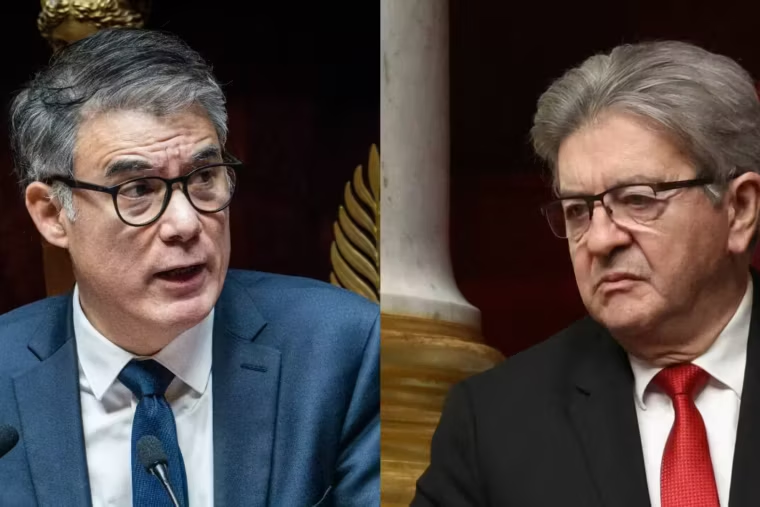
At the heart of his criticism is an avowed target: Jean-Luc Mélenchon and his camp. Azihari describes a political posture which, according to him, seeks to give a moral backbone to often fragile local coalitions, made up of arrangements, mergers of lists and promises of withdrawals in the second round, where the municipal mechanics impose their compromises down to the millimeter.
Another, more inflammatory point runs through his text. Azihari argues that positions which he describes as "racist", "Francophobic" or hostile to certain groups could coexist with high electoral performances in several municipalities, particularly where lists close to La France insoumise have achieved their best scores, which he presents as a breach of the republican ideal which the left nevertheless claims at length in its speeches.
A slogan that serves primarily as electoral glue.
A slogan that serves primarily as electoral glue. To support his argument, the author places this strategy within a longer history of realignments on the left. He notably cites a report from Terra Nova, a think tank close to the Socialist Party in the early 2010s, which discussed the formation of an electoral majority based on "a diverse France," a line he believes is being continued today by Mélenchon, with a logic of blocs and clienteles rather than unity in the classical sense.
Behind the words lies an old French debate that refuses to die: that of the "republican front" and its variations, now challenged by the expression "anti-fascist front." In municipal elections, everything hinges on local politics, alliances are forged in the margins between party machines, and voters sometimes only discover at the last minute who will govern with whom, once the posters have been put away.
Azihari's op-ed comes at a time still marked by the snap parliamentary elections of 2024, which have brought the issue of blocking the far right and the political cost of such knee-jerk reactions back to the forefront. One rather stark reality remains: when moral arguments become a recurring electoral tool, they eventually lose their effectiveness, and the upcoming municipal campaign will reveal how long this rhetoric still holds up against the very realities of cities and neighborhoods.

Community
Comments
Comments are open, but protected against spam. Initial posts and comments containing links undergo manual review.
Be the first to comment on this article.