
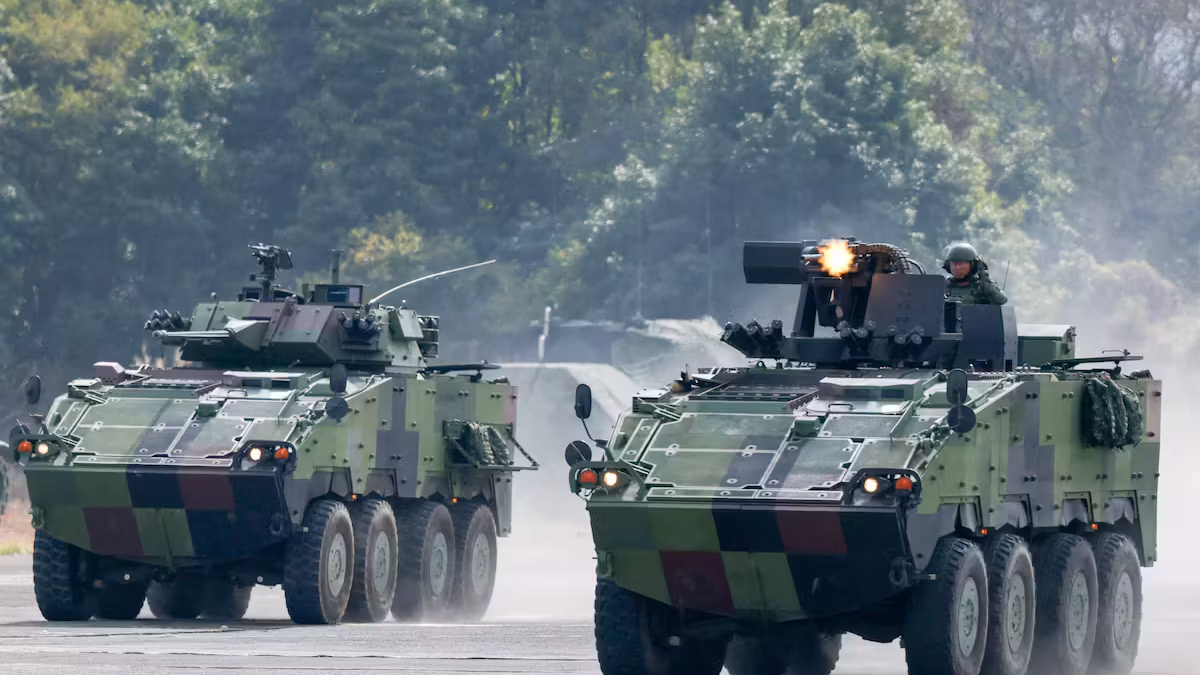
Hundreds of people demonstrated in central Taipei on Saturday in support of increased defense spending for Taiwan, after the opposition-dominated parliament reduced a major budget request from President Lai Ching-te.
The president sought approval for an additional $40 billion budget to bolster the island's military capabilities. The plan included the purchase of American weapons as well as the development of locally produced equipment, such as drones and the new integrated air defense system, "T-Dome".
But this month, the parliamentary opposition, which holds a majority in Parliament, approved only about two-thirds of the requested funds. Opposition parties accepted spending on American weapons, while rejecting several domestic projects they deemed insufficiently detailed and potentially vulnerable to corruption.
Saturday's demonstration was organized by several pro-independence groups and human rights organizations. Participants waved Taiwanese flags and chanted slogans calling for the strengthening of the island's military capabilities in the face of increasing pressure from Beijing.
“True peace requires a strong national defense,” said Wang Hsing-huan, leader of Taiwan’s small Statebuilding Party. “Only by strengthening our defense can we protect Taiwan’s freedom,” he told the protesters.
Among the participants was Angela Yen, a 34-year-old civil engineer, who argued that Taiwan absolutely must prepare itself against Chinese ambitions. "We must protect ourselves against China's expansion," she said, asserting that Taiwan and China were "two different countries."
For their part, the main opposition parties maintain that they support military spending but refuse, in their words, to sign "blank checks." Cheng Li-wun, president of the Kuomintang, the main opposition party, stated on Saturday that Taiwan should invest in "peace rather than war" and avoid sending the younger generation to fight in a conflict with Beijing.
This controversy comes amid persistent tensions between China and Taiwan. Beijing considers the democratically governed island to be part of its territory and has been increasing its military displays around Taiwan for several years.

Community
Comments
Comments are open, but protected against spam. Initial posts and comments containing links undergo manual review.
Be the first to comment on this article.