
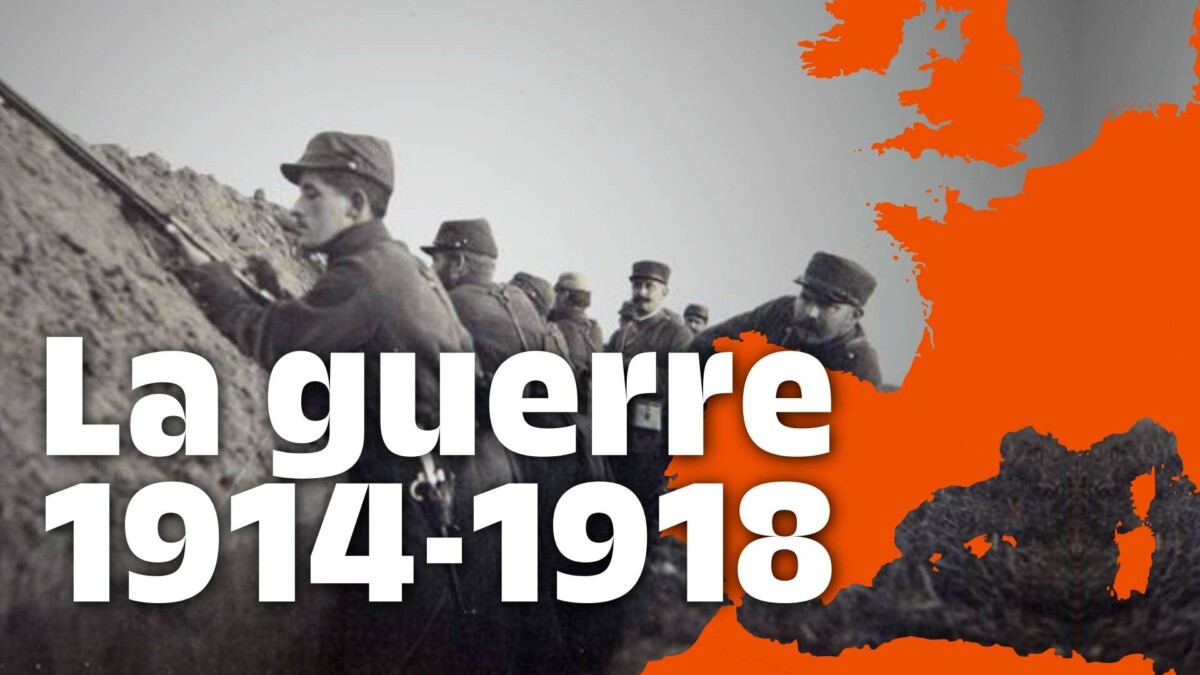
Romain Mauffrey signs his first novel by reconstructing, hour by hour or almost, the fateful month of July 1914, from June 28 to July 28, between the assassination of Archduke Franz Ferdinand in Sarajevo and the Austro-Hungarian declaration of war on Serbia.
On the cover of Men of JulyThree figures stand out against a blue sky: Raymond Poincaré, President of the French Republic, Franz Joseph I, Emperor of Austria and King of Hungary, and Tsar Nicholas II. It is these three sovereigns, surrounded by a few secondary but decisive figures, that Romain Mauffrey has chosen to place at the center of his story.
The cast is carefully chosen. It includes René Viviani, President of the Council, friend of the socialist Jean Jaurès and notorious womanizer; Maurice Paléologue, French ambassador to Russia, described as unctuous and warmongering; Augustin de Iturbide y Green, nephew of a former Mexican emperor who became a university professor in Washington; and Leopold Berchtold, the Austro-Hungarian minister whom the author presents as the most realistic and probably the most bellicose of the lot.
These men have thirty days to decide the fate of the world. The countdown begins on June 28, 1914, when Gavrilo Princip, a Bosnian Serb, assassinates Archduke Franz Ferdinand in Sarajevo. It ends on July 28, when the Austro-Hungarian Empire declares war on Serbia, drawing Europe and then the rest of the world into the 1914-1918 conflict.
Mauffrey captures this fatal mechanism through fictionalized scenes, both public and private: diplomatic meetings, walks, meals, travels, and conversations between couples. The dialogue is carefully crafted, the details exquisite. The author portrays leaders who, as the days go by, resign themselves to accepting what seems increasingly inevitable, even though initially no one wanted war.
What the novel highlights is less the mechanics of alliances than the psychology of the decision-makers: their hesitations, their contradictions, their calculations of honor, and their vanities. Powerful men who appear all the more ordinary, caught in a machine they helped set in motion without always considering the consequences.
The men of July, Romain Mauffrey, Éditions Hervé Chopin.


Community
Comments
Comments are open, but protected against spam. Initial posts and comments containing links undergo manual review.
Be the first to comment on this article.