

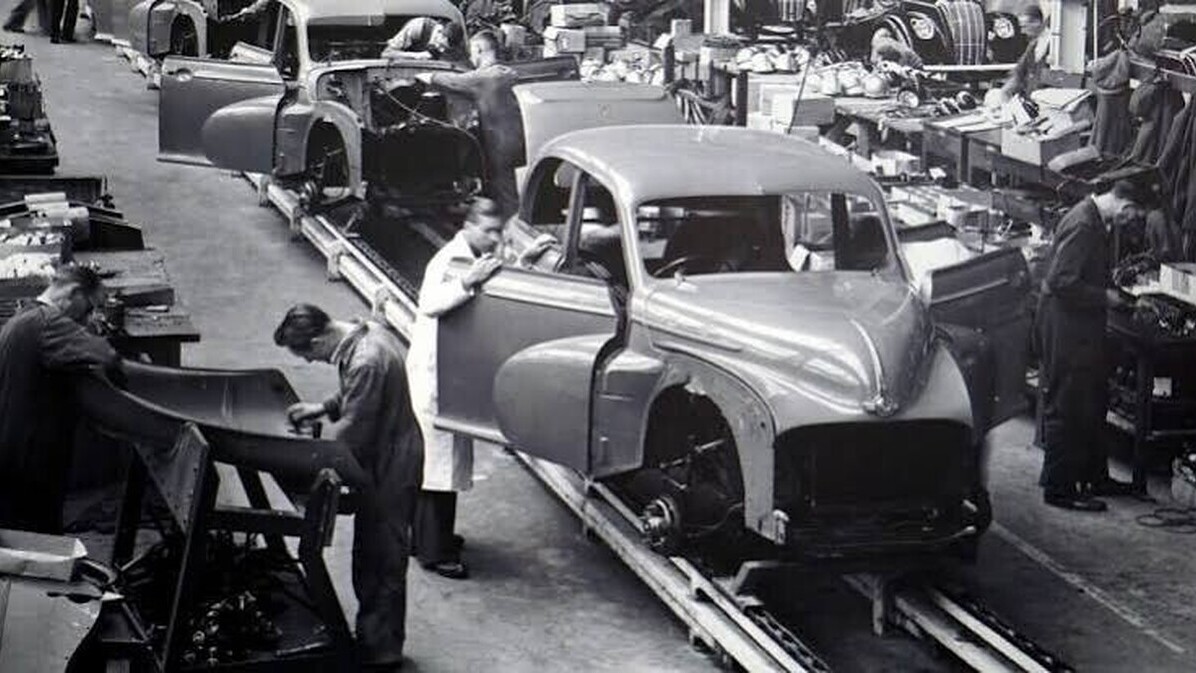
Fordism is generally presented as an industrial method based on mass production, product standardization, and the extreme division of labor. However, its influence extends far beyond the walls of automobile factories. By making goods more abundant and less expensive, it created the conditions necessary for the emergence of consumption accessible to the working classes.
Henry Ford invented neither the automobile nor the assembly line. His decisive contribution lay in combining several existing methods to mass-produce a complex product. In 1913, the Highland Park plant adopted a moving assembly line on which each worker repeated a specific operation. The vehicle now came to them, significantly reducing the time required to manufacture a Ford Model T.
Produce more to sell for less
This organizational structure allows for increased production volumes while decreasing the cost per car. The Model T is gradually ceasing to be a product reserved for the wealthy and becoming accessible to a growing segment of the American population. This principle can then be applied to household appliances, clothing, furniture, and many other everyday objects.
Fordism thus created a unique economic cycle: increased productivity drove down prices, lower prices expanded the pool of buyers, and this new demand justified even greater production. Companies no longer manufactured solely to fulfill existing orders; they had to continuously sell enormous quantities of standardized goods.
The worker also becomes a consumer
In January 1914, Ford announced a daily wage of up to five dollars, roughly twice the usual pay of many factory workers at the time. This decision was primarily aimed at reducing the number of resignations caused by the arduous and monotonous nature of assembly line work. However, it also helped establish a fundamental principle: that workers should have sufficient income to purchase a portion of the goods produced by industry.
Fordist logic thus links mass production and mass consumption. The worker is no longer just a source of labor; they also become a potential customer. With rising wages, reduced working hours, and the gradual expansion of vacation time, households have more money and time to shop, travel, and enjoy leisure activities.
Advertising, credit, and the ongoing renewal of needs
Mass production alone, however, is not enough to guarantee sales. Companies then develop advertising, large distribution networks, and consumer credit to transform desires into purchases. Brands learn to present their products as symbols of comfort, freedom, and social success. Owning a car, a refrigerator, or a television gradually becomes the norm.
Fordism is therefore not the sole origin of the consumer society, since department stores, advertising, and credit sales already existed. Nevertheless, it constituted its decisive accelerator by combining abundant production, affordable prices, regular wages, and mass markets. After 1945, this model became the foundation of Western growth. It also established a lasting dependence on purchasing, the constant replacement of goods, and the intensive exploitation of resources, the social and environmental consequences of which remain visible today.








Community
Comments
Write a comment
Be the first to comment on this article.