

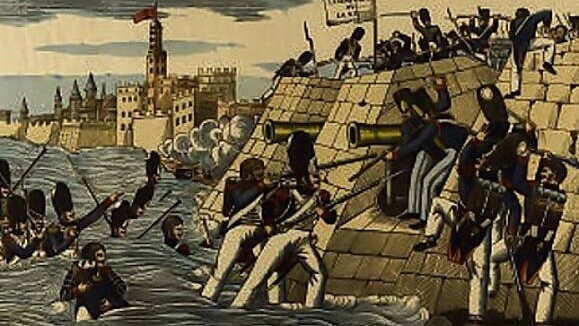
On August 31, 1823, the Trocadero fort, which defends the entrance to the port of Cadiz in Andalusia, was taken at bayonet point by French soldiers, a feat of arms which would later become famous in France under the name given to the Parisian district of Trocadero.
An expedition led to restore Spanish absolutism
This military operation was part of a French expedition launched at the initiative of Viscount François de Chateaubriand, who had abandoned his writing career to become Minister of Foreign Affairs under King Louis XVIII. His objective was to put an end to a liberal experiment being conducted in Spain and to restore the full authority of King Ferdinand VII to the throne, who was then constrained by a constitution imposed by Spanish liberals.
The French soldiers, engaged at low tide, did not hesitate to jump directly into the water to take the fort which commands the entrance to the Bay of Cadiz, an assault carried out with determination despite the defenses of the site.
A "prodigy" claimed by Chateaubriand himself
This victory was the expedition's greatest achievement, allowing the Duke of Angoulême to be triumphantly acclaimed upon his return to Paris, while Ferdinand VII, once restored to his full powers, launched a brutal repression against the Spanish liberals. In his Memoirs from Beyond the Grave, Chateaubriand, whose modesty was not his primary quality according to his own biographers, concluded with considerable emphasis: "To stride across Spain, to succeed where Bonaparte had failed (...), it was a true marvel!"
This military success, the first won by the French army since the defeat at Waterloo eight years earlier, would help to restore the image of the restored French monarchy on the international stage.







Community
Comments
Write a comment
Be the first to comment on this article.