This is a moment that history will remember: this Monday evening in New York, Emmanuel Macron will address the United Nations General Assembly to announce France's official recognition of the State of Palestine. A highly symbolic gesture that comes amid a tense diplomatic sequence, in which about ten other countries, including the United Kingdom, Canada, and Australia, have already taken this step this weekend.
In his speech, the French president is expected to reiterate that this recognition is part of a comprehensive peace process. It aims to reaffirm the legitimacy of the Palestinian people to have a state, while isolating Hamas, which Paris continues to consider a terrorist movement. "Recognition of the Palestinian state is a prerequisite for stopping the war," he declared Sunday on the American network CBS, insisting that the objective is to respond to "the aspirations for security and peace of both Israelis and Palestinians."
A gesture that divides France and causes tension in the Middle East
But this diplomatic shift is not limited to symbolism: it crystallizes divisions, both in France and in the Middle East. In Tel Aviv, the Israeli government denounces a "reward for terrorism." Benjamin Netanyahu warned that "a Palestinian state will never see the light of day west of the Jordan." In Ramallah, however, Mahmoud Abbas hails a decisive step toward "a just and lasting peace." Between these two irreconcilable poles, Paris is trying to position itself as the architect of a peace that has been impossible for decades.
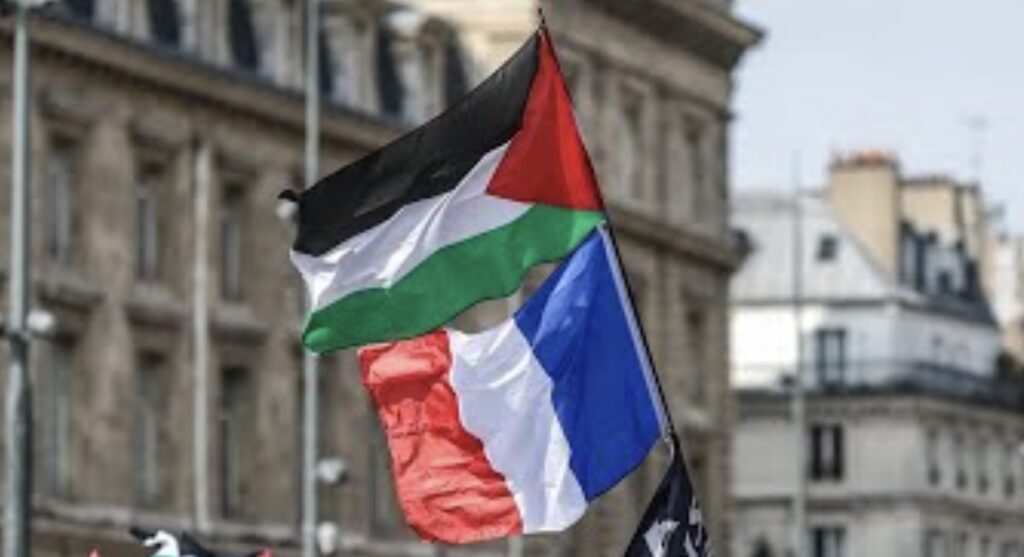
In France, the decision is fueling heated debate. On the right, Marine Le Pen and Laurent Wauquiez denounced a dangerous concession, going so far as to call the recognition a "Hamas victory." On the left, clientelism persists, with Jean-Luc Mélenchon and Olivier Faure calling for a moral victory and calling for increased pressure on Israel, some even demanding economic sanctions. Beyond this political divide, French society itself appears divided, particularly around the sensitive issue of Palestinian flags flying in certain town halls.
Tensions are also evident within the French Jewish community, which is concerned about a surge in anti-Semitic acts since October 2023. Major Jewish institutions have sent an open letter to the president, urging him to make this recognition conditional on the release of the hostages and the dismantling of Hamas. The CRIF (French National Federation of Jewish Federations) also points out that barely 29% of French people support immediate recognition. Emmanuel Macron, aware of these concerns, has promised to strengthen the judicial response to anti-Semitism.
The French gesture, however, is part of a broader movement: in May 2024, Ireland, Spain, Norway, and Slovenia had already recognized the Palestinian state. According to the UN, 142 of the 193 member states now recognize Palestine, proclaimed in 1988 by the PLO in exile. The Franco-Saudi initiative of recent months, intended to avoid a "permanent war," is thus materializing in this performative statement which, with a simple speech, inscribes Palestine in French diplomacy.
The question remains: will this gesture, however strong, change anything on the ground? Nothing is less certain. Israel remains inflexible, Hamas is holding hostages and continuing its offensives, and the international community remains incapable of imposing a lasting peace. But in the history of diplomacy, certain decisions are as important for their symbolic resonance as for their immediate effects. By recognizing Palestine, France once again places itself in the camp of those who, from De Gaulle to Chirac, have sought to combine national independence with commitment to world peace.