
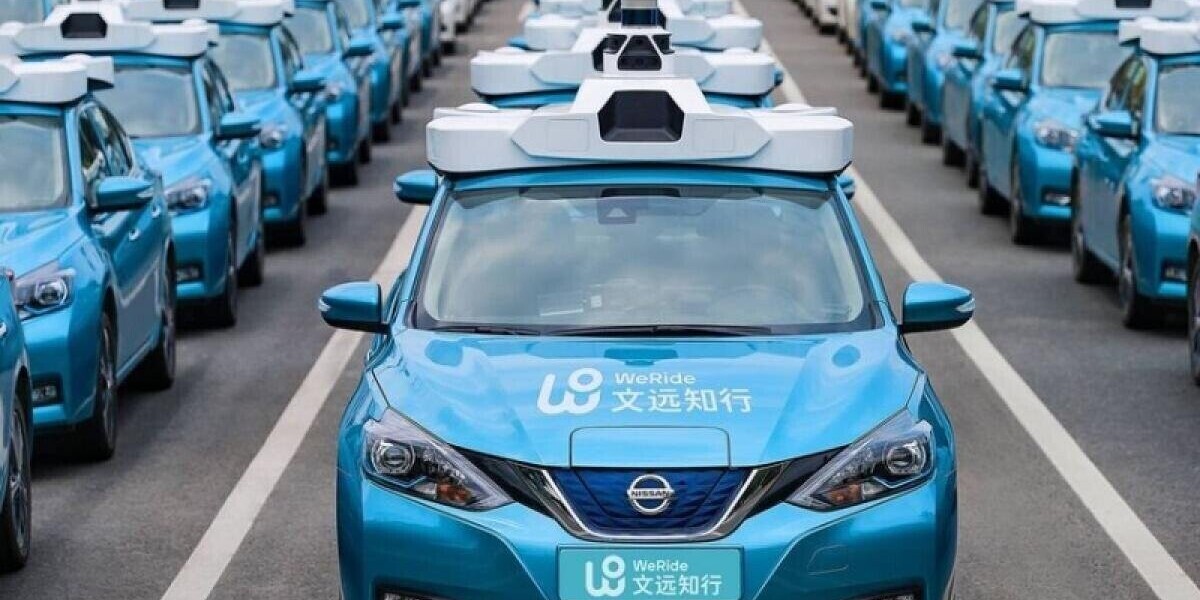
In Beijing's Yizhuang district, driverless vehicles now circulate alongside ordinary cars. Baidu, WeRide, and Pony.ai operate commercial robotaxi services there, and the industry is eyeing international markets.
Booking a robotaxi in Beijing takes only a few minutes: an app, a confirmation on a touchscreen, and the vehicle merges itself into the capital's dense traffic, weaving between buses, cyclists, scooters, and pedestrians. This scene, now commonplace in the Yizhuang district, illustrates China's ambition in the field of autonomous driving.
The Chinese industry has a considerable structural advantage: the industrial ecosystem that has made the country the world's leading market for electric vehicles. Established manufacturers like BYD, Chery, Geely, and SAIC produce the chassis, while specialized companies develop the software. Autonomous vehicles share the same batteries, sensors, chips, and onboard computers as electric cars—components already produced on a large scale.
“We are seeing a pace of innovation and adaptation in China’s electric vehicle industry that is unparalleled anywhere else in the world,” says Kyle Chan, a foreign policy researcher at the Brookings Institution. According to him, this capacity “spills over into other related industries through what I call overlapping industrial technology ecosystems.”
The complexity of Chinese urban traffic is another advantage. Each trip generates massive amounts of data useful for improving software. Maeve Zhang, marketing director at WeRide, acknowledges, however, that this advantage doesn't automatically translate abroad: "In the Middle East, temperatures are very high. In Southeast Asia, there's heavy rainfall… and in Switzerland, winter temperatures can be very, very low." These extreme conditions degrade battery performance and interfere with the cameras and sensors on which these vehicles rely.
From a commercial standpoint, its American competitor Waymo, a subsidiary of Alphabet, maintains a significant lead. It operates paid, driverless services in several American cities and has developed recognized expertise in user experience. "Having tested Waymo, WeRide, and Pony… I must say that Waymo's user experience is far superior to that of all its competitors. Waymo is truly becoming a standard mode of transportation in California," says Tu Le, founder of the consulting firm Sino Auto Insights.
Chinese companies are nevertheless making progress in the American market through partnerships. Uber and Lyft, which have abandoned the development of their own autonomous vehicles, are now partnering with Chinese companies. These agreements offer them "access to millions of customers they wouldn't have if they created their own app," according to Tu Le.
Safety remains a key concern. Earlier this year, a software glitch in Baidu's Apollo Go service immobilized around 100 robotaxis in Wuhan. Passengers reported being unable to exit the vehicles because the doors had automatically locked. The service was suspended for several weeks. In the United States, General Motors shut down its Cruise division after one of its vehicles dragged a pedestrian several meters in San Francisco in 2023.
Beyond safety, robotaxis face obstacles that electric vehicles have not encountered: complex regulatory approvals, detailed mapping, local operating teams, and the need to build public trust. They also raise specific geopolitical questions, as they collect significant amounts of location and imagery data, making them particularly sensitive to national security concerns in foreign markets.
James Yu, CEO of QCraft, whose autonomous buses already operate in more than twenty Chinese cities, is optimistic about the long term: "It's very promising technologically; perhaps in five, seven, at most ten years, it will be part of everyone's life." For Kyle Chan, the stakes go beyond simple transportation: China is seeking to build "a digitally connected, AI-powered, high-tech economy that leverages its current strengths in batteries, electric vehicles, motors, and related technologies."




Community
Comments
Comments are open, but protected against spam. Initial posts and comments containing links undergo manual review.
Be the first to comment on this article.